
Yes, edibles do expire, but “expired” doesn’t automatically mean unsafe. The distinction that matters: food spoilage (mold, bacterial growth, rancidity) is a genuine health risk and a reason to discard. Potency loss, where THC and CBD break down over time, is a different problem entirely. A gummy that’s six months past its best-by date but shows no mold or off-odor isn’t dangerous. It may just hit softer than expected.
Quick verdict:
- Toss immediately: visible mold, slimy texture, fermentation smell, bulging or compromised packaging
- Use with caution: stale texture, faded color, or past best-by date with no other red flags — potency may be reduced
- Likely fine: sealed, properly stored product within or slightly past its best-by window with no sensory changes
Potency changes over time because THC oxidizes and converts to cannabinol (CBN), a mildly sedating compound with far less psychoactivity. The rate depends heavily on how the product is stored.
Key Takeaways
Lab-tested, properly stored edibles from a licensed dispensary give you the most reliable potency and the clearest safety signal of any option available to U.S. consumers right now.
| Point | Details |
|---|---|
| Safety vs. potency | Mold and bacterial growth are safety risks; THC loss to CBN is a potency issue, not a health danger. |
| THC degradation rate | Studies show average THC losses increase over years of storage under room-temperature conditions. |
| Best storage method | Cool, dark, airtight storage slows degradation; freezing preserves cannabinoid profiles best for long-term storage. |
| Read your COA | Check microbiology, potency, and heavy metals panels; the FDA does not regulate most commercial cannabis edibles federally. |
| Saylessny advantage | Lab-tested edibles with COAs on file, inventory rotation, and same-day NYC delivery remove the guesswork on freshness. |
Table of Contents
- How Long Do Edibles Last by Product Type?
- What Happens to THC and CBD as Edibles Age?
- How to Tell If an Edible Is Unsafe to Eat
- How to Store Edibles to Preserve Potency and Safety
- What Do “Best-By,” Potency Dates, and Expiration Dates Actually Mean?
- Homemade vs. Store-Bought Edibles: Which Is Safer?
- Are There Legal Implications to Consuming Expired Edibles?
- THC-Dominant vs. CBD-Dominant Edibles: Does Expiration Differ?
- How Packaging Materials Affect Shelf Life and Safety
- How to Dispose of Expired Edibles Safely and Legally
- The Case for Buying Fresh and Lab-Tested Every Time
- Fresh, Lab-Tested Edibles Available for Same-Day Delivery in NYC
- Sources
How Long Do Edibles Last by Product Type?
Shelf life varies more by product category than most consumers realize. The food matrix, water content, and carrier ingredients all play a role. Shelf-life testing for cannabis edibles requires both standard food safety tests (sensory, microbiological, chemical) and cannabinoid potency testing over time, which is why licensed manufacturers can give you a meaningful best-by date.
| Edible Type | Typical Best-By Range | Key Storage Note |
|---|---|---|
| Gummies | a range of several months period when sealed | Airtight, cool, dark; humidity causes stickiness and mold |
| Chocolate | several months typical range | Avoid temperature swings; bloom affects texture, not safety |
| Baked goods | 1–2 weeks (refrigerated) | High moisture = fast mold; freeze for longer storage |
| Beverages | several months shelf life when sealed | Acidic drinks carry CBD→THC conversion risk over time |
| Oils and tinctures | about one to two years under proper storage conditions | Carrier oil type matters; MCT is more oxidatively stable |
| Capsules | similar to oils, up to a couple of years with good storage | Similar to oils; protect from heat and light |
A few things shorten shelf life faster than the date on the label suggests: opening the package, storing near a heat source, or buying a product with perishable inclusions like dairy or fresh fruit. If you bought it from a licensed dispensary, the product should carry a Certificate of Analysis (COA) and manufacturer storage guidance. Follow both.
Beverages deserve special attention. Acidic, room-temperature drinks fortified with CBD can show measurable CBD-to-THC conversion over months of storage, which affects both potency and drug-test risk.
What Happens to THC and CBD as Edibles Age?
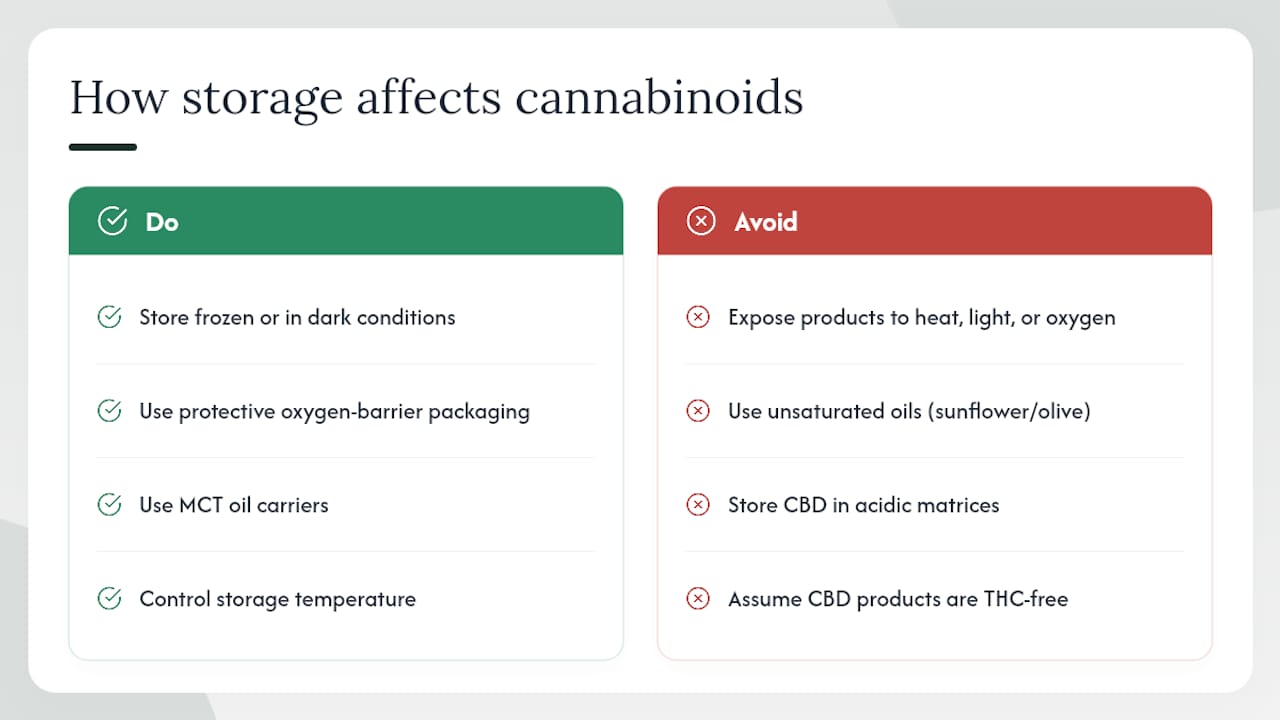
THC doesn’t just disappear. It oxidizes and forms degradation products, most notably CBN, through a process accelerated by heat, light, and oxygen exposure. The psychoactive punch fades; the sedating, mildly relaxing character of CBN takes its place. For users who want a specific effect, that shift matters.
A UNODC long-term storage study found average THC losses occur over multi-year room-temperature storage periods. Those numbers come from cannabis plant material, not finished edibles, but they establish the degradation trajectory. Finished edibles with protective packaging and controlled ingredients will generally hold potency longer, though the same chemistry applies.
More recent chemometric modeling of stored cannabis samples confirms that storage time, temperature, and light exposure are the dominant variables in cannabinoid profile changes. Freezing and dark storage consistently outperform room-temperature, light-exposed conditions.
The carrier oil in tinctures and oil-based edibles also matters. Research on oxidative changes in cannabis oils found that sunflower and olive oil carriers showed greater free radical formation and more cannabinoid loss under heat and aging than MCT oil, which was more oxidatively stable. If your tincture uses an unsaturated oil base, it’s more vulnerable to degradation.
One less-obvious risk: CBD-dominant products stored in acidic matrices. A small study on CBD-fortified beverages and condiments found measurable Δ9-THC formation from CBD conversion in low-pH products over 2–15 months of storage, with one lemonade sample reaching measurable Δ9-THC per serving after extended storage. That’s enough to produce psychoactive effects in a product marketed as non-intoxicating, and it creates real drug-test risk for people who assume CBD products are THC-free.
For a deeper look at how minor cannabinoids like CBN behave and what effects they produce, the CBG, CBN, and THCV guide at Saylessny covers the full picture.
How to Tell If an Edible Is Unsafe to Eat
Potency loss is inconvenient. Mold is a health risk. Knowing which you’re dealing with takes about 30 seconds.
Discard immediately if you see or smell any of these:
- Visible mold (fuzzy growth, white or green spots, discoloration)
- Slimy or unusually wet texture on a product that should be dry
- Fermentation smell, sour or “off” odor not present when the product was fresh
- Bulging, swollen, or punctured packaging
- Condensation inside a sealed package (suggests temperature abuse and moisture intrusion)
- Perishable inclusions (dairy, fresh fruit, cream) past their refrigerated life
Use caution but don’t automatically discard if:
- Texture is stale or slightly hard but no mold is present
- Color has faded but no odor change
- The product is past best-by but was stored correctly and sealed
Allergen risk is worth flagging separately. Mold growth on edibles can produce mycotoxins, and some mold species are allergenic. For immunocompromised individuals, pregnant people, or anyone with respiratory sensitivities, the threshold for discarding should be lower. When in doubt, toss it.
Pro Tip: If potency is your only concern and the product passes the visual and smell check, start with half your normal dose and wait the full 90 minutes before deciding whether to take more. Older edibles can be unpredictable in both directions.
How to Store Edibles to Preserve Potency and Safety
The single most effective change you can make: cool, dark, and sealed. That combination slows oxidation, prevents moisture intrusion, and limits light-driven THC degradation. Freezing goes further, preserving the cannabinoid profile better than any other method for long-term storage.
By product type:
- Gummies: Store in an airtight container away from direct light. Refrigeration works; freezing works better for anything you won’t use within a few months. Thaw at room temperature in the sealed container to prevent condensation.
- Chocolate: Keep below 70°F and away from humidity. Refrigeration is fine but can cause bloom (a white surface haze from cocoa butter migration). Bloom changes texture, not safety or potency.
- Baked goods: Refrigerate for up to two weeks; freeze for longer. Wrap tightly to prevent freezer burn and moisture loss.
- Oils and tinctures: Dark glass bottles in a cool cabinet or refrigerator. Freezing is safe and extends shelf life significantly. MCT-based oils are more stable than sunflower or olive oil carriers.
- Capsules: Same rules as oils. Keep sealed, cool, and dark.
Avoid temperature swings. Moving a product from a warm car to a cold refrigerator repeatedly creates condensation inside packaging, which accelerates both mold risk and cannabinoid degradation.
Pro Tip: If your opened manufacturer packaging won’t reseal tightly, transfer the product to a small glass jar with a rubber-sealed lid. A mason jar works. Add a food-safe silica gel packet if you’re in a humid climate. No special equipment needed.
What Do “Best-By,” Potency Dates, and Expiration Dates Actually Mean?
These terms are not interchangeable, and the regulatory picture in the U.S. makes the distinction more important than it would be for conventional food.
The FDA does not currently approve or regulate the safety, quality, or labeling of most commercial cannabis edibles sold in state-regulated markets. Consumers rely on state testing requirements and Certificates of Analysis for safety signals. (FDA — Cannabis Research and Drug Approval Process)
Without federal oversight, the date on your package reflects whatever the manufacturer determined through their own shelf-life testing, validated against state requirements. “Best-by” typically marks the end of the quality and potency window, not a hard safety cutoff. A “potency date” specifically signals when cannabinoid content may fall below the labeled amount. Neither is the same as a food safety expiration in the traditional sense.
Some states have stepped in with specific rules. New York’s labeling regulations under 9 NYCRR 128.5 require a date of expiration on the unopened cannabis product. Other states, like New Mexico, go further and explicitly prohibit altering expiration dates or affixing a new label with a later date. That kind of rule exists because the temptation to extend shelf life on unsold inventory is real.
A COA is your most useful tool. When reading one, look for:
- Cannabinoid potency panel: confirms THC/CBD content matches the label
- Microbiology panel: checks for mold, yeast, E. coli, Salmonella
- Heavy metals panel: confirms the product is within safe limits
- Pesticide residue panel: relevant for flower-derived extracts
COAs are typically available on the manufacturer’s website or through the dispensary where you purchased. Ask for one if it isn’t posted.
Homemade vs. Store-Bought Edibles: Which Is Safer?
Commercial products from licensed dispensaries generally hold up better on every safety dimension: dosing consistency, microbiological safety, shelf life, and labeled storage guidance. That’s not a knock on homemade edibles. It’s just the reality of controlled manufacturing versus a home kitchen.
Where homemade edibles fall short:
- Dosing variability: Without lab testing, THC distribution in a batch of brownies is uneven. One piece may be twice as potent as another.
- Microbiological risk: Home kitchens don’t run microbiology panels. Mold and bacterial contamination are harder to detect and easier to miss.
- Packaging and protection: Most home storage doesn’t match the oxygen and light barriers of commercial packaging.
- No labeled guidance: There’s no manufacturer-tested best-by date, so you’re estimating.
Practical steps for safer homemade edibles:
- Use low-water-activity recipes (hard candies, oil infusions, chocolate) over high-moisture ones (custards, cream-filled items)
- Refrigerate or freeze immediately after making
- Label every batch with the date made and a conservative use-by window (one week refrigerated, three months frozen for most items)
- Store in airtight, opaque containers
Are There Legal Implications to Consuming Expired Edibles?
Consuming an expired edible isn’t illegal in any U.S. state. The legal risk sits on the production and retail side, not the consumer side. Dispensaries and manufacturers face regulatory consequences for selling products past their labeled expiration date or for relabeling products with extended dates, as the New Mexico rule above illustrates.
For consumers, the more relevant legal consideration involves drug testing. THC metabolites remain detectable in urine for days to weeks depending on frequency of use, body composition, and metabolism. An older edible with degraded THC still contains THC, and CBN, while not typically screened for in standard panels, doesn’t eliminate THC metabolite presence. If you’re subject to workplace or legal drug testing, consuming any cannabis edible, fresh or aged, carries the same risk.
THC-Dominant vs. CBD-Dominant Edibles: Does Expiration Differ?
The degradation chemistry is similar but the practical consequences diverge. THC converts primarily to CBN over time, reducing psychoactivity. For a THC-dominant edible, that means a weaker, more sedating effect as the product ages. For users chasing a specific recreational or therapeutic effect, the drift is noticeable.
CBD-dominant products present a different wrinkle. CBD is generally considered more chemically stable than THC under typical storage conditions, but the acidic matrix risk described earlier applies specifically to CBD products. A CBD beverage or condiment stored at room temperature in an acidic formulation can accumulate measurable Δ9-THC over months, which matters for consumers who chose CBD specifically to avoid intoxication or THC exposure. The decarboxylation and cannabinoid chemistry explainer at Saylessny covers how heat and chemistry affect cannabinoid forms, which is useful background here.
Both product types benefit from the same storage approach: cool, dark, sealed, and consumed within the manufacturer’s recommended window.
How Packaging Materials Affect Shelf Life and Safety
Packaging is the first line of defense against the three main enemies of cannabinoid stability: oxygen, light, and moisture. The material choices manufacturers make directly affect how long a product holds its labeled potency and stays microbiologically safe.
Opaque, multilayer packaging blocks UV and visible light, which drive photo-oxidation of THC. Nitrogen-flushed or vacuum-sealed packaging removes oxygen before sealing, slowing the oxidative degradation pathways that produce CBN and other byproducts. Child-resistant closures that also create an airtight seal serve double duty.
Thin plastic bags, even heat-sealed ones, allow oxygen permeation over time. Glass jars with rubber-sealed lids outperform most plastic for long-term storage. Mylar pouches with zip-lock closures sit in between. Once you open any package, the clock accelerates regardless of the original material, because you’ve introduced ambient air and humidity.
For tinctures, dark amber or cobalt glass bottles are standard for a reason. Clear glass exposes the oil to light with every use. If your tincture came in clear packaging, transfer it to a dark bottle after purchase.
How to Dispose of Expired Edibles Safely and Legally
Throwing cannabis edibles in the trash is legal in most U.S. states for personal-quantity amounts, but a few steps reduce environmental and accidental-ingestion risk.
Render the product undesirable before disposal: mix it with an unpalatable substance like used coffee grounds, dirt, or cat litter in a sealed bag before placing it in the trash. This is the same method the FDA recommends for unused prescription medications and it works for edibles. Do not flush cannabis products down the toilet; wastewater treatment systems are not designed to remove cannabinoids.
Some licensed dispensaries accept unused or expired cannabis products for proper disposal. In New York, check with your dispensary about take-back options. Do not place cannabis products in standard recycling bins.
If a product is significantly past its date and shows any spoilage signs, double-bag it before disposal to contain mold spores.
The Case for Buying Fresh and Lab-Tested Every Time
The potency-vs-safety distinction that runs through this article points to one practical conclusion: the fresher and better-tested the product, the fewer judgment calls you have to make. When you buy a gummy that’s three months from its manufacture date with a COA on file, you know what you’re getting. When you’re squinting at a product that’s been in your drawer for a year, you’re guessing on both potency and safety.
The conventional wisdom is to treat best-by dates as rough guidelines and use your senses to fill the gap. That’s reasonable for a bag of chips. For a product where the active ingredient is a cannabinoid that degrades unpredictably and where dosing errors have real consequences, the margin for error is narrower. A stale gummy that delivers 40% less THC than labeled isn’t just disappointing. It can lead someone to double their dose and have a genuinely unpleasant experience.
The more useful rule: treat the best-by date as the outer limit for predictable potency, not a suggestion. Buy in quantities you’ll use within that window. Store correctly from day one. And if a product is showing any sensory changes at all, the cost of discarding it is lower than the cost of a bad experience or a food-safety incident.
Fresh, Lab-Tested Edibles Available for Same-Day Delivery in NYC
Saylessny carries lab-tested edibles from curated brands, with COAs available and inventory rotated to keep products fresh. Every product on the menu comes from licensed manufacturers who meet New York state testing requirements, which means microbiology, potency, and heavy metals panels, not just a best-by date stamped on the package.

For NYC consumers who want to skip the guesswork on edibles expiration entirely, the answer is buying fresh from a source that can show you the lab results. Koa Cannabis Co.’s infused minis and tins are a strong starting point, and the full curated brands menu at Saylessny covers gummies, chocolates, beverages, and more, all available for pickup in The Bronx or same-day delivery across NYC. Place your order online and know exactly what you’re getting.
Sources
The findings in this article draw from peer-reviewed research, regulatory texts, and industry guidance. Here are the key references, organized by topic:
Potency and cannabinoid degradation:
- FDA — FDA and Cannabis: Research and drug approval process
- PubMed — Study on conversion of CBD to THC in acidic food/beverage products
- PubMed — Oxidative changes and cannabinoid loss in cannabis oils
- UNODC bulletin — Long-term storage effects on THC and CBN (1997 study)
- Perennia — Cannabis edible shelf-life factsheet
- Nature — Chemometric modeling of long-term cannabinoid transformation (Scientific Reports)
- ScienceDirect — Chemical characterisation of oxidative degradation products of Δ9-THC
- Cornell Law — New York 9 NYCRR 128.5 (labeling requirements)
Shelf-life testing and storage guidance:
Regulation and labeling:
This article is general information, not a substitute for advice from a qualified doctor. Consult a qualified healthcare professional about your own circumstances before acting on anything here.