
If you have ever shared the same cannabis strain with a friend only to have two completely different experiences, you have witnessed the unique complexity of the endocannabinoid system. While one person may feel a wave of creative euphoria, another might feel hit by a heavy sense of relaxation or even a spike in temporary anxiety. Understanding why these differences occur is the key to mastering your own relationship with cannabis and finding the products that work for your specific biology.
The Mystery of the “Individual High”: Why One Strain, Two People, and Two Different Worlds?
The “subjective experience” of cannabis is a well-known phenomenon in the wellness community. For decades, we chalked these differences up to “tolerance,” assuming that the person who didn’t feel much simply used cannabis more often.
However, modern science tells a different story. It isn’t just about how much you use; it is about how your body is wired. Your internal biological environment acts as a filter. When cannabinoids like THC or CBD enter your system, they don’t just “cause” a high; they interact with a pre-existing, highly complex network that is already busy maintaining your body’s balance.
What is the Endocannabinoid System (ECS)? The Body’s Universal Regulator
To understand the “high,” you must first understand the system it interacts with. The Endocannabinoid System (ECS) is a vast cell-signaling network found in all mammals. Its primary job is homeostasis—keeping your body’s internal environment stable even when the outside world changes.
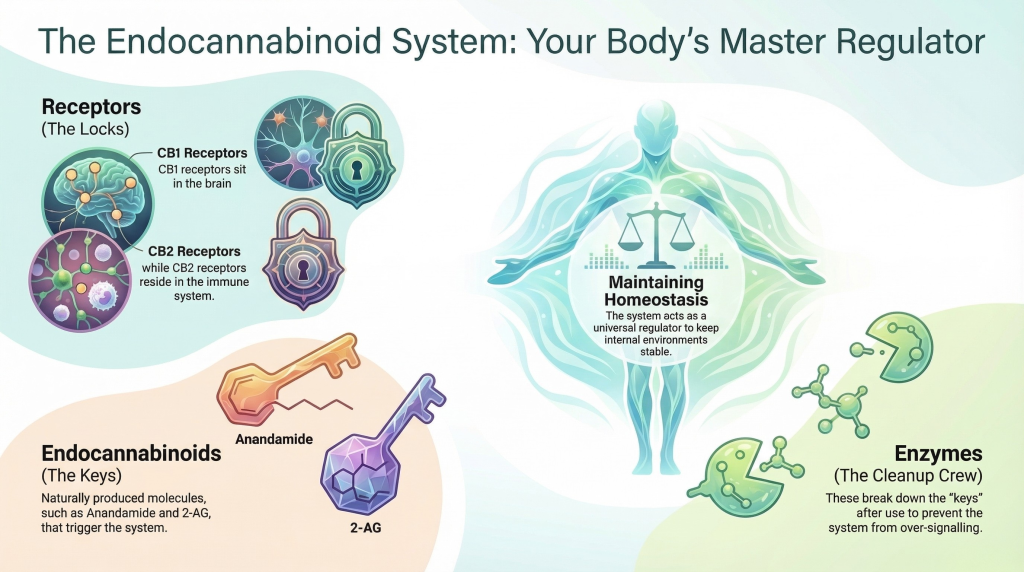
The Three Pillars of the ECS:
- Receptors (The Locks): These sit on the surface of cells. The two main types are CB1 (mostly in the brain and central nervous system) and CB2 (mostly in the immune system).
- Endocannabinoids (The Keys): These are molecules your body naturally produces, such as Anandamide and 2-AG.
- Enzymes (The Cleanup Crew): These break down the “keys” once they have done their job so the system doesn’t over-signal.
The Genetic Lottery: How Your DNA Shapes Your High
Your DNA provides the blueprint for your ECS, and no two blueprints are identical. This is the foundational reason why a “heavy hitter” strain for one person might feel like a “mellow buzz” for someone else.
CNR1 Gene Variations The CNR1 gene provides instructions for making CB1 receptors. Some people are born with more of these receptors in the brain’s emotional centers, while others have fewer. If you have a high density of receptors, you may be more sensitive to THC, meaning a small dose goes a long way.
The “Bliss Molecule” and the FAAH Gene Anandamide is often called the “bliss molecule” because it helps regulate mood and pain. The FAAH enzyme is responsible for breaking Anandamide down. However, some people have a genetic variation that makes their FAAH enzyme less active. These individuals naturally have higher levels of “natural cannabis” in their system. For these people, adding supplemental THC can sometimes feel “too much,” leading to overstimulation or anxiety because their system is already “full.”
COMT and Dopamine The COMT gene influences how your brain breaks down dopamine. Since THC triggers dopamine release, your genetic COMT profile determines how long that “reward” feeling lasts. If your body clears dopamine slowly, the euphoric effects of cannabis might feel more intense or last significantly longer than average.
Metabolism and the “First-Pass” Secret: Why Edibles are a Different Beast
One of the most common complaints in cannabis is: “I didn’t feel the edible, but the joint hit me instantly.” This is due to the “first-pass metabolism” in the liver.
Inhalation vs. Digestion When you smoke or vape, THC enters the bloodstream through the lungs and goes straight to the brain. When you eat a gummy or brownie, the THC must travel through the digestive tract and into the liver before it hits your bloodstream.
11-Hydroxy-THC When the liver processes Delta-9 THC, it converts it into a different compound called 11-Hydroxy-THC. This metabolite is significantly more potent and can cross the blood-brain barrier more easily than inhaled THC. This is why “edible highs” feel more psychedelic and body-heavy.
The CYP2C9 Enzyme Your liver uses an enzyme called CYP2C9 to break down THC. Some people are “ultra-fast metabolizers,” meaning their liver destroys the THC before it can ever reach the brain. These are the people who claim “edibles don’t work on me.” Conversely, “slow metabolizers” may find that even a 5mg edible keeps them high for twelve hours or more.
The Theory of Clinical Endocannabinoid Deficiency (CECD)
What if some people use cannabis not just for fun, but because their body is naturally “low” on endocannabinoids? This is the theory of Clinical Endocannabinoid Deficiency (CECD), pioneered by Dr. Ethan Russo.
The theory suggests that if your body doesn’t produce enough anandamide or 2-AG, you might experience conditions like migraines, fibromyalgia, or IBS. For these individuals, the “high” isn’t just a recreational experience; it is a restorative one. When they consume cannabis, they may not feel “stoned” in the traditional sense; instead, they may simply feel “functional” or “balanced” for the first time. This baseline health status drastically changes how the brain perceives the presence of THC.
The “Entourage Effect”: It’s Not Just About THC
Many people shop for cannabis based on the highest THC percentage, but this is like buying a car based only on how fast the engine can spin without looking at the steering wheel.
Terpenes as Steering Wheels Terpenes are the aromatic oils that give cannabis its smell (citrus, pine, pepper). They aren’t just for scent; they change how THC interacts with your receptors.
- Myrcene (earthy) can make a high feel more sedating (“couch-lock”).
- Limonene (citrus) can make a high feel more energetic and anti-anxiety.
The Role of CBD and Minor Cannabinoids CBD acts as a “buffer.” It doesn’t bind to CB1 receptors directly; instead, it changes the shape of the receptor so that THC can’t bind as tightly. This is why high-CBD strains often feel “level-headed” and less likely to cause paranoia.
External Factors: The “Set and Setting” Influence
Your internal biology is the hardware, but your environment and mindset are the software.
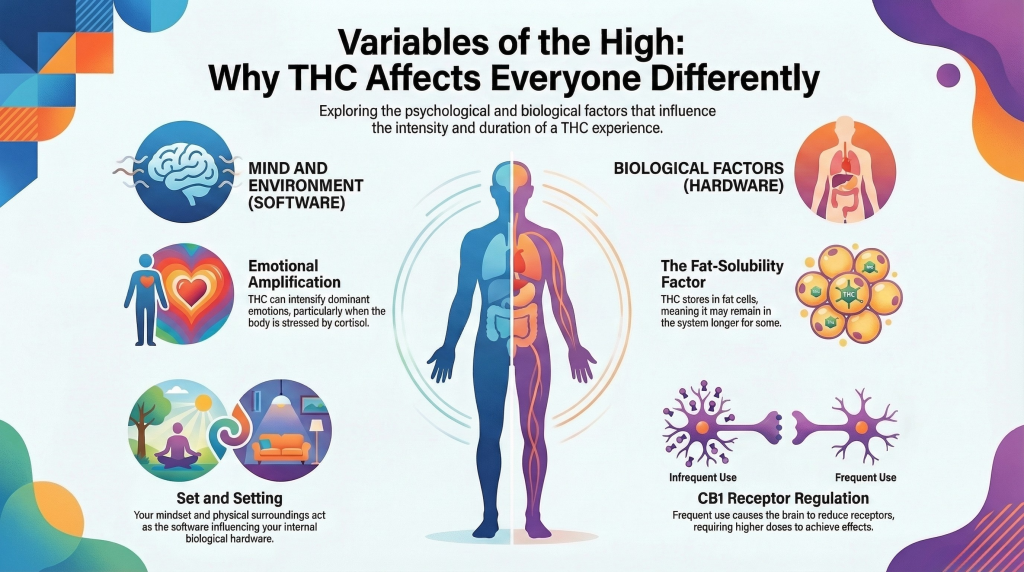
- Psychological State: If you are already stressed, your body is flooded with cortisol. THC can amplify whatever emotion is currently dominant.
- Body Composition: THC is fat-soluble. It stores itself in fat cells. People with higher body fat percentages may find that THC stays in their system longer, though the immediate “peak” of the high might be more gradual.
- Tolerance Levels: Frequent use causes the brain to “pull in” its CB1 receptors to protect itself from overstimulation. This is why daily users need more product to achieve the same effect as a novice.
Microdosing and Personalization: Finding Your “Optimal Tone”
Because everyone’s ECS is different, the “standard dose” is a myth. The goal of modern cannabis use is finding your Optimal Tone—the specific ratio of cannabinoids and terpenes that makes you feel your best.
The Biphasic Effect Cannabis is “biphasic,” meaning low and high doses can have opposite effects. A small dose might relieve anxiety, while a large dose of the same strain might cause it. This is why “starting low and going slow” is the golden rule of personalization.
Why Say Less NY is the Solution
Navigating the complexities of your own biology can be overwhelming. You shouldn’t have to be a scientist to enjoy the benefits of cannabis. This is where Say Less NY comes in.
At Say Less NY, we understand that every “high” is a personal journey. We don’t just sell products; we provide a curated experience designed to help you understand your unique ECS. Whether you are a “slow metabolizer” looking for the perfect low-dose edible or someone looking for specific terpene profiles to match your DNA, our team is dedicated to helping you find your perfect balance.
People Also Ask (FAQ)
Why do I get paranoid while my friends are just relaxed?
This is often due to your genetic CNR1 profile (receptor density) or your current levels of the FAAH enzyme. Your brain may be more sensitive to the “alarm” signals THC can trigger in the amygdala.
Can I change my endocannabinoid system?
While you can’t change your genetics, you can support your ECS through diet (Omega-3 fatty acids), regular exercise (which boosts anandamide), and “tolerance breaks” to reset your receptors.
Why don’t edibles work for me?
You likely have a highly efficient version of the CYP2C9 liver enzyme that breaks down THC before it can enter your bloodstream, or your gut may not absorb cannabinoids effectively.
What is the “Bliss Molecule”?
Anandamide is a natural endocannabinoid produced by your body. It is named after the Sanskrit word “Ananda,” meaning “bliss” or “joy,” because of its role in mood regulation.
Does my weight affect how high I get?
Indirectly, yes. Since THC is stored in fat, your body composition can affect how long THC remains in your system and how it is distributed after consumption.
Is “Sativa vs. Indica” actually real?
It is a bit of an oversimplification. The effects are more accurately determined by the terpene profile and the ratio of THC to CBD, rather than just the plant’s growth structure (Sativa/Indica).
Ready to Find Your Perfect Match?
Stop guessing and start experiencing cannabis the way your body was meant to. Whether you’re looking to boost your “bliss molecule” or find a terpene profile that fits your lifestyle, we are here to guide you.
Contact Say Less NY Today to explore our curated selection and find the products that respect your unique biology.