
Short answer: for some adults, a properly dosed, lab-tested THC beverage can reduce ethanol-related harm, but it swaps one set of risks for a different, less understood set. The World Health Organization is unambiguous that there is no safe level of alcohol consumption, and ethanol’s damage to the liver, heart, and DNA is exhaustively documented. THC beverages carry their own problems: unpredictable onset, wide dose variation, and a much thinner research base. A University at Buffalo study found that people who switched to cannabis drinks cut weekly alcohol intake nearly in half, which suggests real harm-reduction potential for some drinkers.
That’s not a green light to swap blindly. Here’s the bottom line:
- Alcohol’s harms are well established and dose-dependent with no safe floor.
- THC beverages may lower ethanol exposure but bring dosing unpredictability and less long-term data.
- Start low, wait long, and buy only lab-tested products with a visible Certificate of Analysis.
Key Takeaways
Choosing between alcohol and a THC beverage comes down to trading a well-documented, dose-linear harm for a less mapped but potentially lower-ethanol-exposure alternative.
| Point | Details |
|---|---|
| Alcohol’s harm is settled science | The WHO confirms no safe drinking threshold and links alcohol to seven cancer types. |
| THC beverages absorb unpredictably | Liver metabolism delays onset and stretches duration, raising the risk of re-dosing too soon. |
| Substitution shows promise, not proof | UB survey data found nearly half the weekly alcohol intake after switching, but self-report limits certainty. |
| Labels and lab results are non-negotiable | Check mg per serving versus per container, and buy only from sources with visible Certificates of Analysis. |
| Say Less offers a lab-tested starting point | Every THC beverage on the menu carries verified potency and contaminant testing for pickup or NYC delivery. |
Table of Contents
- What Are THC Beverages and How Are They Made?
- How Do Onset, Peak, and Duration Compare?
- Which Carries More Long-Term Health Risk?
- How Can You Reduce Surprises With Dosing and Labels?
- Can THC Beverages Actually Replace Alcohol?
- What Legal Rules Actually Affect You?
- How Should First-Timers Try a THC Beverage Safely?
- When Does Switching Actually Make Sense?
- Try a Lab-Tested THC Beverage From Say Less
- Frequently Asked Questions
- Sources
What Are THC Beverages and How Are They Made?
THC beverages are drinks infused with Δ9 THC, the primary psychoactive compound in cannabis, sometimes blended with CBD or hemp-derived cannabinoids for a smoother effect. Some cans carry ambiguous labels mixing Δ8 THC or synthetic derivatives, so reading the fine print matters more than it does with a can of beer.
Dosing spans an enormous range. Harvard Health notes some low-dose beverages contain just 2 to 4 mg THC per serving, meant to mimic a light buzz, while other products pack up to 200 mg per container, closer to a heavy edible dose split across multiple servings.
Formulation changes everything about how a drink hits you:
- Emulsified THC (nanoemulsion) dissolves faster and can produce quicker, more consistent onset than oil-based tinctures.
- Alcohol-blended options exist but defeat much of the harm-reduction purpose if you’re trying to cut ethanol.
- Added caffeine or adaptogens can mask intoxication cues, making it harder to gauge how impaired you actually are.
How Do Onset, Peak, and Duration Compare?
Alcohol is predictable. It absorbs through the stomach and small intestine within minutes, peaks in blood concentration around 30 to 90 minutes after drinking, and clears at a fairly steady rate most drinkers can learn to anticipate.
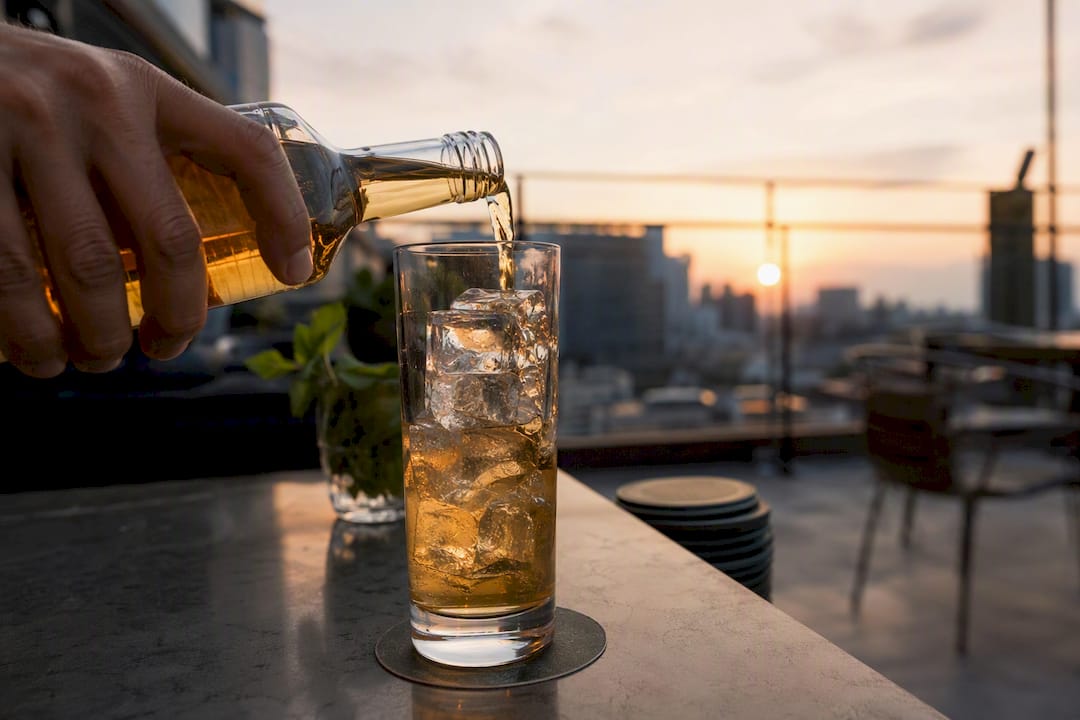
THC beverages behave differently, and that difference is where most bad nights come from. Ingested THC gets processed through the liver, a route that delays onset and stretches out duration compared to smoking or vaping. A critical review of cannabis-infused beverages found that even with emulsified formulations designed to speed things up, onset still varies by product and can take anywhere from 15 minutes to over an hour, with effects lasting considerably longer than a comparable dose smoked.
Here’s the sequence that gets people into trouble:
- They drink a THC beverage and feel nothing after 20 minutes.
- They assume the dose was too low and drink a second one.
- Both doses hit at once, sometimes 45 to 90 minutes later, stacking into an intensity they didn’t plan for.
Impairment also differs qualitatively. Alcohol dulls motor coordination and reaction time in a fairly linear way tied to blood alcohol concentration.
Pro Tip: Set a timer for 90 minutes after your first sip before you even consider a second can. If you’re still unsure, wait longer. THC doesn’t reward impatience.
Never drive after either substance, and never assume a “beverage” feels like alcohol just because it comes in a can.
Which Carries More Long-Term Health Risk?
Alcohol’s harm profile is one of the most thoroughly mapped in public health. The WHO classifies alcohol as a Group 1 carcinogen tied to seven cancer types, and the agency states plainly that no amount is risk-free.
Alcohol consumption is linked to many new cancer cases globally each year, and the WHO emphasizes there is no threshold below which drinking becomes safe.
The NIAAA’s summary of alcohol’s effects on the body adds liver disease, cardiovascular damage, and dependence to that list, all backed by decades of longitudinal data. This is not contested science. It’s a settled, well-replicated harm profile.
THC’s long-term picture is murkier, and that uncertainty cuts both ways. Regular heavy use is associated with dependence in a meaningful subset of users, and psychiatric risks, including exacerbation of anxiety or psychosis in vulnerable individuals, are documented in clinical literature. What’s missing is the decades of beverage-specific outcome data alcohol research has accumulated. Ethanol’s damage is chronic and dose-linear. THC’s risks cluster more around acute overconsumption, especially through ingestion, since the liver’s delayed processing raises overdose potential when people re-dose too soon, per the same critical review cited above.
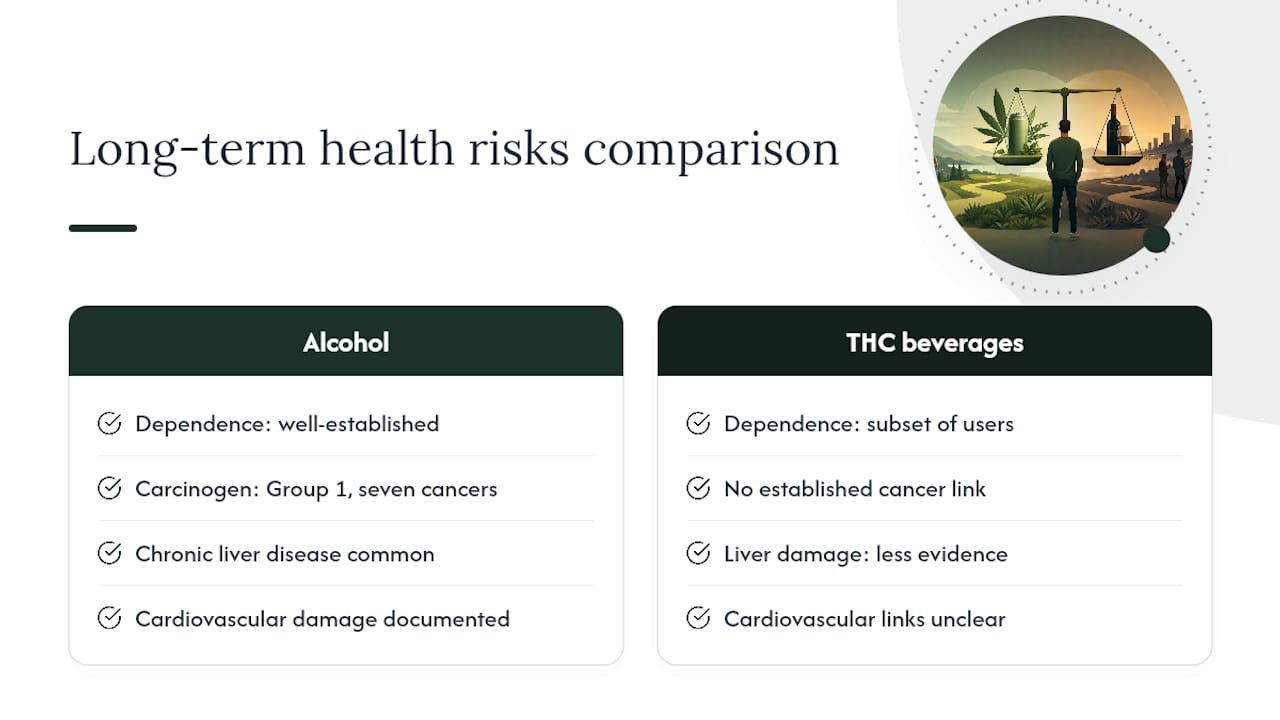
The honest takeaway: alcohol’s harms are proven and severe. THC’s harms are real but less mapped, particularly for the beverage format specifically, which is still a young product category.
How Can You Reduce Surprises With Dosing and Labels?
The single biggest risk factor with THC beverages isn’t the cannabinoid itself, it’s inconsistent labeling and unregulated sourcing. Products from licensed dispensaries carry lab results, called Certificates of Analysis, confirming potency and screening for contaminants like pesticides or heavy metals. Clinical experts caution that unlicensed or gas-station cannabinoid drinks often skip this step entirely, which is exactly why the source matters as much as the dose.
Practical rules that actually work:
- Check whether the label states mg THC per serving or per container. These are not the same number, and confusing them is the most common beginner mistake.
- Watch for cannabinoid type. Δ9 THC behaves differently than Δ8 or synthetic analogs, and blends aren’t always disclosed clearly.
- Start at 2 to 5 mg if you’re new to beverages, and wait 60 to 90 minutes, sometimes longer, before considering more.
- Store beverages away from heat and light, and check expiration dates since potency can degrade over time.
Pro Tip: If a product’s packaging has no batch number, no lab name, and no QR code linking to test results, put it back. That’s not a minor omission.
Our edible dosage guide breaks down mg ranges in more depth if you want a fuller reference before your first purchase.
Can THC Beverages Actually Replace Alcohol?
The strongest evidence for substitution comes from a University at Buffalo survey led by researcher Jessica Kruger, whose framing positions cannabis beverages as a harm-reduction tool because they remove ethanol exposure and avoid the respiratory harms of smoking. The data backs it up directionally: participants reported decreasing their alcohol consumption after switching, and a majority said they reduced or stopped alcohol use entirely.
That’s a meaningful signal, but it comes with real caveats:
- The data is self-reported, which invites recall bias and social-desirability skew.
- People who choose to switch may already be motivated to cut alcohol, a selection bias that inflates apparent effect size.
- Nobody has tracked these substitution patterns over years yet, so the long-term outcome picture is still unwritten.
Substitution can lower ethanol exposure for some drinkers. It doesn’t erase risk. It relocates it.
What Legal Rules Actually Affect You?
Cannabis beverages and alcohol are regulated through very different systems, and that gap affects product predictability more than most people realize. Licensed dispensaries operate under testing and labeling mandates that unlicensed hemp-derived sellers often don’t, which is exactly why product consistency varies so much between a dispensary can and a gas-station one.
A few practical points to keep straight:
- Purchase age and legal sales channels for cannabis beverages differ from alcohol’s, and eligibility depends on your state’s specific cannabis program.
- Driving impaired on THC is illegal everywhere, even where cannabis sales are legal, and legal blood-THC limits vary by state in ways that don’t map cleanly onto how impaired you actually feel.
- Hemp-derived beverages sold outside licensed dispensaries frequently fall into regulatory gray zones with far less testing oversight.
Check your state’s current rules before buying or gifting; our New York THC beverage law guide covers what’s currently permitted for buyers in this market.
How Should First-Timers Try a THC Beverage Safely?
Follow this sequence the first time, and every time you’re introducing someone else to the category:
- Confirm lab results and batch testing before you buy, not after.
- Choose the lowest available dose, ideally 2 to 5 mg.
- Drink somewhere comfortable, with people you trust, and nothing urgent planned for a few hours.
- Wait a full 90 minutes minimum before considering a second serving.
- Never combine with alcohol or sedating medications.
If you feel unusually anxious, dizzy, or nauseated, stop, sit down, hydrate, and let it pass. These effects are uncomfortable but not typically dangerous, and they resolve with time.
Pro Tip: Hosting a mixed crowd? Label THC drinks clearly, keep them physically separate from alcohol, and have at least one person who isn’t consuming either.
When Does Switching Actually Make Sense?
Cautious substitution makes sense for adults who want fewer ethanol-driven hangovers and are willing to treat THC with the same respect they’d give a new medication. It’s not a universal upgrade, and pretending otherwise does readers a disservice. As Say Less has watched Bronx customers navigate this shift firsthand, the ones who do it well start slow and read labels obsessively.
Try a Lab-Tested THC Beverage From Say Less
If you’re weighing THC beverages against alcohol, the product you buy matters as much as the decision itself. Say Less lab-tests every beverage on the menu and curates from brands built on transparency rather than guesswork, so the mg count on the label is the mg count in the can.

That matters more with drinks than almost any other cannabis format, since dosing errors here carry the highest risk of an unpleasant overshoot. Our THC drinks explained guide walks through formulation types and onset windows in more detail, and the edible dosage guide gives you a mg chart to reference before you commit to a serving size. When you’re ready to buy from a source that shows its lab work, browse the current menu at Say Less for pickup or same-day delivery across the Bronx and NYC.
Frequently Asked Questions
Is drinking THC beverages safer than drinking alcohol?
Not universally. THC beverages may reduce ethanol-specific harms like liver damage and no safe-threshold cancer risk, but they introduce dosing unpredictability and a thinner long-term safety record.
How long does it take for a THC beverage to kick in compared to alcohol?
Alcohol typically peaks within 30 to 90 minutes. THC beverages can take 15 minutes to over an hour depending on formulation, and effects often last longer once they set in.
Can you mix THC beverages with alcohol?
It’s not advisable. Combining the two can amplify impairment unpredictably and complicates how your body processes both substances.
What’s a good starting dose for a first-time THC beverage drinker?
Most guidance points to 2 to 5 mg THC, followed by a wait of at least 60 to 90 minutes before considering more.
Do THC beverages show up the same way on a breathalyzer or driving test as alcohol?
No. THC impairment isn’t measured by breathalyzer, and legal blood-THC limits vary by state, so driving after any THC beverage carries legal and safety risk regardless of how you feel.
This article is general information, not a substitute for advice from a qualified doctor. Consult a qualified healthcare professional about your own circumstances before acting on anything here.
Sources
- No level of alcohol consumption is safe for our health — WHO
- Cannabis drinks: How do they compare to alcohol? — Harvard Health
- People who switched to cannabis drinks cut their alcohol use nearly in half — University at Buffalo (ScienceDaily summary)
- Potential Risks from Cannabis-Infused Beverages: A Critical Review — PMC
- Alcohol’s effects on the body — NIAAA