
Yes, THC beverages are legal in New York, but only through licensed adult-use cannabis dispensaries if the drink contains more than 0.5 mg of THC per serving. Anything sold outside that system, including hemp-derived cannabinoid drinks at bodegas, smoke shops, or online, is capped at 0.5 mg total THC per serving under rules the Office of Cannabis Management (OCM) enforces. The Cannabis Control Board (CCB) sets policy for the adult-use side, while 9 NYCRR Part 114 governs the hemp beverage market that everyone else operates under.
Here’s what to do with that information right now:
- Buy anything above 0.5 mg THC per serving only from a licensed adult-use dispensary. That’s the legal line, full stop.
- Check the package for a QR code linked to a certificate of analysis (COA). No COA, no purchase.
- Bring ID. Every legal channel, dispensary or hemp retailer, requires proof you’re 21 or older.
Key Takeaways
New York THC beverage law splits sharply between adult-use dispensary sales, with no hemp-style cap, and cannabinoid hemp retail, capped near 0.5 mg per serving, and only licensed sellers with COA-backed products are legal.
| Point | Details |
|---|---|
| Two legal tracks exist | Adult-use dispensaries sell higher-potency beverages; hemp retailers are capped around 0.5 mg per serving. |
| Check the COA every time | Scan the package QR code and confirm the testing lab is accredited before buying. |
| Single-serving packaging is required | Legal hemp beverages must ship in one-dose packages, never multi-serving bottles. |
| Pending bills could add liquor stores | S9220 would let liquor stores sell up to 5 mg THC beverages if it becomes law. |
| Dispensaries remain the safest default | When potency or legality is unclear, a licensed adult-use dispensary carries the fewest compliance risks. |
Table of Contents
- What Are the Current NY THC Beverage Laws?
- Which Stores Can Legally Sell THC Drinks in New York?
- What Should THC Beverage Labels and Lab Reports Show?
- What Happens If You Buy or Sell Illegal THC Beverages?
- What New Laws Could Change Where THC Drinks Are Sold?
- How Do You Buy THC Beverages Safely in New York?
- Where Is New York’s THC Beverage Market Headed?
- Where Can You Verify NY THC Beverage Rules Yourself?
- Frequently Asked Questions About NY THC Beverage Laws
- Sources
What Are the Current NY THC Beverage Laws?
New York runs two separate legal tracks for THC drinks, and mixing them up is the single most common mistake shoppers make. Understanding which track a product falls under determines where you can legally buy it and how much THC it can actually contain.
The first track is adult-use cannabis, meaning THC derived from state-licensed marijuana cultivation. These beverages can carry meaningful doses, and the OCM confirms that dispensaries are the only legal outlet for anything above 0.5 mg of THC per serving. This is the same regulatory structure that governs flower, vapes, and edibles sold at shops like Say Less, and it’s built on the state’s Cannabis Law framework overseen by the CCB.
The second track is cannabinoid hemp, regulated under 9 NYCRR Part 114, which took effect December 13, 2023. This program permits low-dose hemp-derived beverages to be sold more broadly, including at retailers that aren’t cannabis dispensaries, but the potency ceiling is dramatically lower. Guidance tied to Part 114 sets limits around 1 mg of THC per serving and 10 mg per package for orally consumed hemp products, and every beverage sold under this program must come in single-serving packaging, no multi-serving bottles allowed. The Alcoholic Beverage Control Law still governs how alcohol interacts with these products, which is why you’ll never legally find a THC seltzer that also contains booze.
| Rule element | Adult-use dispensary beverages | Cannabinoid hemp beverages |
|---|---|---|
| Regulating body | OCM, Cannabis Control Board | OCM under 9 NYCRR Part 114 |
| Max THC per serving | No hemp-style cap; potency varies by product | Roughly 1 mg per serving |
| Max THC per package | Set by adult-use packaging rules | Roughly 10 mg per package |
| Packaging | Child-resistant, dispensary-labeled | Single-serving package required |
| Where sold | Licensed adult-use dispensaries only | Hemp retailers, some general retail |
If you’ve read that a THC seltzer at your local deli contains 5 mg or 10 mg of THC, that product is either mislabeled, illegally sourced, or simply not compliant with New York’s hemp beverage rules as they stand today.
Which Stores Can Legally Sell THC Drinks in New York?
Right now, exactly two retail paths exist for legal THC beverages, and a third is waiting on the legislature. Licensed adult-use dispensaries can sell any legal THC beverage regardless of potency, while cannabinoid hemp retailers are restricted to products at or below the Part 114 thresholds. Liquor stores currently cannot sell THC beverages of any kind, though that could change (more on that in a moment).
| Retail channel | Max THC allowed | Testing/labeling | Age verification | Alcohol/nicotine allowed |
|---|---|---|---|---|
| Licensed adult-use dispensary | No hemp-tier cap | Full COA, dispensary labeling | Strict 21+ check | Never |
| Cannabinoid hemp retailer | ~0.5 mg per serving (retail cap) | COA required under Part 114 | 21+ required | Never; no synthetic cannabinoids either |
| Liquor store (pending bill) | Up to 5 mg per serving under S9220 | Would require COA if enacted | Would require 21+ | No, beverages only |
Before you hand over your money anywhere, run through this quick verification routine:
- Confirm the retailer’s license. Adult-use dispensaries display their OCM license; you can also check the retailer and distributor list OCM maintains.
- Look for the COA QR code on the package, not just a generic “lab tested” claim printed on the label.
- Check that the beverage is single-serving, not a multi-dose bottle sold as if it were one drink.
- Verify the mg count matches the channel. A gas station drink claiming 10 mg THC is a red flag, not a bargain.
- Ask if the retailer checks ID every time, not just on your first visit.
If you’re newer to New York’s legal market and want a broader primer on how adult-use sales work statewide, our guide to cannabis legality in New York breaks down the licensing structure in more detail.
What Should THC Beverage Labels and Lab Reports Show?
A legal THC beverage label is not a marketing flourish, it’s a compliance document. Every legitimate product should list milligrams of THC per serving, total THC per package, a full ingredient list, the licensed manufacturer or processor name, a lot number for traceability, and a QR code or link to the COA.
The COA itself is where the real verification happens. Accredited third-party labs test for potency (to confirm the label’s mg claims are accurate) and for contaminants including pesticides, heavy metals, and residual solvents left over from extraction. OCM’s guidance for licensees treats this testing regime as non-negotiable for anything sold under the Cannabinoid Hemp Program, and adult-use products face comparable testing requirements before they ever reach a shelf.
Packaging rules matter just as much as the chemistry. Beverages must ship in single-serving containers, a direct response to the risk of someone drinking an entire multi-dose bottle in one sitting. Certain combinations and cannabinoid types are flatly prohibited: no alcohol mixed into THC drinks, no nicotine, and no synthetic or isomerized cannabinoids like delta-8 or delta-10 in beverages sold under either legal track. If you want to understand how these cannabinoids differ chemically and why regulators treat synthetic versions so cautiously, our breakdown of THC versus THCA covers the underlying science.
Pro Tip: Before you open a THC beverage, scan the QR code on the label and confirm the lab named on the COA is actually accredited, not just a name printed to look official. A quick search of the lab’s name plus “accreditation” takes ten seconds and can save you from a product that was never tested at all.
What Happens If You Buy or Sell Illegal THC Beverages?
Enforcement in New York runs through a few different doors depending on what went wrong. The OCM handles licensing violations and product compliance issues for both adult-use and hemp channels. The Cannabis Control Board sets the policy those enforcement actions are measured against. The New York State Liquor Authority steps in when alcohol and cannabis products improperly cross paths, and local police departments handle straightforward illegal sales or possession cases involving unlicensed operators.
The consequences for operating outside the licensed system are real. OCM’s enforcement division can pursue license revocation and civil fines against registered businesses that violate testing or labeling rules, and unlicensed sellers, the shops running THC products with zero state oversight, face separate civil and potentially criminal exposure for operating outside the Cannabis Law framework entirely.
The health stakes are why this matters beyond paperwork. Products sold by unlicensed “copycat” retailers routinely skip lab testing altogether, meaning there’s no verification of actual potency or check for contaminants. Some of these products contain synthetic cannabinoids that were never approved for any legal beverage category in New York.
If something goes wrong, act quickly:
- Report a suspected illegal product to OCM through its enforcement channels rather than just leaving a bad review online.
- Preserve the packaging and your receipt if you experience an adverse reaction. This is the evidence investigators need.
- Seek medical attention immediately for severe symptoms like difficulty breathing, chest pain, or extreme disorientation. Don’t wait to see if it passes.
- Note the retailer’s name and location when filing any report, since unlicensed sellers often operate briefly before relocating.
What New Laws Could Change Where THC Drinks Are Sold?
Two bills currently moving through Albany could reshape this entire landscape, and neither has become law yet.
Senate Bill S9220 would create a new “low-potency cannabis beverage retail permit,” allowing liquor stores, not just dispensaries or hemp retailers, to sell single-use THC beverages containing up to 5 mg of total THC. That’s ten times the current hemp beverage ceiling under Part 114, but still far below what adult-use dispensaries can carry. The bill includes its own tax structure and permit conditions specifically for liquor store operators who want in.
Senate Bill S8575, sometimes called the Hemp Beverage and Taxation Act, takes a different approach. It proposes its own definitions for cannabinoid hemp beverages, a separate retailer licensing structure, and a taxation scheme built specifically around hemp-derived drinks rather than adult-use cannabis products. Industry observers have described the low-potency beverage concept as a middle ground, something that could pull sales away from unregulated shops without abandoning lab-testing and labeling standards.
A bill is not a law. Both proposals would still need to pass both legislative chambers, get signed, and then go through a rulemaking process coordinated between OCM and the State Liquor Authority before any liquor store could legally stock a THC beverage. That process typically takes months at minimum after passage, not days. Until then, the current dual-track system, dispensaries for anything above 0.5 mg, hemp retailers for anything at or below it, remains the law. Always check OCM’s site for the current status before assuming a pending bill has taken effect.
How Do You Buy THC Beverages Safely in New York?
Once you know the legal framework, the actual buying process comes down to a short checklist you can run through in under a minute at the counter or before you click “add to cart” online.
- Verify the license. Dispensaries and hemp retailers should display their OCM license number; ask if you don’t see it.
- Check the per-serving and per-package mg numbers against the channel you’re buying from (dispensary versus hemp retailer).
- Confirm single-serving packaging, especially for anything sold under the hemp program.
- Scan the COA QR code and confirm the lab is accredited before you drink anything.
- Expect an ID check every time, not just on a first visit.
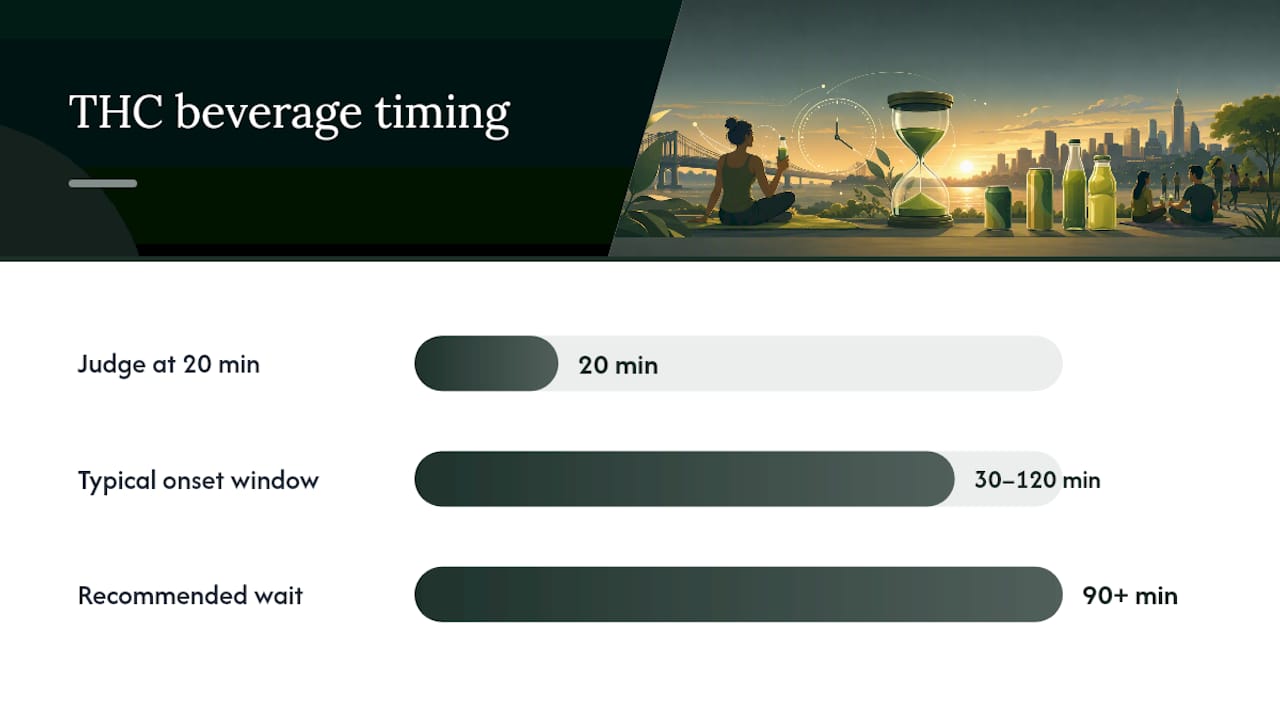
Dosing beverages is genuinely different from other edibles, and it trips up even experienced consumers. Onset with a drink can take anywhere from 30 minutes to two hours depending on your metabolism and whether you’ve eaten, sometimes slower than a gummy because absorption depends on how the beverage is formulated. Start with the lowest available dose, wait at least 90 minutes before considering more, and never mix THC beverages with alcohol, the combined effects are unpredictable and significantly increase the risk of overintoxication. Store unopened beverages away from anywhere children might find them; a THC seltzer looks exactly like a regular one in the fridge.
Pro Tip: If you’re used to smoking or vaping, resist the urge to judge a beverage’s strength by how it feels after 20 minutes. Give it the full window before deciding whether you need more. Impatience with beverage onset is the number one reason people accidentally overconsume.
For readers comparing beverages against other infused products, our look at how Doozies and LayUp drinks are setting labeling standards walks through what strong compliance actually looks like on a shelf.
Where Is New York’s THC Beverage Market Headed?
The regulatory gap between a 0.5 mg hemp seltzer and a full-strength dispensary beverage has created real confusion for consumers, and I don’t think that gap closes cleanly even if S9220 passes. Liquor stores gaining access to 5 mg beverages would still leave a meaningful potency ceiling between that channel and what dispensaries carry, and licensed dispensaries will keep holding the advantage on selection, potency range, and staff who can actually explain dosing.
What won’t change, regardless of which bill moves forward, is the importance of lab testing and clear labeling. Any expansion of retail channels only works for consumers if COA verification and single-serving packaging come along with it. Buying from a licensed dispensary today already gets you that protection without waiting on Albany.
Where Can You Verify NY THC Beverage Rules Yourself?
- OCM Consumers page: covers who can legally sell THC beverages and the 0.5 mg hemp retail cap.
- 9 NYCRR Part 114 adopted text: the full regulatory language behind hemp beverage potency and packaging limits.
- Cannabinoid Hemp Regulations Guidance for Licensees: OCM’s plain-language walkthrough of testing, labeling, and packaging expectations.
- 9 NYCRR §114.8 via Cornell Law: the specific code section governing cannabinoid hemp product requirements.
- S.9220 bill text: proposed liquor store beverage permit and 5 mg potency ceiling.
- S.8575 bill text: the Hemp Beverage and Taxation Act’s licensing and tax framework.
Ready to skip the guesswork entirely? Browse Say Less’s curated brand lineup and order online for pickup or same-day NYC delivery, every product lab-tested, labeled, and sold through a licensed adult-use dispensary.
Frequently Asked Questions About NY THC Beverage Laws
Are THC drinks legal in NY right now?
Yes, if purchased from a licensed adult-use dispensary. Hemp-derived THC beverages sold elsewhere are legal only up to 0.5 mg of THC per serving.
Can I buy a THC seltzer at a regular liquor store?
Not yet. Liquor stores cannot legally sell THC beverages today; S9220 would change that if it passes and clears rulemaking.
What’s the maximum legal THC per serving for hemp beverages?
Roughly 0.5 mg for hemp retail sales, with related guidance citing figures near 1 mg per serving and 10 mg per package for other cannabinoid hemp products under Part 114.
How do I know if a THC beverage is actually lab-tested?
Look for a QR code on the packaging linking to a certificate of analysis, then confirm the testing lab holds real accreditation.
Is it illegal to bring a legally purchased THC beverage across state lines?
Yes. Even where you bought it legally in New York, transporting it across state lines typically violates federal law and the laws of neighboring states, so don’t carry it over the border.
What should I do if I get sick after drinking a THC beverage?
Seek medical attention right away, keep the packaging and receipt, and report the product to OCM’s enforcement division once you’re safe.
This article is general information, not a substitute for advice from a qualified lawyer. Consult a qualified legal professional about your own circumstances before acting on anything here.
Sources
- Consumers | New York State Office of Cannabis Management
- Part 114 – Cannabinoid Hemp (adopted text) | NY OCM
- Cannabinoid Hemp Regulations Guidance for Licensees (Revised October 2024) | NY OCM
- 9 NYCRR § 114.8 — Cannabinoid hemp product requirements (Cornell Law)
- S.9220 — Senate bill text (PDF) establishing low potency cannabis beverage retail permit
- S.8575 — ‘Hemp Beverage and Taxation Act’ (PDF)