
THC drinks are beverages infused with delta-9 tetrahydrocannabinol, the same psychoactive compound in cannabis flower and gummies. Most commercial versions use nano-emulsification, a process that breaks THC oil into microscopic water-soluble droplets, which can speed absorption compared with traditional oil-based edibles. They will intoxicate you. The high is real, and the dosing rules matter.
What you need to know right now:
- Onset: Real-world consumer data puts median onset around 40 minutes, though nano-emulsified products can hit faster, sometimes within 15–20 minutes.
- Duration: Effects typically last one to three hours, shorter than most gummies.
- Core safety rule: Start at 2.5–5 mg, sip slowly, wait at least 90 minutes before considering more, and never drive.
Key Takeaways
THC drinks are intoxicating cannabis beverages that use nano-emulsification for faster absorption, with a median onset around 40 minutes, typical effects lasting one to three hours, and real label accuracy risks that make buying from a licensed, lab-tested source the single most important safety decision.
| Point | Details |
|---|---|
| What THC drinks are | Beverages infused with delta-9 THC, usually nano-emulsified for faster, more consistent absorption than oil-based edibles. |
| Onset and duration | Median onset around 40 minutes; effects typically last one to three hours, shorter than most gummies. |
| Top dosing rule | Start at 2.5–5 mg, sip slowly, and wait at least 90 minutes before considering any additional dose. |
| Biggest safety caution | Never drive after consuming; never mix with alcohol; negative experiences rise sharply when THC drinks are combined with other substances. |
| Buy smart | Purchase only from licensed sellers with third-party COAs; avoid products that list only “hemp extract” without a clear mg-per-serving figure. |
| Saylessny | The Bronx’s licensed dispensary offering lab-tested THC products with same-day NYC delivery and transparent COA documentation. |
Table of Contents
- THC drinks explained: what they are and the types you’ll find
- How THC drinks are made and why formulation changes everything
- How do THC drinks compare to edibles and alcohol?
- Dosing guidance, serving sizes, and what the evidence says about label accuracy
- Safety risks, vulnerable groups, and interactions
- Legal basics, where to buy safely, and what to check at the shelf
- How to try a THC drink safely the first time
- What recent studies and large consumer datasets say about THC beverages
- Potential health effects and benefits beyond intoxication
- Environmental impact and sustainability in THC drink production
- Why I think the “just like a beer” framing is the biggest risk in this category
- THC beverages at Saylessny: lab-tested products, no guesswork
- Sources
THC drinks explained: what they are and the types you’ll find
A THC beverage is any drink that delivers a measured dose of tetrahydrocannabinol (THC), the cannabinoid responsible for the cannabis high. On menus and store shelves, you’ll see them called cannabis drinks, weed drinks, THC seltzers, or infused beverages. The vocabulary matters because different names often signal different legal origins and formulations.
Quick glossary:
- Delta-9 THC: The primary psychoactive cannabinoid in cannabis. When a label says “THC,” this is almost always what it means.
- Delta-8 THC: A milder psychoactive cannabinoid, often synthesized from hemp-derived CBD. Legal in more states than delta-9 but with less research behind it.
- Hemp-derived: Made from cannabis plants containing less than 0.3% delta-9 THC by dry weight under federal law. Many THC beverages use hemp-derived delta-9 to navigate federal rules.
- Marijuana-derived: Made from cannabis plants above the 0.3% threshold, legal only in states with recreational or medical programs, and sold through licensed dispensaries.
- Nanoemulsion: A formulation technology that makes THC water-soluble by reducing oil droplets to nano-scale particles, improving absorption speed and consistency.
Common product types on the market:
- Sparkling seltzers and hard-seltzer-style cans (typically 2–10 mg per can)
- Nonalcoholic THC cocktails and mocktails
- Concentrated shots (often 10–100 mg, meant to be added to other drinks)
- Canned teas and lemonades
- Tonic-style beverages with added CBD or adaptogens
- Dissolvable powders and drink mixes
The source material, hemp versus marijuana, changes where you can legally buy a product and how it’s regulated. Hemp-derived drinks often appear in grocery stores, bars, and online retailers. Marijuana-derived drinks are sold exclusively through licensed dispensaries. Labels may list the cannabinoid as “hemp extract,” “cannabis extract,” or by specific compound name, so reading carefully pays off.
How THC drinks are made and why formulation changes everything
Standard THC oil and water don’t mix. That’s the core problem every THC beverage manufacturer has to solve, and the solution, nano-emulsification, is what separates a well-made drink from one that separates into an oily layer at the bottom of the can.
Nano-emulsification works by using high-energy processing and emulsifying agents to break THC oil into droplets measured in nanometers. At that scale, the droplets stay suspended in liquid and behave more like water-soluble compounds. The result is a drink that looks and pours like any other beverage but delivers THC in a form your body can absorb far more efficiently than a standard oil-based gummy or capsule.
Why this matters for how you feel: A peer-reviewed Addiction journal review identified nano-emulsified THC beverages as having meaningfully higher bioavailability than traditional oil-based edibles, while also flagging the regulatory and dosing standardization challenges that come with faster, less predictable absorption.
The absorption pathway is a hybrid. Some THC enters the bloodstream quickly through the oral and gastric mucosa, the lining of your mouth and stomach. The rest goes through partial first-pass liver metabolism, where THC converts to 11-hydroxy-THC, a metabolite that is more potent and longer-lasting than THC itself. This dual pathway is why a THC drink can feel faster than a gummy but still produce a lingering effect an hour or two later.
One practical variable almost no one mentions: stomach contents. An empty stomach speeds onset and raises peak intensity. A full stomach slows everything down and smooths the curve. If you’re learning your dose, eating a normal meal first gives you a more predictable experience.
How do THC drinks compare to edibles and alcohol?
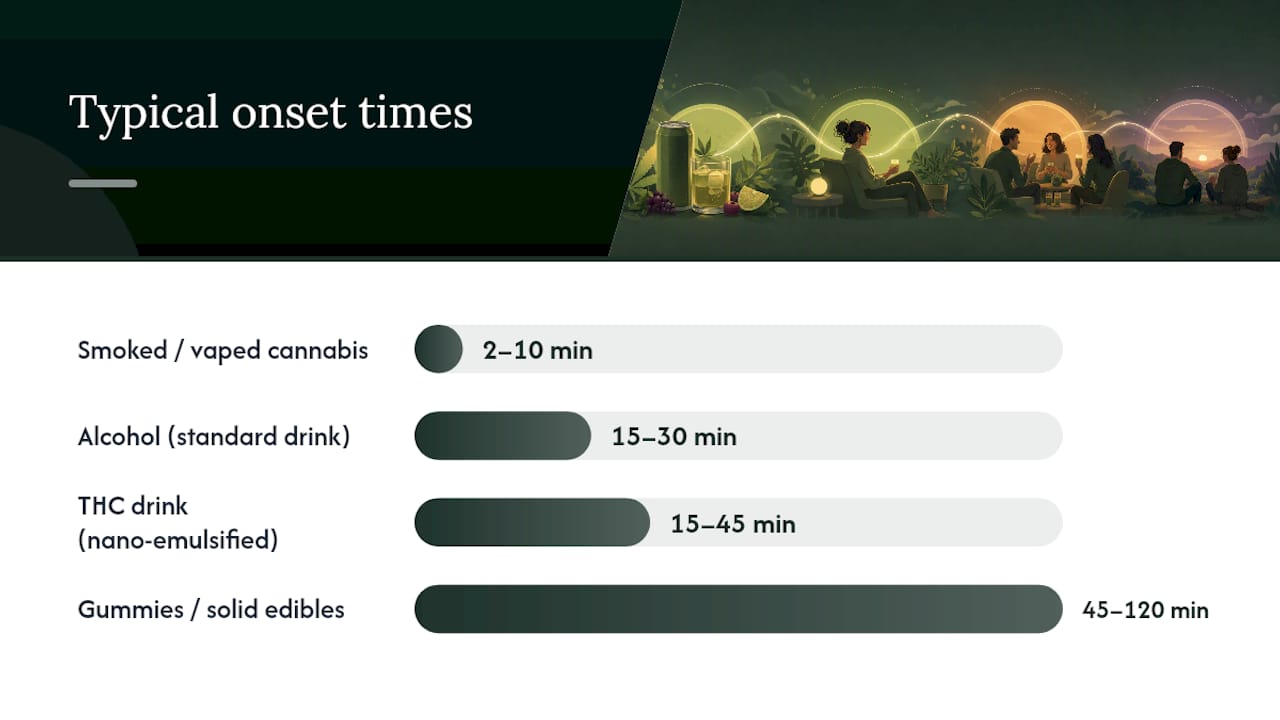
This is the question most people actually want answered before they try one. The short version: THC drinks sit between smoked cannabis and traditional edibles in terms of onset speed, and they produce a different kind of impairment than alcohol, even when the social setting feels similar.
Side-by-side comparison:
| Format | Typical onset | Peak | Duration | Notes |
|---|---|---|---|---|
| THC drink (nano-emulsified) | 15–45 min | 45–90 min | 1–3 hours | Faster than gummies; hybrid absorption |
| Gummies / solid edibles | 45–120 min | 1–3 hours | 4–8 hours | Longer, stronger metabolite conversion |
| Smoked / vaped cannabis | 2–10 min | 15–30 min | 1–3 hours | Fastest onset; most controllable |
| Alcohol (standard drink) | 15–30 min | 30 minutes | 1–3 hours | Different impairment mechanism; no THC |
At low doses (2.5–5 mg), most people report mild relaxation, a slight mood lift, and reduced social anxiety. At 10 mg, effects become noticeably stronger, with more pronounced euphoria and some cognitive slowing. Above 20 mg, especially for people without tolerance, the experience can tip into anxiety, rapid heart rate, or disorientation.
Harvard Health notes that THC beverages are increasingly marketed as social alcohol alternatives but still cause genuine impairment. The social framing is the risk: people who would never drink five beers in an hour will sip a THC drink the same way, not realizing the dose is stacking.
Pro Tip: Sip, don’t chug. Because nano-emulsified THC absorbs faster than a gummy, drinking a full can quickly can deliver the full dose before you feel the first effects. Treat it like a cocktail you’re nursing, not a soda you’re finishing.
Dosing guidance, serving sizes, and what the evidence says about label accuracy
The standard starting recommendation across consumer guides and dispensary staff is 2.5–5 mg of THC for a first-time or low-tolerance user. That range is conservative by design. At 5 mg, most people feel something noticeable without feeling overwhelmed. At 10 mg, effects are strong enough that new users sometimes find them uncomfortable.
Tolerance changes the math significantly. A regular cannabis user might find 10 mg produces mild effects, while someone who hasn’t used cannabis in years could feel 5 mg intensely. There’s no universal dose, which is exactly why starting low and waiting matters more than any specific number.
The label accuracy problem is real and worth taking seriously. A critical review published in PMC found widespread labeling inconsistencies across cannabis beverage products, including THC over-labeling in multiple samples. In plain terms: the drink may contain more THC than the label says, or the distribution within the liquid may be uneven, meaning the first half of the can might deliver a different dose than the second half.
What this means at the shelf: A product labeled “5 mg per serving” may not be delivering exactly 5 mg. Without a Certificate of Analysis (COA) from an independent lab, you’re trusting the manufacturer’s own testing. Always ask for the COA or look for it on the brand’s website before buying.
How to read a THC beverage label:
- Find the mg per serving, not per container. A 12 oz can might list 10 mg total with a serving defined as half the can.
- Check whether the serving size is clearly defined in volume (e.g., 6 oz = 5 mg).
- Look for a batch number and QR code linking to third-party lab results.
- If the label lists only “hemp extract” with no mg amount, treat it as an unknown dose and avoid it.
Safety risks, vulnerable groups, and interactions
⚠️ Warning: Do not drive or operate machinery after consuming any THC beverage. Cannabis impairs reaction time, judgment, and coordination regardless of how mild the dose feels. NIDA’s clinical evidence summary confirms cannabis impairs driving ability, and that impairment does not always feel obvious to the person experiencing it.
Mixing THC drinks with alcohol is one of the most common causes of bad experiences. Alcohol increases THC absorption and intensifies impairment in ways that are hard to predict. Real-world consumer data shows negative experience rates rise sharply when drinks are combined with alcohol or stacked with other cannabinoid products.
Groups who face higher risk:
- Pregnant and breastfeeding people: THC crosses the placental barrier and appears in breast milk. No safe level has been established.
- Adolescents: The developing brain is more sensitive to THC’s effects on memory, attention, and mental health.
- People on sedating medications: Benzodiazepines, opioids, sleep aids, and some antidepressants can interact with THC to amplify sedation or anxiety.
- Frequent drivers or people with demanding jobs: Even residual impairment the morning after a high dose can affect performance.
- People with a personal or family history of psychosis: THC can trigger or worsen psychotic symptoms in susceptible individuals.
Signs of overconsumption to watch for:
- Rapid or pounding heartbeat
- Severe anxiety or panic
- Confusion or inability to speak clearly
- Nausea and vomiting
- Extreme drowsiness or unresponsiveness
If someone is unresponsive or you’re unsure whether they’re safe, call 911. For a conscious person experiencing anxiety or disorientation, move them to a calm, quiet space, reassure them that the feeling will pass, and keep them hydrated. You can also call Poison Control at 1-800-222-1222 for guidance.
Legal basics, where to buy safely, and what to check at the shelf
Cannabis law in the United States is a patchwork. Under federal law, marijuana-derived THC remains a Schedule I controlled substance per the DEA’s classification. Hemp-derived delta-9 THC is federally legal under the 2018 Farm Bill as long as the product contains less than 0.3% delta-9 THC by dry weight, but that threshold creates a meaningful loophole for beverages: a large-volume drink can contain a significant absolute amount of THC while staying under the percentage limit. State laws vary widely, and some states have moved to restrict hemp-derived THC products regardless of federal status.
The practical upshot: always check your state’s current rules before purchasing. What’s sold freely in one state may be prohibited in another, and online shipping of THC products crosses into legally complex territory.
Buying checklist:
- COA available: Third-party lab Certificate of Analysis confirms potency and screens for contaminants.
- Exact mg per serving: Clearly stated in milligrams, not just “hemp extract.”
- Single-serving definition: Volume or unit clearly defined on the label.
- Full ingredient list: Including emulsifiers, sweeteners, and any added cannabinoids (CBD, CBN, etc.).
- Expiration date: THC degrades over time; older products may be less potent or off-flavor.
- Licensed seller: For marijuana-derived products, purchase only from a state-licensed dispensary.
Hemp-derived products sold outside dispensaries often receive less regulatory scrutiny. A licensed dispensary is held to state testing and labeling standards that most grocery-store or online hemp products are not. That gap in oversight is where most of the label accuracy problems originate.
How to try a THC drink safely the first time
Getting the experience right the first time mostly comes down to preparation, not luck.
- Choose your dose. Start at 2.5–5 mg if you’re new to cannabis or returning after a long break. If you have regular cannabis experience, 5–10 mg is a reasonable starting point.
- Pick the right setting. A comfortable, familiar environment with people you trust reduces the chance that mild anxiety escalates. Avoid crowded bars or unfamiliar social situations for your first try.
- Don’t mix substances. Skip alcohol entirely. Even one drink changes how THC absorbs and how impaired you feel.
- Sip slowly over 30–45 minutes. Don’t finish the can quickly. Pacing your intake gives you time to feel the early effects before the full dose hits.
- Wait 45–90 minutes before considering more. The most common mistake is redosing too soon because “nothing is happening yet.” Set a timer.
- Have a plan for the evening. No driving, no demanding tasks. If you’re uncertain, have a sober friend nearby.
Pro Tip: Before buying, ask the budtender three questions: Does the COA show the mg per serving or per container? Is this product nano-emulsified or oil-based? And what’s the recommended starting dose for someone with low tolerance? A good dispensary will answer all three without hesitation.
When selecting a product, prioritize transparent labeling, a linked or printed COA, a clearly defined serving size, and a licensed seller. The endocannabinoid system varies significantly between individuals, so the same 5 mg dose can feel very different depending on your body weight, metabolism, and prior cannabis exposure.
What recent studies and large consumer datasets say about THC beverages
The research on cannabis beverages is growing but still limited compared with smoked cannabis. Here’s what the strongest current evidence actually shows.
| Source | Key finding |
|---|---|
| critical review published in PMC | Widespread labeling inconsistencies; THC over-labeling in multiple beverage samples; no standard serving definition across jurisdictions |
| Addiction journal review | Nano-emulsified beverages show higher bioavailability than oil-based edibles; regulatory gaps allow hemp-derived products to exploit federal thresholds |
| 23rd State real-world dataset | Median onset ~40 minutes; typical duration 1–3 hours; negative experiences rise when drinks are combined with alcohol |
| Health Canada regulatory framework | Sets a 10 mg per beverage limit as a public health standard; highlights lack of equivalent limits in many U.S. jurisdictions |
The most important research gap right now is long-term effects. Most studies measure acute intoxication and short-term outcomes. What regular consumption of THC beverages does to cognition, liver function, or mental health over months or years is largely unstudied. Public health researchers have noted that the commercial growth of THC beverages has outpaced the clinical research needed to understand them fully.
For consumers, the practical implication is straightforward: the evidence supports cautious, low-dose use with lab-tested products, and it does not yet support treating THC drinks as a fully characterized, risk-free alternative to alcohol.
Potential health effects and benefits beyond intoxication
Most people try THC drinks for the same reasons they’d reach for a beer: relaxation, social ease, a mental break from the day. At low doses, those effects are real and fairly consistent. THC activates CB1 receptors in the brain’s limbic system, which tends to reduce anxiety and lower the perception of stress. For some people, that translates to genuine relief from social anxiety, mild pain, or difficulty winding down at night.
Pain relief is the most studied potential benefit. Cannabis has a reasonable evidence base for certain types of chronic pain, particularly neuropathic pain and pain associated with inflammation. Whether a 5 mg THC beverage delivers enough THC to produce meaningful pain relief for someone with chronic conditions is a different question, and the honest answer is: probably not for most people with significant pain, though it may take the edge off mild discomfort.
Sleep is another common reason people reach for low-dose THC products. THC can reduce the time it takes to fall asleep, though it also tends to suppress REM sleep with regular use, which matters for memory consolidation and overall sleep quality. Occasional use for sleep is different from nightly use, and the research supports treating it as an occasional tool rather than a nightly habit.
The entourage effect is worth considering when choosing a beverage. Products that include CBD alongside THC often produce a more balanced, less anxious experience. CBD appears to blunt some of THC’s more intense psychoactive effects, which is why a 5 mg THC / 5 mg CBD drink often feels gentler than a 5 mg THC-only product. Understanding minor cannabinoids like CBN and CBG, which appear in some beverages, can also help you choose a product matched to your intended effect.
Environmental impact and sustainability in THC drink production
THC beverages carry a larger environmental footprint than most consumers realize, and it’s worth knowing where the pressure points are.
Cannabis cultivation itself is resource-intensive. Indoor growing, which produces most of the marijuana-derived THC used in beverages, consumes significant electricity for lighting, climate control, and ventilation. Hemp cultivation for hemp-derived products is generally less energy-intensive, particularly when grown outdoors, but still requires water and land.
The beverage production side adds its own footprint. Aluminum cans, glass bottles, and multi-layer packaging all require energy to produce and transport. Nano-emulsification processing uses specialized equipment and chemical emulsifiers, some of which raise questions about downstream environmental impact that the industry hasn’t fully addressed.
A few brands have moved toward regenerative growing practices, reduced-packaging formats, and carbon-offset programs, but these remain the exception rather than the standard. If sustainability matters to you, look for brands that publish their growing practices and sourcing transparently. Outdoor or greenhouse-grown hemp-derived products generally carry a lighter footprint than indoor marijuana-derived ones, all else being equal.
The honest picture: the THC beverage industry is young, growing fast, and has not yet developed the sustainability standards that more mature food and beverage categories have. That’s a gap worth watching as the market matures.
Why I think the “just like a beer” framing is the biggest risk in this category
The most dangerous thing about THC drinks isn’t the THC. It’s the can.
People have decades of learned behavior around canned beverages. You crack one open, you drink it, you grab another. That rhythm is deeply ingrained, and THC drinks look and feel exactly like the beverages that trained it. The problem is that the dose-response curve for THC is nothing like alcohol’s. With alcohol, you feel the first drink before you finish the second. With a nano-emulsified THC drink, you might finish the whole can before the first milligram has registered.
The research backs this up. The PMC critical review specifically flags delayed intoxication as a primary risk factor for cannabis beverages, and the real-world data shows negative experiences spike when people combine drinks with alcohol or simply consume too much too fast. The “social alternative to alcohol” marketing is accurate in one sense: THC drinks can fill that social role. But the consumption pattern that works for alcohol is exactly the wrong pattern for THC.
My honest take is that THC drinks are a genuinely useful product category for the right person using them the right way: someone who understands the delay, respects the dose, and treats the can as a single serving to be paced over an hour. For that person, a well-formulated, lab-tested THC beverage offers a real alternative to alcohol with a different and often more manageable impairment profile. The risk is the person who picks one up at a party, drinks it like a seltzer, and then wonders why they’re having a terrible time ninety minutes later.
Start low. Sip slowly. Wait longer than you think you need to.
THC beverages at Saylessny: lab-tested products, no guesswork
If you’re in NYC and ready to try a THC-infused product from a source you can actually trust, Saylessny is The Bronx’s licensed recreational dispensary with same-day delivery across the city. Every product on the menu is lab-tested, with COAs available so you know exactly what’s in what you’re buying.

The difference between buying from a licensed dispensary and picking up a hemp drink at a convenience store is the testing standard. Saylessny carries curated brands, including options from Doozies and LayUp, which have set a clear bar for edible and beverage quality in New York. You get transparent mg-per-serving labeling, verified potency, and staff who can answer the COA questions this article told you to ask. Browse the full dispensary catalog or place a same-day delivery order at saylessny.com.
Sources
- Public health considerations about tetrahydrocannabinol‑infused beverages
- Potential Risks from Cannabis-Infused Beverages: A Critical Review
- Cannabis drinks: How do they compare to alcohol?
- How long do THC drinks take to kick in? | 23rd State
- NIDA: Cannabis (Marijuana) DrugFacts
- DEA: Marijuana
This article is for general informational purposes only and is not a substitute for medical, legal, or professional advice. Cannabis laws vary by state and locality. Confirm current rules with your state’s regulatory authority or a qualified professional before purchasing or consuming THC products.
FAQ
Are THC drinks the same as CBD drinks?
No. CBD drinks contain cannabidiol, which is non-intoxicating. THC drinks contain tetrahydrocannabinol, which produces a psychoactive high. Some beverages contain both; always check the label for the specific cannabinoid and mg amounts.
Can you fail a drug test after drinking a THC beverage?
Yes. Standard drug tests screen for THC metabolites, and a THC beverage will trigger a positive result just as smoking or eating an edible would. The amount and timing affect how long metabolites remain detectable.
How is a THC drink different from a regular edible?
The main difference is formulation and onset speed. Nano-emulsified THC beverages absorb faster than oil-based gummies or chocolates, producing effects in roughly 15–45 minutes versus 45–120 minutes for most solid edibles. Duration tends to be shorter as well.
What should I do if I took too much?
Move to a calm, quiet space. Stay hydrated with water. Remind yourself the feeling will pass. If the person is unresponsive or you’re genuinely concerned, call 911. For non-emergency guidance, Poison Control (1-800-222-1222) can help.
Where can I buy THC drinks legally?
It depends on your state. Marijuana-derived THC drinks are sold through licensed dispensaries in states with recreational or medical programs. Hemp-derived THC drinks may be available more broadly, but quality and testing standards vary significantly. Always buy from a licensed, lab-tested source.