
The fastest way to spot fake carts is to check three things before you inhale: the purchase channel, a matching Certificate of Analysis, and a batch number that lines up with what’s printed on the packaging. If any of those three fail, treat the cartridge as suspect and don’t use it. Do not rely on the appearance test as your primary defense. If you already vaped something questionable and feel short of breath, chest pain, or nausea, get medical care immediately and tell the clinician you vaped.
TL;DR:
- Always verify the batch number and scan the QR code on the cartridge against official lab websites before use, ensuring it matches and is recent.
- Legitimate distillate should be light gold to amber with a consistent oil flow during tilt testing; murky, dark, or sediment-filled oil indicates counterfeits.
- Purchase only from licensed dispensaries with transparent lab documentation; suspiciously low prices or unverifiable sources are high-risk signs.
- Avoid relying solely on visual appearance; counterfeit products can look indistinguishable while containing harmful substances like vitamin E acetate or pesticides.
- If experiencing symptoms after vaping, seek immediate medical care, report the product, and dispose of the cartridge safely to help authorities track illicit supply chains.
Table of Contents
- What Oil Color and Hardware Quality Tell You (and What They Don’t)
- Reading the COA, QR Code, and Batch Number Correctly
- Why Draw Resistance and Airflow Reveal More Than Looks
- The Real Health Risks: Vitamin E Acetate, Pesticides, and Heavy Metals
- A Fast Checklist for Verifying Any Cartridge Before You Use It
- Where You Buy Matters More Than How the Cart Looks
- What to Do the Moment You Suspect a Cartridge Is Fake
- How Say Less Reduces Counterfeit Risk for Bronx and NYC Shoppers
- The Verification Order Most Guides Get Backward
- Sources
What Oil Color and Hardware Quality Tell You (and What They Don’t)
Legitimate distillate typically runs light gold to amber, with a clean, honey-like consistency. Live resin carts can skew slightly darker or cloudier because of the added terpene profile, but they still shouldn’t look muddy or separated. Dark brown oil, a greenish tint, visible sediment, or cloudiness that doesn’t clear when you warm the cartridge in your hand are all signs something’s off with either the extraction or the additives.
A simple bubble test can help. Tip the cartridge upside down and watch the air bubble travel from one end to the other. Clean, properly viscous oil moves at a fairly consistent, slow pace. Oil that’s been cut with cheap thinning agents often moves erratically, either too fast or in fits and starts, because the additive changes the fluid dynamics in ways real cannabis oil doesn’t behave.
Hardware matters just as much as the oil inside it. Run your fingers over the mouthpiece and threading. A loose mouthpiece, threading that doesn’t match the battery cleanly, visible glue residue, or a cartridge that leaks oil around the base are all mechanical tells of a rushed or counterfeit build. Wicking material peeking out where it shouldn’t, or a cotton smell instead of a clean vapor draw, points to lower-grade internals.
Here’s the catch: none of this is conclusive on its own. Testing on illicit vape samples found products tainted with vitamin E acetate and pesticides that were visually indistinguishable from legitimate, lab-tested cartridges. Diluents and viscosity agents can be engineered to mimic the look and feel of clean oil almost perfectly.
Quick visual checklist:
- Oil color falls within light gold to amber (or a clear live resin tint), never muddy brown or green
- Bubble travels at a steady, consistent pace during a tilt test
- Mouthpiece and threading feel snug with no glue or gaps
- No leaking, pooling, or residue around the cartridge base
- No burnt-plastic or cotton smell on the first draw
Pro Tip: Warm the cartridge slightly in your palm for thirty seconds before you tilt it. Cold oil moves sluggishly even when it’s completely clean, and that can trick you into flagging a good cart as fake.
Reading the COA, QR Code, and Batch Number Correctly
A real Certificate of Analysis is the single strongest piece of evidence you have, and it needs to show more than a THC percentage. Look for full panels covering potency, residual solvents, heavy metals, pesticides, and microbial contaminants, along with clear pass or fail markers or measured amounts rather than vague language. A valid COA should reference the exact batch number printed on your specific cartridge, and the test date should fall within the last twelve months. Anything older suggests the product sat in a supply chain far longer than it should have, or that the documentation was recycled from an unrelated batch.
Here’s the verification sequence that actually works:
- Locate the QR code or batch number printed directly on the cartridge or box, not just on a sticker that could have been swapped.
- Scan the code or type the batch number into the brand’s official website or the testing lab’s portal directly, rather than trusting a redirect.
- Confirm the lab holds real accreditation and that its name matches what’s printed on the packaging.
- Match the batch number on the COA against the one on your product. A mismatch invalidates the document entirely for that cartridge.
- Check the test date. If it’s missing, older than a year, or suspiciously close to today’s date with no clear lab timestamp, treat it as a red flag.
Fake QR codes are getting more convincing. Some redirect to generic-looking but entirely fabricated lab report pages, often missing any real accreditation number or using a domain that has nothing to do with the actual testing lab. Regulatory markings matter too: a state license number on the packaging, clear serving size and warning language, and child-resistant packaging features are all baseline requirements for legally sold product.
Why Draw Resistance and Airflow Reveal More Than Looks
A smooth, consistent draw usually means the coil or ceramic heating element is doing its job and the wick is saturated evenly. A restricted, sputtering, or uneven draw often points to a clogged wick, a poorly seated coil, or oil that’s too thick because it’s been cut with the wrong additive. None of that is visible from the outside.
Leakage is one of the most reliable hardware tells. Oil pooling around the mouthpiece threads, a greasy film on the outside of the cartridge, or a chemical or burnt smell coming off the device before you even take a hit usually means the seal failed, or that the cartridge was refilled with a fluid the hardware wasn’t designed for.
Ceramic coil cartridges and cotton wick cartridges behave differently, and knowing which one you’re holding helps you judge whether something’s wrong. Ceramic coils tend to produce a cleaner draw with less risk of a burnt taste, while wick based hardware is more prone to dry hits if the oil is too viscous or the wick wasn’t saturated during filling. If your cartridge suddenly tastes different halfway through, especially harsher or more chemical, that’s often a sign the original oil has been diluted or that the cartridge was refilled into authentic looking hardware after the fact.
Watch for these hardware signals specifically:
- Draw feels restricted, gurgly, or requires unusually hard pulls
- Any leakage or oily residue around the mouthpiece or base
- A burnt plastic, chemical, or overly sweet smell on inhale
- Flavor or vapor quality shifts noticeably partway through the cartridge
- The cartridge reseals oddly or the mouthpiece feels different from factory-sealed units you’ve used before
The Real Health Risks: Vitamin E Acetate, Pesticides, and Heavy Metals
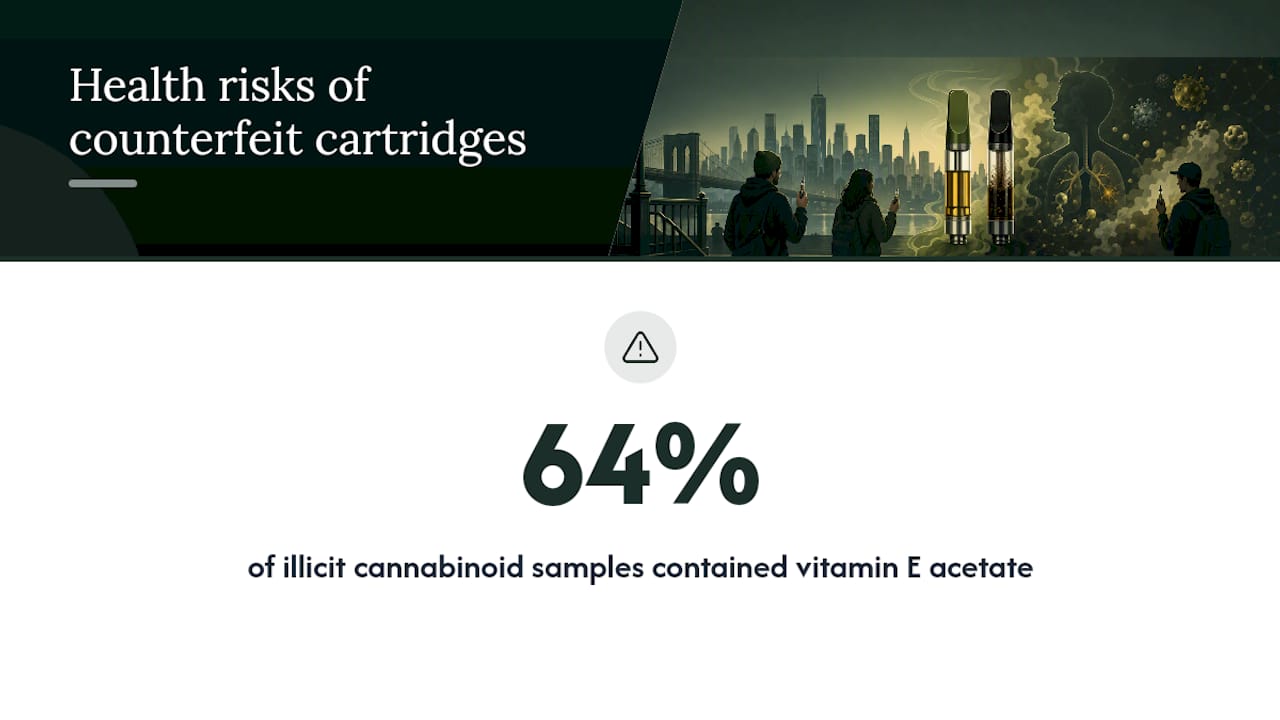
The 2019 EVALI outbreak is the clearest evidence of what happens when counterfeit cartridges reach real people. Investigators traced the lung injuries to illicit vape products, and lab analysis of fluids recovered from patients found vitamin E acetate present in 64% of cannabinoid-containing illicit samples, sometimes as the single most abundant compound in the fluid. Vitamin E acetate was added as a cheap thickening agent to mimic the viscosity of pure THC distillate, and when heated and inhaled it caused a form of chemical pneumonia in hundreds of people.
The compounds found in illicit vape fluid weren’t limited to vitamin E acetate. Pesticide residue, including myclobutanil, heavy metals leached from low-quality heating elements, residual solvents from sloppy extraction, and in some cases undisclosed synthetic cannabinoids showed up across tested black-market samples.
Inhaling any of these introduces risks that oral or topical exposure doesn’t carry, because the lungs absorb compounds directly into the bloodstream with none of the filtering your liver would normally provide. Reported symptoms during the outbreak included persistent cough, shortness of breath, chest pain, fever, and gastrointestinal distress, and severe cases required hospitalization.
Federal regulators urged consumers to stop using THC vaping products from informal or unregulated sources entirely during and after the outbreak. If you develop breathing trouble, chest pain, or persistent nausea after vaping, seek medical attention right away and tell the clinician specifically what you used and where it came from. That detail changes how they treat you.
A Fast Checklist for Verifying Any Cartridge Before You Use It
Run through this before opening a new cartridge, especially one from a source you haven’t used before:
- Confirm you bought it through a licensed dispensary, not a private seller, pop-up, or unverified online listing.
- Scan the QR code or navigate to the brand or lab’s website directly, and cross-check the batch number against your packaging.
- Verify the test date falls within the last twelve months and the lab listed holds legitimate accreditation.
- Check that potency, solvent, heavy metal, pesticide, and microbial panels are all present, not just a THC percentage.
- If any step fails, discard the plan to use it. Documentation that doesn’t match the physical product isn’t proof of anything.
Suspicious COA links often live on domains with no clear connection to the lab name printed on the certificate, or arrive as a downloaded PDF with no live verification option at all. A legitimate lab lets you search their own database directly.
Pro Tip: If a QR code takes you to a page asking you to download a file before showing results, close it. Real lab portals display results directly in the browser, never behind a forced download.
If a COA does check out on every point, you can trust it. If even one detail doesn’t match, don’t let an otherwise convincing certificate talk you out of your own judgment.
Where You Buy Matters More Than How the Cart Looks
Buying exclusively through licensed dispensaries is the most effective single step you can take to avoid counterfeit cartridges, because licensed retailers are required to source from vetted manufacturers, maintain testing records, and submit to state inspections that informal sellers simply don’t face. You can check a dispensary’s licensing directly before you buy if you’re unsure whether a shop is operating legally.
Social media marketplaces and unlicensed delivery services are where most counterfeit cartridges circulate, often dressed up in packaging that looks close enough to a known brand to pass a quick glance. A price that’s dramatically below what licensed shops charge for the same brand is a warning sign, not a bargain. Legitimate testing and compliance costs money, and a cartridge selling for half the going rate usually cut corners somewhere in that process.
- Buy only from state-licensed dispensaries or their verified delivery services
- Avoid cartridges sold through private social media accounts or unlicensed pop-ups
- Treat prices well below the standard market rate as a red flag, not a deal
- Ask staff to show you the COA in-store before you commit to a purchase
What to Do the Moment You Suspect a Cartridge Is Fake
Stop using it immediately and put it somewhere others in your household can’t reach it, especially kids or pets. If you’re experiencing chest pain, coughing, shortness of breath, or nausea, get medical care right away and be specific with the clinician about what you vaped and when.
Before you throw anything out, take the following steps:
- Photograph the cartridge, the packaging, and any QR code or batch number visible on it.
- Screenshot the COA or lab page you scanned, including the URL, in case it disappears later.
- Report the product to your state cannabis regulator and to the FDA’s MedWatch program, along with your local health department if symptoms were involved.
- Dispose of the cartridge safely through a household hazardous waste program rather than regular trash, and never attempt to confront or negotiate with an illicit seller directly.
Preserving that evidence isn’t just for your own records. It helps regulators trace illicit supply chains back to their source and pull dangerous product off the market faster.
How Say Less Reduces Counterfeit Risk for Bronx and NYC Shoppers
Every cartridge on our menu at Saylessny comes from curated, licensed brands, and every batch has lab documentation available for you to review before you buy. Our staff can pull up a COA at the counter and walk you through it, which is more than most informal sellers will ever offer you.
That kind of transparency matters because packaging alone can be replicated by counterfeiters. What can’t be faked as easily is a verified supply chain and a batch number that actually traces back to a real lab.
- Curated inventory from vetted brands like Cannabals and Florist Farms, with lab results tied to the batch in front of you
- In-store staff who can show you a COA and explain what each panel means, not just point you to a shelf
- Delivery across NYC that keeps the same licensed sourcing standards as walking into the store
- Clear labeling on every product, including batch numbers you can verify yourself
Buying through a licensed retailer doesn’t eliminate every risk in the cannabis market, but it removes the biggest one: not knowing where the product actually came from.
The Verification Order Most Guides Get Backward
Most articles on this topic lead with visual checks, oil color, bubble tests, mouthpiece quality, and treat lab documentation as an afterthought. That ordering is backward. Testing during the EVALI outbreak proved that tainted cartridges looked completely normal, which means appearance should be your last check, not your first.
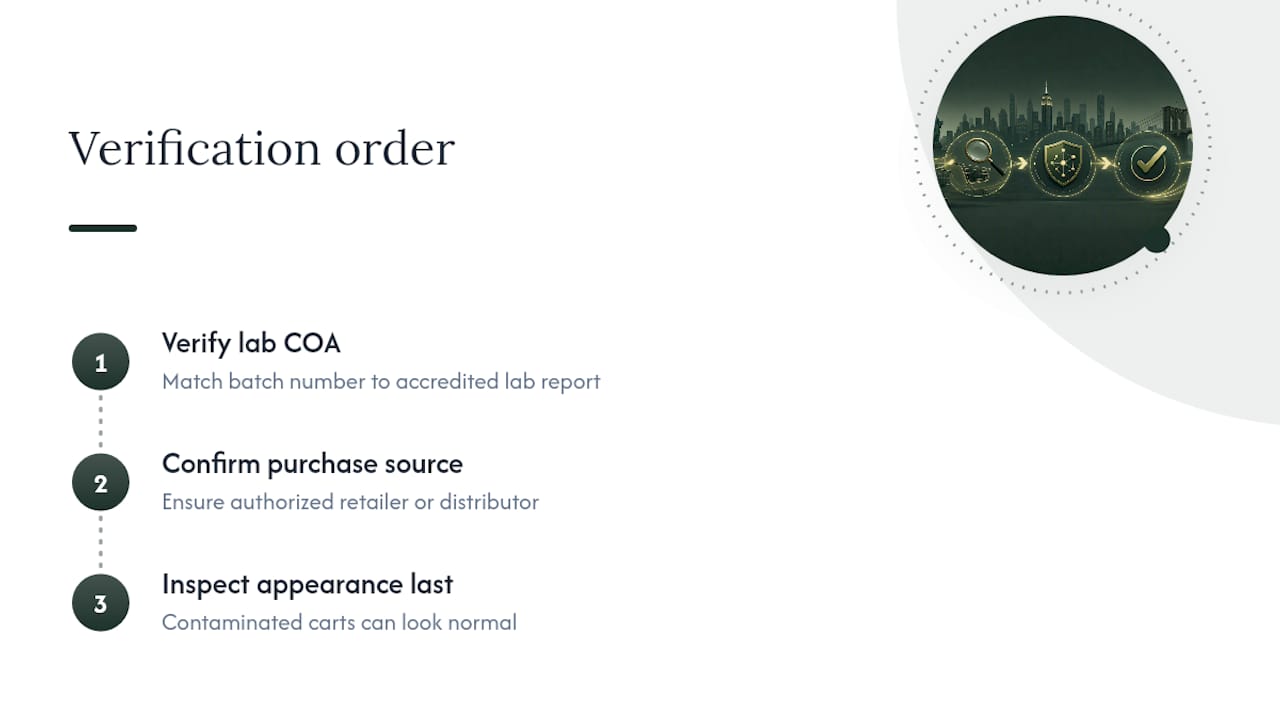
The evidence points to one clear priority: verify the purchase channel and match the COA batch number before you even look at the oil. If those two things check out, a visual scan is just a final sanity check. If they don’t, no amount of clean looking oil should change your decision.
What gets overlooked most is how easy it is for counterfeiters to fake the parts people trust on sight, packaging, hardware, even branded boxes, while the one thing they can’t convincingly fake is a batch number that traces back to a real accredited lab. That’s where your attention belongs first, every time.
— Jake
This article is general information, not a substitute for advice from a qualified doctor. Consult a qualified healthcare professional about your own circumstances before acting on anything here.
Sources
- Tests show bootleg marijuana vapes tainted with hydrogen cyanide — NBC News
- Notes from the Field: EVALI outbreak investigation — CDC MMWR
- Analysis of cannabinoid-containing fluids in illicit vaping cartridges recovered from pulmonary injury patients: identification of vitamin E acetate — PMC
- FDA warns public to stop using THC-containing vaping products — FDA