
The simplest way to buy safe cannabis in New York is to shop a licensed dispensary that displays the state’s Dispensary Verification Tool and to scan every product’s Certificate of Analysis before you pay. That single habit filters out unlicensed sellers and mislabeled products in one move. Say Less, a licensed Bronx dispensary, is one option built around exactly that standard. The rest of this guide covers label reading, product categories, market data, and a shopping workflow you can use on your next order.
TL;DR:
- Always verify the batch testing date and matching lot number on the Certificate of Analysis before purchasing to avoid mislabeled or contaminated products.
- For edibles and concentrates, start with lower doses and give products the full onset time to ensure safety and accurate effects.
- Check the specific product category, as brands often specialize, meaning a reputable flower brand may not have quality edibles or vapes.
- Be aware that the New York market is diverse with over 500 brands, and most market share is concentrated among the top brands in each product category.
- Shop at licensed dispensaries with verified menus, ask staff for CoA details, and use local delivery or in-person pickup depending on your familiarity with the product.
Table of Contents
- How to Evaluate New York Cannabis Brands: Reading Labels and Certificates of Analysis
- What Product Categories Mean for Your Brand Choice
- What NY Market Data Reveals About Brand Choice
- How to Shop Local Brands in New York: A Verification Workflow
- Why Trust Say Less to Help You Evaluate New York Brands
- Profiles of Notable and Emerging New York Cannabis Brands
- Sustainable and Locally Sourced Cannabis Brands in New York
- Consumer Reviews and Feedback Trends on New York Cannabis Brands
- An Editorial Take on Trying New Brands Safely
- Try New York Brands Today Through Say Less
- Sources
- FAQ
How to Evaluate New York Cannabis Brands: Reading Labels and Certificates of Analysis
Every legal cannabis product sold in New York must pass batch testing before it reaches a shelf. The Office of Cannabis Management requires a Certificate of Analysis, or CoA, for each batch, and that document is your best defense against buying something mislabeled or contaminated.
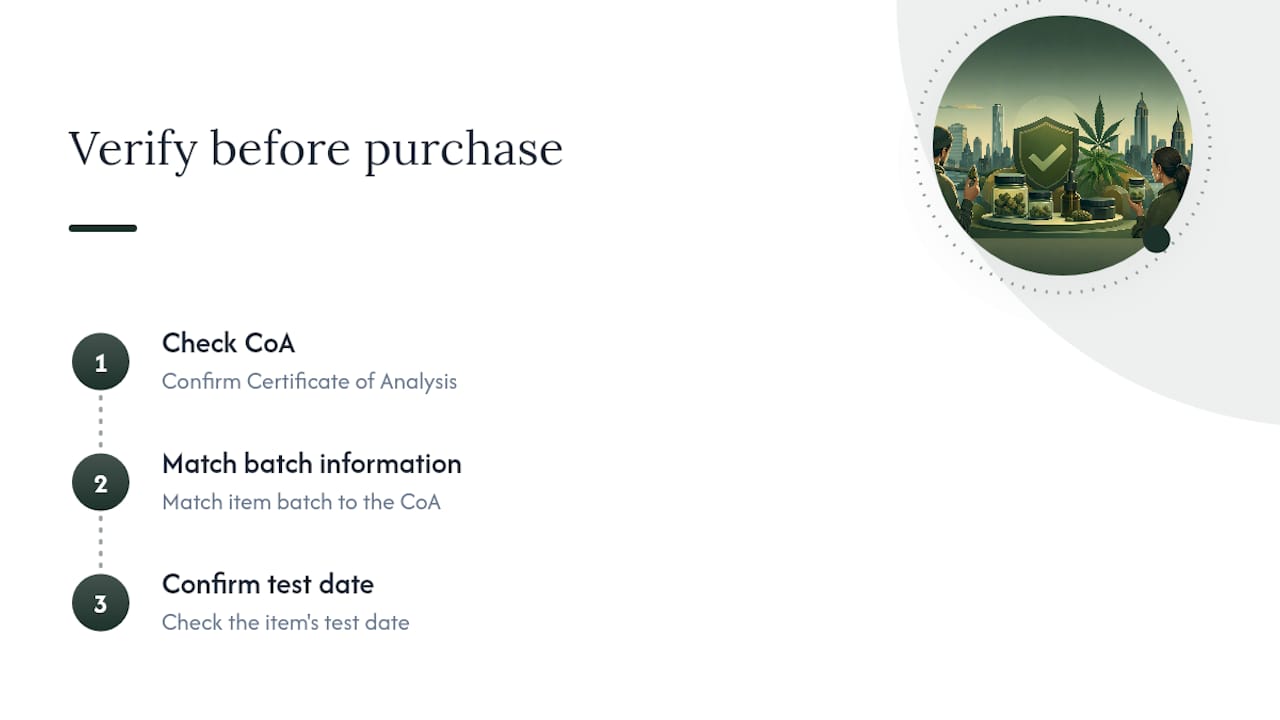
The CoA lists potency (THC and CBD by weight), pesticide screening, heavy metals, residual solvents, and microbial contaminants. You’ll usually find it through a QR code printed on the package or a link on the brand’s product page. Before you buy, pull it up and check three things: the test date, the batch or lot number printed on the package, and whether those numbers match what’s in front of you. A CoA from six months ago attached to a fresh-looking jar is a mismatch worth walking away from.
Quick label checklist:
- License number of the dispensary, visible at checkout or on the receipt
- The universal state cannabis symbol printed on the package
- THC/CBD percentages or milligrams, plus serving size for multi-dose products
- Allergen disclosures on edibles (nuts, dairy, gluten)
- A test date and lot number that match the CoA you scanned
Pro Tip: Never buy anything showing a “FAILED” result on its own CoA. Legitimate dispensaries pull failed batches before they ever hit the shelf, so seeing one is a sign you’re looking at a product that shouldn’t be for sale at all, according to OCM consumer guidance.
Terpene profile and freshness often matter more to the actual experience than the headline THC number, according to a breakdown of New York product labels.
What Product Categories Mean for Your Brand Choice
Flower, pre-rolls, vapes, edibles, and concentrates aren’t interchangeable, and picking a brand without picking a format first is how a lot of first-time buyers end up disappointed, as explained in this detailed industry blog about cannabis trends and product education.
- Flower hits fastest when smoked, usually within minutes, and effects taper off in two to four hours. Check trichome coverage and cure quality alongside the THC percentage.
- Pre-rolls offer the same profile as flower with less prep. Infused pre-rolls can carry significantly more total THC per joint, so check the label instead of assuming it’s a standard flower dose.
- Vapes deliver fast onset with a cleaner taste than combustion, since lower vaporization temperatures preserve more terpenes. Cart lifespan and hardware quality vary a lot by brand.
- Edibles take 30 to 90 minutes to hit and can last 4 to 8 hours. Start at 2.5 to 5 milligrams if you’re new, and wait the full onset window before taking more.
- Concentrates (rosin, badder, diamonds) are the most potent format and the least forgiving for beginners. A small dab goes a long way.
Many New York brands specialize in one category rather than spreading across all five. State sales data backs this up: the top five edible brands account for 53% of edible sales, while the top five topical brands capture 99% of topical sales, according to the 2024 OCM market report. That concentration means a brand’s reputation in flower tells you almost nothing about whether its edibles are any good. Judge each product line on its own label, not the brand name attached to it.
What NY Market Data Reveals About Brand Choice
New York’s legal market isn’t a handful of big names. Over 500 brands currently sell products statewide, and no single company dominates the shelf the way a few players might in a state with a smaller license count, per the 2024 OCM market report.
Sales are still concentrated at the top, though. The top brands capture a notable share of total sales, with leading groups accounting for significant portions. That leaves more than half the market split among hundreds of smaller and regional brands, many of which never show up outside a specific region or a handful of dispensaries.
Flower and pre-rolls are the most competitive categories in the state, which means you’ll find the widest selection and the most brand turnover there. If you’re hunting for a niche or regional brand, expect it to be inconsistent from one dispensary to the next. New York’s market rules also bar exclusive distribution deals between distributors and retailers for branded products, according to the state’s cannabis market rules, so availability differences usually come down to purchasing decisions at each shop rather than an exclusivity contract locking a brand out.
How to Shop Local Brands in New York: A Verification Workflow
Before you walk into a shop or place a delivery order, run the same three checks every time.
- Confirm the retailer’s license using the OCM Dispensary Verification Tool or its published dispensary list.
- Scan the product’s CoA on-site and confirm the license number matches the shop you’re standing in.
- Ask the budtender or delivery agent for the batch number and test date if it isn’t printed clearly.
- Ask when the batch was received. Flower loses terpenes over time, even sealed.
- Pick pickup when you want to inspect product in person before paying; pick delivery when you already know the brand and product line you want.
| Situation | Best move |
|---|---|
| First time trying a new brand | Pickup, so you can check the CoA and packaging in person |
| Reordering a known product | Delivery is fine, since you already know what you’re getting |
| Buying edibles for someone new to cannabis | Ask staff for the lowest available milligram option |
| Shopping a niche or regional brand | Call ahead. Availability is inconsistent outside its home region |
Consuming responsibly matters as much as buying responsibly. Start low, especially with edibles and concentrates, and give any product the full onset window before deciding whether to take more.
Why Trust Say Less to Help You Evaluate New York Brands
There are licensed Bronx dispensaries that build around exactly the verification habits this guide describes. That’s not a marketing claim so much as a description of the daily work.
- Fully licensed under New York’s regulatory framework, with every product traceable to a batch and CoA
- A curated brand menu helps narrow down choices from a large number of brands.
- Staff are available to help explain product information such as potency, test dates, and lot numbers on request.
- Many dispensaries offer same-day delivery and in-store pickup options, supporting the verification habits above.
Shoppers get access to a menu the dispensary has already vetted for lab compliance, plus staff who treat CoA questions as normal, not an inconvenience.
Profiles of Notable and Emerging New York Cannabis Brands
New York’s licensed market includes a mix of established multi-category names and newer regional specialists, and the OCM market report and state consumer resources reference several brands shoppers commonly encounter, including Dank, Ayrloom, MFNY, Florist Farms, Leal, Rolling Green, Camino, Ruby Farms, and Jeeter.
Some of these brands lean into flower and pre-rolls, where competition is fiercest and shelf turnover is constant. Others have built a name in edibles or beverages, categories where a handful of brands often hold a disproportionate share of sales. Jeeter, for instance, is widely known for pre-rolls, while Camino has built recognition around its edible line. Rolling Green has developed a following around flower quality specifically.
None of that means a brand is interchangeable across categories. A brand that earned a strong reputation for vapes isn’t automatically a safe bet for its edibles line, and the only way to know for sure is the same one that applies to any product on the shelf: check the CoA, check the test date, and judge the specific item in front of you rather than the name on the label. Emerging brands without a long sales history deserve the same scrutiny, if not more, since they haven’t built the track record that bigger names have.
Sustainable and Locally Sourced Cannabis Brands in New York
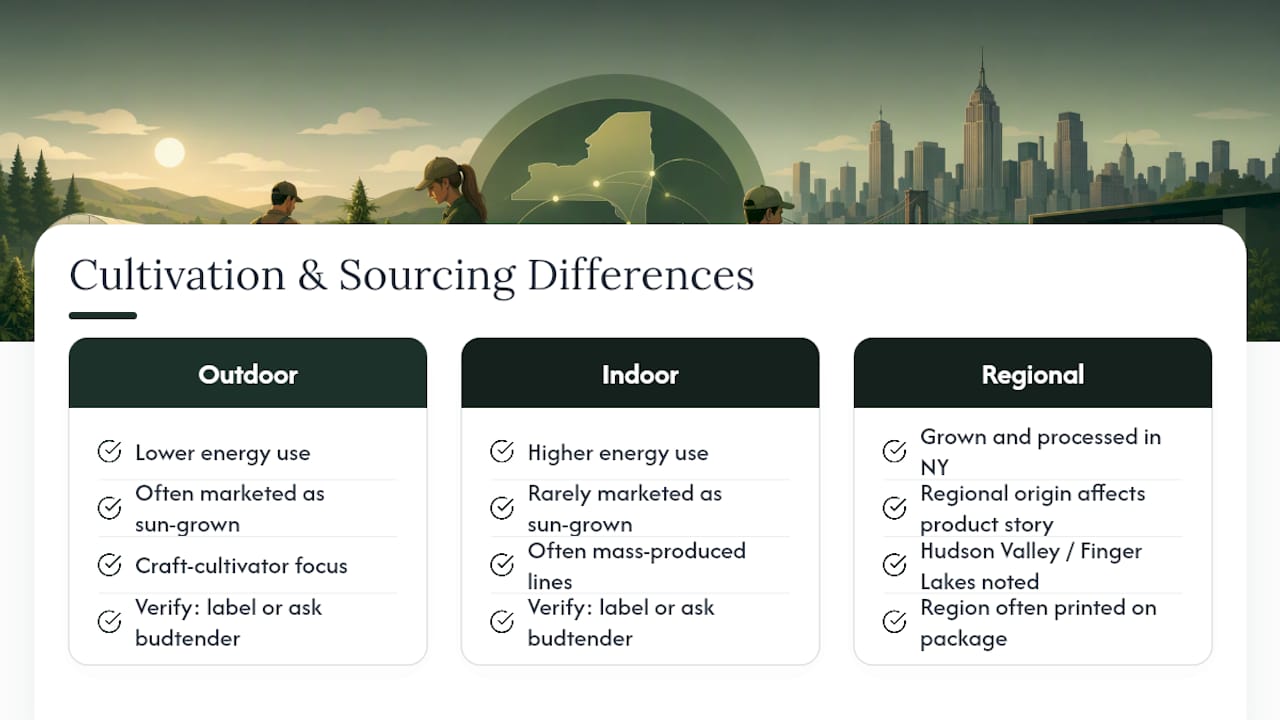
New York’s licensing structure was built with small and craft cultivators in mind, and a meaningful share of the state’s growers operate outdoor or greenhouse farms rather than large indoor facilities. That distinction matters if sustainability factors into your buying decisions.
Outdoor and mixed-light cultivation generally uses less energy than fully indoor grow operations, since it relies on natural sunlight instead of round-the-clock artificial lighting. Some New York brands market themselves specifically around this practice, positioning their flower as sun-grown or craft-cultivated. Labels don’t always spell out cultivation method in detail, so if sustainability matters to your purchase, ask your dispensary directly or look for it on the brand’s own packaging and website.
Locally sourced, in this context, generally means grown and processed within New York State, which every licensed product technically satisfies since interstate cannabis commerce isn’t legal. The more useful distinction for shoppers is regional. Products grown upstate in the Hudson Valley or Finger Lakes region carry a different story than mass-produced lines, even though both meet the same testing standard. If that distinction matters to you, ask which region a flower brand’s product was cultivated in. Most budtenders can tell you, and it’s often listed on the packaging itself.
Consumer Reviews and Feedback Trends on New York Cannabis Brands
Cannabis reviews in New York tend to cluster around a few recurring themes: consistency between batches, terpene freshness, and whether the labeled potency matches the actual experience. Shoppers who leave detailed feedback frequently mention a mismatch between a high THC percentage on the label and a milder real-world effect, which usually traces back to test date and storage rather than a mislabeled product.
Edibles draw a different pattern of feedback, with reviewers focused heavily on onset time and dosing accuracy. Because edible effects take longer to appear, negative reviews often come from people who took a second dose before the first one fully kicked in, a timing issue rather than a product defect.
Vape reviews skew toward hardware complaints as much as product complaints. Cart clogging, inconsistent draws, and battery compatibility come up almost as often as flavor or potency in delivery-based feedback.
The pattern across most categories is the same: reviewers who check the CoA and test date before buying report fewer disappointments than those who buy on THC percentage alone. That’s not a coincidence. It’s the same verification habit this entire guide is built around, and it shows up in real feedback just as much as it does in official testing requirements.
An Editorial Take on Trying New Brands Safely
Trying new brands is part of the fun of a legal market this size, but novelty shouldn’t outrun caution. Start with a small amount of anything unfamiliar, check the CoA before the hype, and give a new brand’s edibles line a lower starting dose than you’d give a name you already trust. New York’s licensing system also opened space for social equity applicants and smaller cultivators who didn’t have a foothold before legalization. Buying from that wider pool, rather than sticking to the handful of brands with the biggest marketing budgets, is one of the more direct ways a shopper supports the intent behind the state’s program.
— Jake
Try New York Brands Today Through Say Less
Some dispensaries offer a curated menu where brands have cleared lab testing, with staff able to provide Certificates of Analysis on request, easing the shopping experience.

You can browse the current menu for pickup or same-day delivery, check out how the team evaluates flower grades, or dig into Jeeter’s pre-roll and cart lineup if you already know that’s the format you want. New to edibles? The edible dosage guide walks through milligram starting points before you order. Whichever category you’re shopping, the same rule applies: check the batch, check the test date, and order from a menu that’s already been through the verification steps this guide covers.
FAQ
What Are the Best New York Cannabis Brands?
There’s no single official ranking, since over 500 brands currently sell across New York and strength varies by category. Brands like Dank, Ayrloom, Florist Farms, Rolling Green, Camino, and Jeeter show up frequently across dispensary menus, but the better question is which category you’re shopping and whether that specific product’s CoA checks out.
What Is the Best Cannabis Brand in the USA?
There’s no single national leader, since cannabis remains illegal at the federal level and each state runs its own licensed market with different brands and testing rules. The more useful approach is picking a brand that performs well in the specific category and state you’re actually shopping in, verified through that state’s own lab-testing requirements.
What Are Some Major Cannabis Companies in New York?
Brands frequently referenced in state market data and consumer resources include Dank, Ayrloom, MFNY, Florist Farms, Leal, Rolling Green, Camino, Ruby Farms, and Jeeter. Dispensaries like Say Less carry curated selections of these and other licensed brands, with availability varying by location and category.
What Are the Top Cannabis Companies in the US?
Rankings vary widely depending on whether you’re measuring revenue, retail footprint, or brand recognition, and no federal list exists because cannabis isn’t legal nationwide. Within New York specifically, state sales data shows the top 20 brands account for about 46% of sales, which is the closest thing to an official measure of market leadership in this state.
How Do I Know a New York Cannabis Product Is Legit?
Check for the universal state cannabis symbol on the package and confirm the dispensary appears on the OCM Dispensary Verification Tool. Then scan the product’s QR code to pull up its Certificate of Analysis and confirm the batch number matches what’s printed on the package.
Does Say Less Verify Its Products’ Lab Testing?
Say Less sources from licensed New York brands that carry state-required CoAs for every batch, and staff can pull that documentation up on request. Current menu pricing and availability are listed on the Say Less site.