
A Certificate of Analysis, or COA, is a third-party lab report that verifies exactly what’s in a specific batch of cannabis and whether it passed safety testing. Before trusting a single number on it, match the batch or lot number on the COA to the one on your package, confirm the lab holds real accreditation, and check that every safety panel reads “pass,” not “fail” or “not tested.” If any of that is missing, put the product back.
TL;DR:
- Only trust COAs issued by accredited third-party labs with batch numbers matching your product, and ensure all safety panels have a pass result.
- Confirm that the QR code links directly to the lab’s site and that the batch, product name, and testing date are current and correspond to your purchase.
- Prioritize safety panels testing for pesticides, heavy metals, and solvents over potency figures, especially for concentrates and vapes.
- Look for detailed method notes and limits of detection to understand whether non-detected contaminants are truly absent.
- In-store or online, ask for COAs before buying, as reputable providers will readily show verified reports for every batch.
Table of Contents
- What Is a Cannabis COA and Who Issues It?
- Key COA Panels: What Each Section Actually Means
- How to Verify a COA Matches the Product
- Using COA Numbers to Actually Choose a Product
- What Lab Accreditation and Method Notes Actually Tell You
- How Say Less Uses COAs to Protect Customers
- Find Lab-Tested Cannabis You Can Actually Verify
- Sources
- FAQ
What Is a Cannabis COA and Who Issues It?
A COA is issued by a licensed, independent third-party lab, never by the grower, brand, or dispensary selling the product. That separation matters. A lab with no financial stake in the sale has no reason to inflate potency numbers or soften a failed pesticide screen, which is the entire point of third-party testing.
Each COA is tied to one specific batch or lot, not to a strain or brand in general. The same strain grown a month later, even by the same cultivator, gets its own report and its own numbers. A single COA typically documents three categories of information: cannabinoid potency, terpene content, and a set of safety panels covering contaminants.
You’ll run into a COA in one of three formats:
- A downloadable PDF attached to the product listing or handed over at checkout
- A page on the testing lab’s own portal, searchable by batch number
- A QR code printed on the packaging that links directly to the lab-hosted report
The QR code format is generally the most trustworthy of the three, because it pulls straight from the lab’s server rather than a file that anyone could edit before it reached you.
Key COA Panels: What Each Section Actually Means
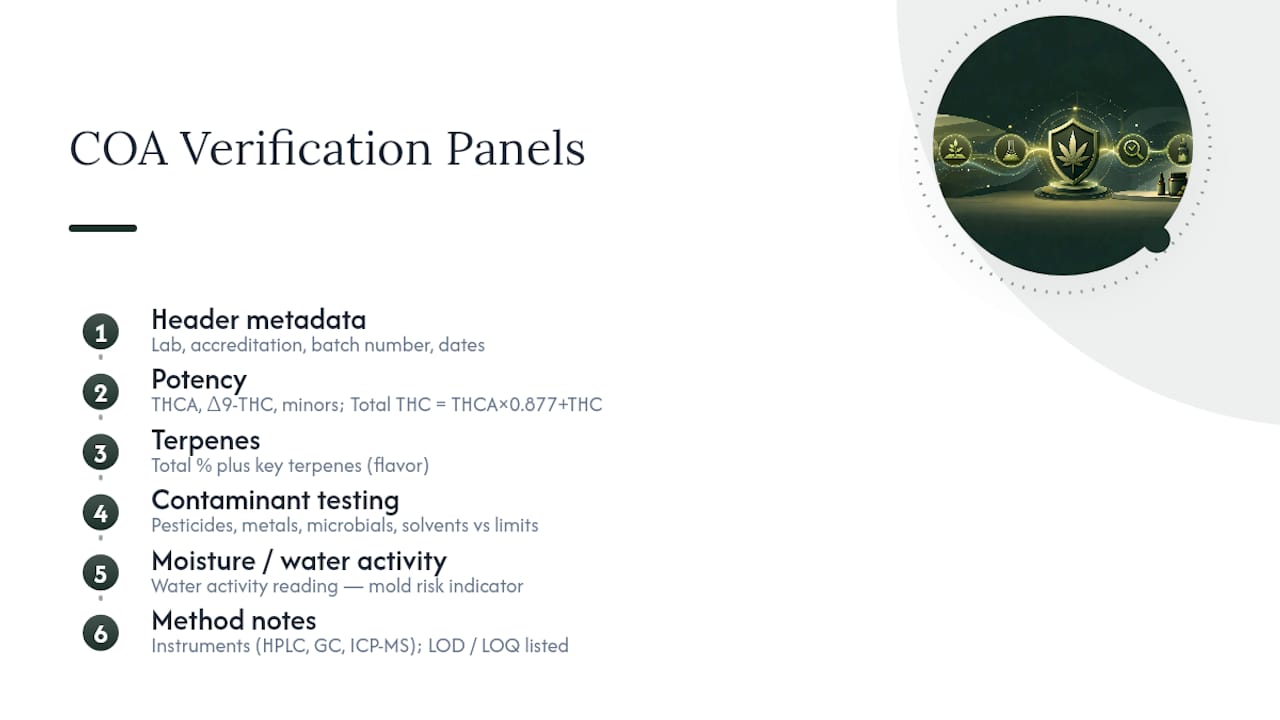
Every COA opens with header metadata: the lab’s name, its accreditation status, the batch or lot number, and the dates the sample was collected and tested. Check this section first. A mismatched batch number here means the rest of the document tells you nothing about the product in your hand.
Potency comes next, listing THCA, delta-9 THC, and often minor cannabinoids like CBD, CBG, or CBN. Because raw THCA converts to active THC when heated, labs calculate Total THC using the formula THCA × 0.877 + THC, which accounts for the weight lost during that conversion, according to StrainCompass’s breakdown of lab reports. Flower typically reports potency as a percentage by dry weight; edibles report it in milligrams per serving.
Terpenes show up as a total percentage plus a breakdown of individual compounds like myrcene, limonene, or caryophyllene. A higher total terpene percentage generally signals a fresher, more aromatic product, and the specific terpenes present offer a rough preview of flavor and feel.
Contaminant panels cover pesticides, heavy metals, microbials, and residual solvents (for vapes and concentrates), each tested against a defined action limit. Anything above that threshold triggers a fail, and state regulators publish exactly what those limits mean, per Washington State’s testing guidance.
Pro Tip: A “moisture content” or “water activity” reading near the bottom of a flower COA isn’t decorative. High water activity is a mold risk indicator, and it’s worth checking even when every other panel looks clean.
Method notes at the bottom name the equipment used: HPLC (high-performance liquid chromatography) for cannabinoids, GC (gas chromatography) for solvents and some terpenes, and ICP-MS (inductively coupled plasma mass spectrometry) for heavy metals. Reputable COAs also list LOD and LOQ, the limit of detection and limit of quantification, which explain why some contaminants read as “not detected” rather than “zero.”
How to Verify a COA Matches the Product
A COA that looks legitimate but belongs to the wrong batch is functionally useless, so verification comes before interpretation. Run through this in under a minute, in-store or online:
- Scan the QR code on the packaging and confirm it opens a report hosted on the testing lab’s own site, not a generic PDF.
- Match the batch or lot number, SKU, and product name exactly between the package and the COA.
- Check the report date. CoA report dates should be reasonably recent; much older documents may not reflect the current batch and should be viewed cautiously.
- Confirm the lab’s name, address, and contact information appear on the document and are searchable independently.
- Verify the safety panel matches the product type. A vape cartridge without residual solvent testing is a real gap, not a formatting quirk.
Pro Tip: If a budtender can’t produce a COA on request or the QR code leads to a dead link, that’s your answer. A legitimate batch has a report ready to show, every time.
Guides from Weedmaps and other consumer resources flag the same recurring red flags: missing batch IDs, broken QR codes, absent safety panels, and “not detected” results with no LOD listed anywhere on the page.
Using COA Numbers to Actually Choose a Product
Once you’ve confirmed a COA is legitimate, the numbers on it should shape what you buy, not just whether you buy. For edibles, compare the Total THC per serving against the label’s dosing claim. If they don’t line up within a reasonable margin, that’s worth questioning before you eat it.
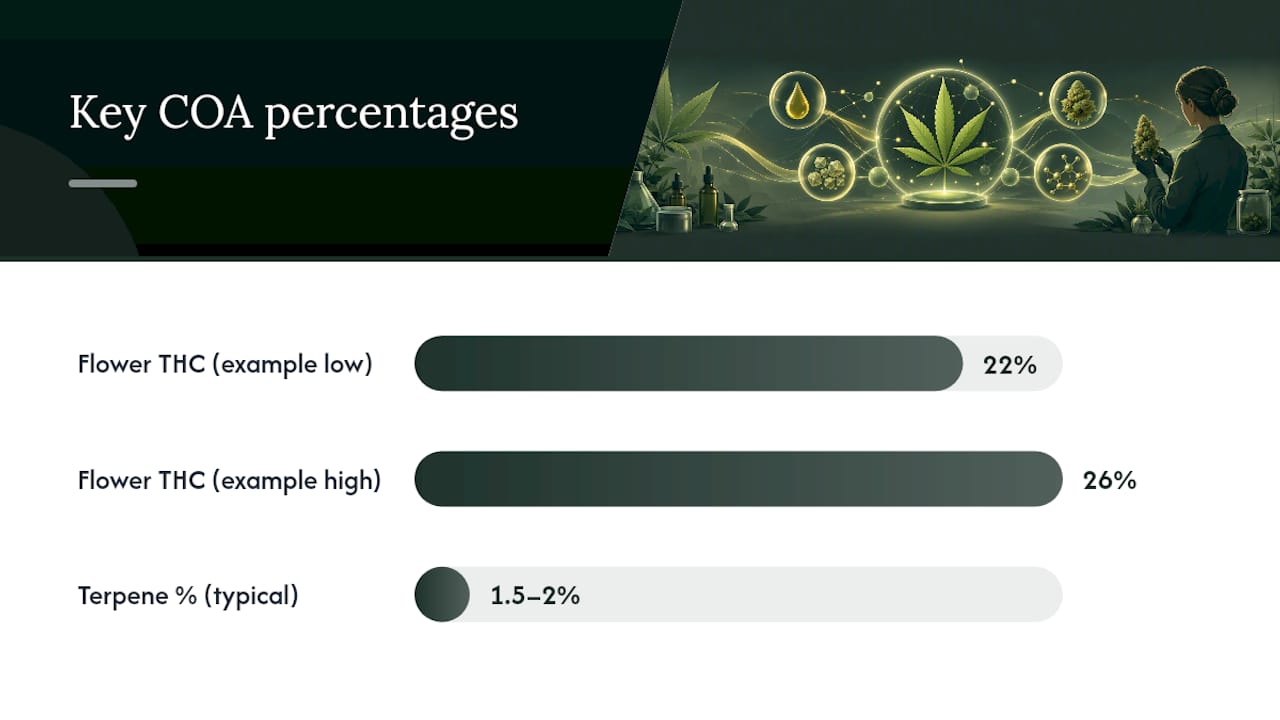
For flower, potency is listed as a percentage by weight, so a jump from 22% to 26% Total THC is meaningful but not the whole story. Check the top three terpenes too, since they influence the experience as much as raw potency does.
Concentrates and vape cartridges carry higher stakes on the safety side. Prioritize the residual solvent panel over a slightly higher potency number, since solvent testing is where concentrate production most often goes wrong. A few buying priorities worth keeping in mind:
- A clean safety panel always outranks a marginal potency difference between two similar products
- Minor cannabinoids like CBG or CBN, when present, are worth understanding on their own terms rather than ignoring
- Terpene percentage above roughly 1.5 to 2% generally correlates with a stronger flavor and aroma profile
None of this replaces matching the product to what you’re actually looking for, but a clean COA is the baseline that makes that matching worthwhile.
What Lab Accreditation and Method Notes Actually Tell You
ISO/IEC 17025 accreditation is the single strongest signal that a lab’s numbers are trustworthy. It’s an internationally recognized standard confirming the lab follows validated testing procedures and calibration practices, and you can verify a lab’s status directly through ISO’s accreditation listings.
- HPLC for cannabinoids and ICP-MS for heavy metals are the field’s standard validated methods; seeing them named on the report adds real confidence
- “Not detected” only means the result fell below the lab’s stated limit of detection, not that the compound is entirely absent, according to Arvida Labs’ explainer on reading COAs
- Ask for the specific LOD number if trace contaminant levels genuinely matter to you
- Watch for reused COAs and mismatched sample IDs, a known supply-chain pitfall; when in doubt, ask the retailer to confirm directly with the lab
How Say Less Uses COAs to Protect Customers
We check every COA before a product goes on our menu, and lab-tested items are flagged so you’re not hunting for that information. If you want to see the report for anything you’re considering, ask, whether you’re browsing in-store or ordering for delivery. Confirming a batch number takes ten seconds, and we’d rather you ask twice than buy once without checking.
— Jake
Find Lab-Tested Cannabis You Can Actually Verify
Reading a COA is only half the job. The other half is buying from a menu where every listed product already has one behind it. We list lab-tested flower, pre-rolls, vapes, and edibles from curated brands, and COAs are available for products before you commit to a purchase.

If you’re comparing options, our guide to choosing cannabis products walks through matching potency and terpenes to what you actually want from a session. Ready to shop? Browse batches from CRU Cannabis or Florist Farms, pick pickup or same-day delivery in NYC, and check the batch number against the COA before you check out.
Sources
- ISO/IEC 17025 testing and calibration laboratories
- Understanding test results (Washington State Liquor and Cannabis Board)
- How to read a cannabinoid COA (Arvida Labs)
- How to read a cannabis COA (Weedmaps)
- How to read a cannabis lab report (StrainCompass)
FAQ
Will 30% THCA Get You High?
Not on its own. THCA is non-intoxicating until it’s decarboxylated by heat, so a flower COA showing 30% THCA describes potential potency once smoked or vaped, not the raw product’s effect while sitting in the jar.
What Is the Difference Between a COA and a COC?
A COA (Certificate of Analysis) reports the actual lab test results for potency and contaminants, while a COC (Certificate of Conformance) simply states a product meets a specification without listing the underlying test data. For cannabis safety and potency decisions, the COA is the document that matters.
Are a COA and an SDS the Same Thing?
No. An SDS (Safety Data Sheet) covers handling, storage, and hazard information for a chemical or product, while a COA reports specific test results for cannabinoids, terpenes, and contaminants in a cannabis batch. They serve entirely different purposes.
What Does a COA Look Like?
A typical COA is a multi-page PDF or lab portal page showing header details (lab name, accreditation, batch number, test dates), a potency table, a terpene profile, and a series of pass/fail contaminant panels with method notes at the bottom.
How Do I Know a COA Belongs to the Product I’m Buying?
Match the batch or lot number printed on the package to the one listed on the COA, and scan any QR code to confirm it opens a report on the testing lab’s own site rather than a generic file.