
Yes, sugar-free cannabis edibles are real, and they cover more ground than most shoppers realize. You can buy or make gummies, chocolates, drinks, mints, capsules, and savory snacks sweetened with allulose, erythritol, monk fruit, or stevia, or left unsweetened entirely. Each sweetener behaves differently in taste, digestion, and blood sugar, and the format you pick should depend on your dosing goals and your diet, not just what looks good on a shelf. Lab testing and a clear dose per piece matter more here than flavor.
TL;DR:
- Most sugar-free edibles are available in gummies, capsules, tinctures, drinks, and savory snacks, with gummies being the most common and convenient option.
- Allulose is the preferred sweetener for baking and setting candies due to its ability to mimic sugar’s texture and its minimal impact on blood glucose.
- Proper label reading is essential, especially for drinks and mints, which may hide hidden carbs, and for dosing accuracy, particularly when making homemade edibles.
- Lab testing and certificates of analysis are critical for safety and potency verification before purchasing any sugar-free edible.
- Blending sweeteners and adding acids can improve flavor and texture, while storage in the fridge or freezer extends shelf life for high-fat, sugar-free treats.
Table of Contents
- Sugar-Free Edibles Options by Format
- The Sweeteners Behind Every Sugar-Free Option
- Weighing Your Format Options: Pros, Cons, and What to Check
- How to Make Sugar-Free Edibles at Home
- Choosing Safe Sugar-Free Edibles: What to Check Before You Buy
- Storage, Shelf Life, and Dosing Safety
- Do Sugar-Free Sweeteners Interact With Medications or Health Conditions?
- Lesser-Known Natural Sweeteners Worth Knowing
- Fixing the Taste and Texture Problems Sugar-Free Edibles Create
- The Environmental Side of Sugar-Free Sweeteners
- What We’re Hearing From Sugar-Free Shoppers
- Find Lab-Tested Sugar-Free Options at a Licensed Dispensary
- Sources
- FAQ
Sugar-Free Edibles Options by Format
Format decides more about your experience than sweetener does. Gummies dominate the sugar-free edibles options category because allulose and erythritol blends can mimic a chewy texture reasonably well. However, they still trail real sugar in bite and shine. Capsules and tinctures skip the sweetener question altogether since there’s nothing to sweeten, which makes them the default pick for anyone tracking carbs closely. Drinks and mints tend to hide carbs in unexpected places, so label reading matters more there than anywhere else on this list.
- Gummies: best for snacking or a familiar mild dose, but check the sweetener blend and total carbs per piece.
- Capsules: best for precise, consistent dosing with zero sweetener to worry about.
- Tinctures: best for flexible dosing you can titrate drop by drop.
- Drinks: best for a social or refreshing format, but scan for added carbs from flavoring.
- Savory snacks: best for strict low-carb or keto needs since there’s no sweetener at all.
Commercial sugar-free versions are easiest to find in gummies, drinks, and capsules. Chocolates and mints are harder to buy pre-made sugar-free and are often better handled as DIY projects, which the recipe section below covers.
The Sweeteners Behind Every Sugar-Free Option
Every sugar-free edible depends on one of a handful of sweeteners, and each one has a distinct personality in the mouth and the gut.
Allulose is the standout for baking and setting because it behaves almost exactly like table sugar when heated or frozen. The FDA has recognized allulose as generally safe, noting it carries roughly 90% fewer calories than sucrose with minimal effect on blood glucose. That combination makes it the sweetener of choice for chocolates and caramels that need to hold their shape.
Erythritol has close to zero glycemic impact and works well in baked goods, though it can leave a cooling sensation on the tongue and cause digestive discomfort in sensitive people when eaten in larger amounts.
Monk fruit and stevia carry zero carbs but hit the tongue with intense, sometimes bitter sweetness on their own. That’s why most recipes and commercial products blend them with erythritol or allulose rather than using either alone.
Sugar alcohols as a broader category require careful label reading. Total carbs on a nutrition panel often include sugar alcohols even though they barely raise blood sugar, so check for “net carbs” if the brand lists it separately.
Quick fact: Allulose has about 90% fewer calories than sugar and produces a negligible rise in blood glucose, per FDA documentation on the sweetener’s safety status.
A monk fruit and erythritol blend is often the simplest swap for home bakers because it balances intensity with a texture that behaves closer to real sugar.
Weighing Your Format Options: Pros, Cons, and What to Check
Every format has a trade-off, and knowing it before you buy saves you from a disappointing edible or a confusing label.
- Gummies: texture depends entirely on which sweetener blend the maker used. Check serving count on the package, not just total mg, since a bag might list 10 pieces at a dose that’s easy to overshoot if you eat “a couple.”
- Chocolates and confections: this is where allulose earns its reputation. Because it caramelizes and sets like sugar, allulose-based chocolate squares hold shape and snap the way you’d expect. Portion control matters more here since chocolate is easy to overeat.
- Drinks and mints: these are the easiest categories to get fooled by. A “sugar-free” mint can still carry a few grams of carbs from other ingredients, and flavored drinks sometimes use fruit juice concentrate that isn’t sugar in name but acts like it in your bloodstream.
- Capsules and tinctures: sugar-free by default, and the best choice if you want dosing precision without thinking about sweeteners at all.
- Savory or unsweetened snacks: the safest bet for anyone on a strict low-carb plan, since there’s no sweetener decision to second-guess.
If you’re shopping in person, a curated edibles selection that separates sugar-free items from the standard lineup saves you the guesswork of scanning every label yourself.
How to Make Sugar-Free Edibles at Home
Making your own gives you total control over sweetener choice, dose, and texture, and none of these recipes require advanced kitchen skills.
- Sugar-free chocolate squares. Melt cannabis-infused coconut oil with dark chocolate, stir in an allulose or erythritol blend to taste, pour into a silicone mold, and refrigerate until firm. Allulose is the better pick here since it sets and snaps like real chocolate.
- Monk fruit gummies. Combine unflavored gelatin, water, a monk fruit and erythritol blend, and your infused oil or tincture. Heat gently until dissolved, pour into gummy molds, and refrigerate for a few hours until set. No baking required.
- No-bake fat bombs. Mix nut butter, MCT oil, a small amount of monk fruit sweetener, and your infused oil, then roll into bite-sized balls and chill. These work well for keto microdosing since the fat content helps carry the cannabinoids more predictably.
Dosing math is simpler than it looks. If your infused oil carries 100mg of THC per 10 grams of oil, that’s 10mg per gram. Split that gram across four gummies, and each piece lands around 2.5mg, a solid beginner microdose. Most first-timers do well starting between 2.5mg and 5mg per piece rather than guessing.
Pro Tip: Weigh your infused oil or butter before mixing rather than measuring by volume. Fat carriers vary in density, and a gram-based measurement keeps your dosing math accurate from batch to batch.
Store high-fat edibles like chocolate squares and fat bombs in the refrigerator, and label each batch with the date made and the milligram dose per piece. For more on how long homemade batches actually last, the guide on edible shelf life and storage breaks down safe timeframes by ingredient type.
Choosing Safe Sugar-Free Edibles: What to Check Before You Buy
A “sugar-free” label on its own tells you almost nothing about safety. What matters is what’s behind it.
- Ask for the Certificate of Analysis (COA). It should show potency per piece, and confirm the product passed testing for solvents, heavy metals, and microbial contaminants.
- Read the nutrition label closely. Look at total carbs versus net carbs, and note how the brand accounts for erythritol or other sugar alcohols in that math.
- Watch for red flags: vague serving sizes, no lab results available on request, “sugar-free” claims with no ingredient list, or marketing that leans on medical promises the product can’t back up.
- Talk to a health professional if you’re managing diabetes or taking medications, since even sugar-free products interact with your body differently than plain snacks do.
Pro Tip: If a dispensary can’t produce a COA on request, that’s a bigger red flag than the sweetener choice. A guide on choosing cannabis products that fit you walks through what a legitimate lab report should include.
Storage, Shelf Life, and Dosing Safety
Sugar-free formulations often skip sugar’s natural preservative effect, which means fat-based recipes like chocolate or fat bombs spoil faster than a sugar-heavy gummy would.
- Refrigerate high-fat sugar-free edibles; freeze them if you’re making a batch that won’t be eaten within a week or two.
- Label every batch with date, dose per piece, and batch number if you’re making multiple versions.
- Store edibles in childproof containers, especially since sugar-free versions can look and taste like regular candy or snacks.
- Wait at least two hours before redosing. Onset varies by metabolism and stomach contents, and impatience is the most common cause of accidental overconsumption.
If you’re new to dosing altogether, a beginner-friendly mg chart makes the wait-and-see approach easier to follow without second-guessing every hour.
Do Sugar-Free Sweeteners Interact With Medications or Health Conditions?
Sugar alcohols like erythritol and maltitol can cause bloating, gas, or diarrhea in people who eat them in quantity, and that digestive response can be more pronounced in people with irritable bowel syndrome or other sensitive gut conditions. This isn’t a cannabis-specific issue. It’s the same reaction some people get from sugar-free gum, and portion size is usually the deciding factor.
For diabetics, the picture is more encouraging than most people expect. Sweeteners like allulose, monk fruit, and stevia produce little to no rise in blood glucose, which is a meaningful advantage over traditional sugar-sweetened edibles. That said, “sugar-free” doesn’t automatically mean “carb-free,” and some products still carry enough total carbohydrate from other ingredients to matter for tight glucose control. Reading the full nutrition panel, not just the front label, is the only reliable way to know.
Medication interactions are less about the sweetener and more about the cannabinoid itself. THC and CBD can interact with certain medications processed through the liver, including some blood thinners and seizure medications, regardless of whether the edible is sweetened with sugar or an alternative. If you take prescription medication regularly, that conversation belongs with a pharmacist or physician before you add any edible to your routine, sugar-free or not.
People managing conditions like kidney disease should also be cautious with sugar alcohols specifically, since some sugar alcohols are processed differently by compromised kidneys. None of this makes sugar-free edibles risky for the average healthy adult. It just means the sweetener swap doesn’t erase the need to think about what else is in the product and what else is in your system.
Lesser-Known Natural Sweeteners Worth Knowing
Beyond the big four of allulose, erythritol, monk fruit, and stevia, a handful of natural sweeteners show up in smaller-batch and artisan sugar-free edibles, each with its own quirks.
Yacon syrup, derived from a South American root, carries a mild caramel flavor and contains fructooligosaccharides that don’t spike blood sugar the way regular syrup does. It’s harder to find and pricier, which keeps it out of most mainstream products.
Tagatose, a rare sugar related to fructose, sweetens almost like table sugar with a fraction of the calories, but it’s expensive to produce at scale and rarely shows up outside specialty formulations.
Inulin, a fiber-based sweetener extracted from chicory root, adds mild sweetness and a texture boost to baked goods, though it can cause the same digestive discomfort as sugar alcohols if you eat too much at once.
Date sugar and coconut sugar, while not zero-carb, carry a lower glycemic impact than refined sugar and appeal to people who want a “natural” label over a lab-derived one, even though they still raise blood sugar more than allulose or monk fruit.
None of these are common in mass-market sugar-free edibles yet, mostly due to cost and supply limitations. But if you see one listed on a small-batch product, it’s usually a sign the maker cared enough to look past the standard sweetener lineup.
Fixing the Taste and Texture Problems Sugar-Free Edibles Create
The biggest complaint about sugar-free edibles isn’t safety. It’s flavor and mouthfeel. Erythritol’s cooling effect and monk fruit’s occasional bitter aftertaste are the two most common complaints, and both have workable fixes.
Blending sweeteners solves most texture issues. A monk fruit and erythritol combination cancels out each one’s individual weak point, since monk fruit’s intensity balances erythritol’s cooling sensation and vice versa. For chocolate and caramel work, allulose alone tends to outperform blends because it caramelizes and sets closer to real sugar without needing a partner sweetener.
Salt is an underused fix. A small pinch in a sugar-free chocolate or caramel recipe cuts the aftertaste some sweeteners leave behind and makes the sweetness read as more rounded.
Fat helps too, and not just for cannabinoid absorption. Recipes built around nut butter, coconut oil, or MCT oil carry sweetness better on the tongue than water-based recipes do, which is part of why fat bombs and chocolate squares tend to taste more convincing than sugar-free gummies.
Acid balances sweetness in drinks and gummies. A splash of citrus juice or citric acid can cut through the flat quality some sugar-free sweeteners have on their own, giving the final product more dimension than sweetness alone provides.
The Environmental Side of Sugar-Free Sweeteners
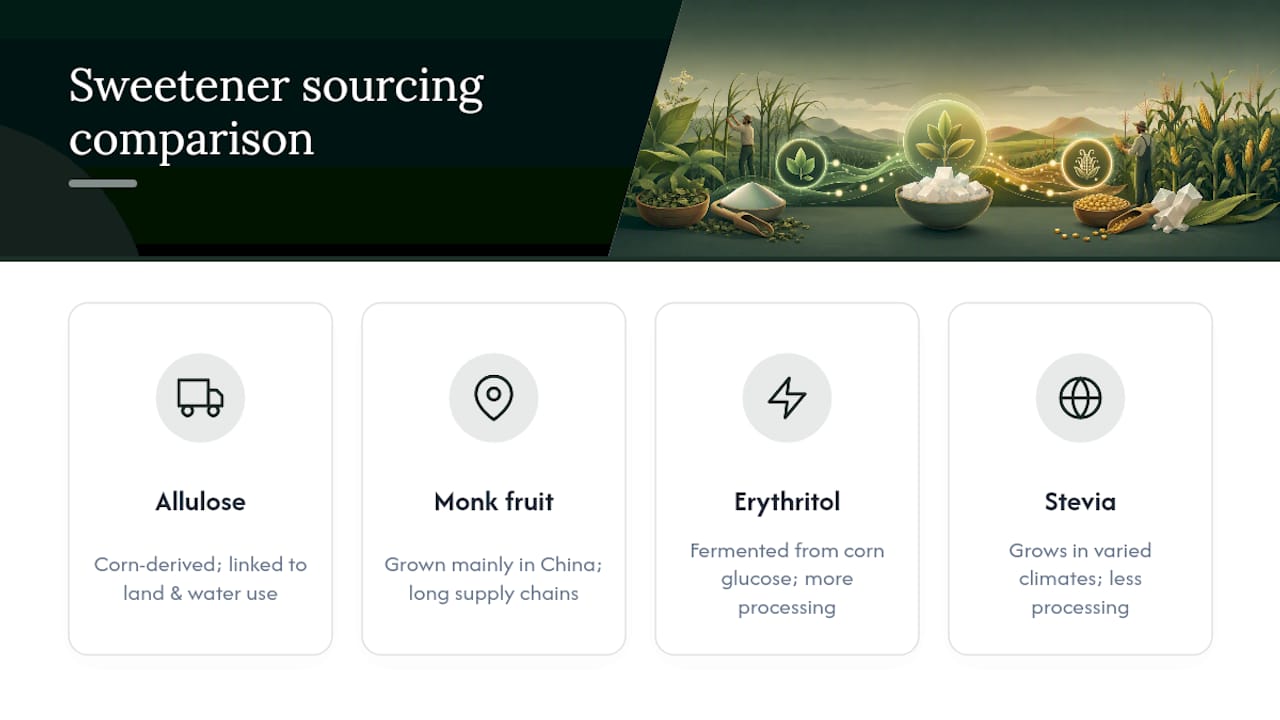
Sweetener sourcing carries its own footprint, and it’s worth a passing thought if you care about where your ingredients come from. Allulose is typically derived from corn, and its production scale ties it to the same land and water use questions as other corn-based products. Monk fruit is grown almost exclusively in a specific region of China, which means supply chains for it are longer and more concentrated than for domestically produced sweeteners, raising questions about transport emissions and grower fairness.
Erythritol production involves fermenting corn-derived glucose, a process that’s more resource-intensive than simply refining sugar cane, though it also avoids some of the land-use pressures tied to large-scale sugar cane farming. Stevia, by contrast, grows in a wider range of climates and requires less processing than erythritol, giving it a comparatively lighter footprint among the major sugar-free options.
None of these sweeteners are inherently “bad” from a sourcing standpoint, but they’re also not automatically greener just because they’re not sugar. If sourcing ethics matter to you, look for brands that disclose where their sweeteners come from rather than assuming “natural” or “sugar-free” implies sustainable.
What We’re Hearing From Sugar-Free Shoppers
Diabetic and keto customers ask the same two questions almost every time: what’s actually in this, and how much carb load am I taking on. That demand tracks with what industry reporting has documented, a steady, if smaller, customer base that reads labels harder than anyone else in the shop. We point people toward COAs and dosage charts before we point them toward a specific product, because the sweetener question only matters once the dose and lab results check out.
— Jake
Find Lab-Tested Sugar-Free Options at a Licensed Dispensary
Reading labels and calculating carbs is only half the work. The other half is knowing the product in front of you actually passed lab testing for potency and contaminants, which is where a lot of “sugar-free” claims online fall apart under scrutiny.

Saylessny keeps lab-tested edibles on the menu with COAs available for anyone who asks, so you’re never guessing whether a sugar-free label is backed by an actual test result. Our staff can point you toward gummies, chocolates, and tinctures that fit a keto or diabetic-friendly diet, and walk you through the edible dosage guide if you’re dialing in a microdose for the first time. If you’d rather browse tincture-style options outside the dispensary menu, THC-free CBD oil is another sugar-free route worth comparing. Check our same-day NYC delivery and pickup menu to see what’s in stock today, or start with our curated lab-tested edibles picks if you want a shortlist instead of scrolling the full menu yourself.
Sources
- Keto Cannabis Edibles: Low-Carb Recipes That Work — This Is Why I’m High
- Sugar-free cannabis: Edible makers seek sweet but healthy solutions — The Spokesman-Review
FAQ
Is there such a thing as sugar-free edibles?
Yes. Sugar-free edibles use alternative sweeteners like allulose, erythritol, monk fruit, or stevia in place of cane sugar or corn syrup, and formats range from gummies and chocolates to drinks, capsules, and tinctures.
What are the healthiest edibles?
The healthiest options tend to be low-sugar or sugar-free edibles that use allulose, monk fruit, or stevia, paired with clear lab testing and accurate dosing information. Format matters too. Capsules and tinctures skip added sweeteners entirely, which makes them a straightforward choice for anyone watching carbs closely.
Can diabetics have edibles?
Diabetics can consider sugar-free edibles made with low-glycemic sweeteners like allulose or monk fruit, since these produce little to no blood sugar spike compared to sugar-based versions. Anyone managing diabetes should still check total carbs on the label and talk with their doctor about how cannabis interacts with their specific medications.
Are edibles as bad for your liver as alcohol?
No, edibles and alcohol affect the liver through different pathways, and cannabis does not carry the same well-documented liver-damage risk that chronic heavy alcohol use does. That said, THC is still metabolized through the liver, so people with existing liver conditions or those on liver-processed medications should talk to a doctor before regular use.
Do sugar-free edibles taste as good as regular ones?
Sugar-free edibles can taste very close to the original, especially when made with allulose, which caramelizes and sets similarly to real sugar. Blending sweeteners like monk fruit and erythritol also helps balance out any bitterness or cooling aftertaste that either one produces alone.