
The most reliable way to smell proof weed is layering two barriers: an airtight, non-porous jar with a silicone gasket as your primary seal, wrapped inside an activated carbon-lined bag or case for transport. Neither layer alone does the job. Together, they block permeation and adsorb whatever escapes. One caveat worth stating up front: nothing sold at retail defeats a trained detection dog, so treat this as discretion for daily life, not a workaround for law enforcement.
TL;DR:
- A combination of a non-porous, airtight glass or stainless steel container with a silicone gasket and an activated carbon-lined bag provides the best smell-proof protection.
- Terpene emissions can fluctuate by up to 1500%, influenced by light, activity, and temperature, affecting odor containment and freshness.
- Proper maintenance, including regular cleaning of gaskets and replacing carbon liners after about a year, is essential for sustained effectiveness.
- No consumer container reliably defeats trained detection dogs; smell proofing mainly enhances discretion and freshness for everyday use.
- Effective storage habits, such as avoiding heat exposure and not stacking multiple containers, are critical to maintaining odor control during travel.
Table of Contents
- What’s the Best Way to Smell Proof Weed for Storage and Travel?
- Why Does Weed Smell So Strong in the First Place?
- How Do You Build a Smell-Proof Storage and Travel Kit?
- Does Smell Proofing Actually Work While Traveling?
- How Do You Test and Maintain a Smell-Proof Setup?
- What Should You Check Before Buying Smell-Proof Storage?
- What Actually Matters Once You Start Living With This System
- Where to Find Lab-Tested Flower Worth Storing Properly
- Sources
What’s the Best Way to Smell Proof Weed for Storage and Travel?
Ranking the methods by real-world containment and freshness comes down to material science more than marketing claims. Here’s how the common options stack up, from strongest to weakest.
- Airtight UV-blocking glass jar with a silicone gasket. Glass doesn’t absorb odor or let terpenes diffuse through its walls, and a compression gasket (not a screw-on lid alone) creates a true hermetic seal. This is the gold standard for home storage, and buyer testing consistently ranks it at the top for both smell containment and freshness preservation.
- Stainless steel vacuum canisters, like the C-Vault. These pull air out and lock it there, which slows oxidation as much as it blocks smell. C-Vault containers use a stainless body with a vacuum valve, making them a strong pick for bulk storage you’re not opening every hour.
- Activated carbon-lined bags and cases. Soft-sided pouches with a true carbon layer, rather than just a thick zipper, adsorb odor molecules instead of merely trapping them. Herb Guard builds its cases around this principle, pairing carbon lining with padded compartments for grinders and papers.
- Vacuum-sealed bags for bulk quantities. Great for larger amounts headed into long-term storage, but not practical for grabbing a nightly bowl. Once opened, you’re resealing from scratch.
- Locking smell-proof stash boxes. Rigid exteriors with foam-lined compartments, useful for organizing multiple items, though the box itself only works if what’s inside is already sealed.
- Mason jar in a dark cabinet. The cheapest option and honestly not bad for short-term home storage, but a screw lid without a gasket isn’t airtight, and it does nothing for transport.
A few specific products come up constantly in this space, each solving a slightly different problem:
- Tightvac containers use a push-button vacuum-seal lid, popular for people who want visual freshness without a bulky canister.
- OZCHIN Smell Proof Bag is a soft carbon-lined pouch aimed at budget travel use.
- INFINITKIN Smell Proof Box combines a lockable case with a carbon lining, splitting the difference between rigid protection and adsorption.
- SHBC Smoker Smell Proof Container bundles a jar-style container with an outer case for smokers who want grinder and lighter storage in one kit.
Marketplace listings show thousands of smell-proof container variations at every price point, but the details matter more than the label. When you’re shopping, check for three things specifically: whether the gasket is silicone (not a thin rubber ring), whether the carbon lining is named explicitly rather than implied by “smell-resistant” marketing, and whether zippers are double-stitched and covered by a fabric flap. Skip anything that just says “airtight” without describing the seal mechanism.
Why Does Weed Smell So Strong in the First Place?
Terpenes are the aromatic compounds doing almost all the work, and they don’t release at a steady rate. Depending on activity and light exposure, individual terpene concentrations can swing by as much as 1500%. That’s why a jar that seemed fine in a dark drawer can suddenly smell noticeable the moment it sits on a sunny windowsill.
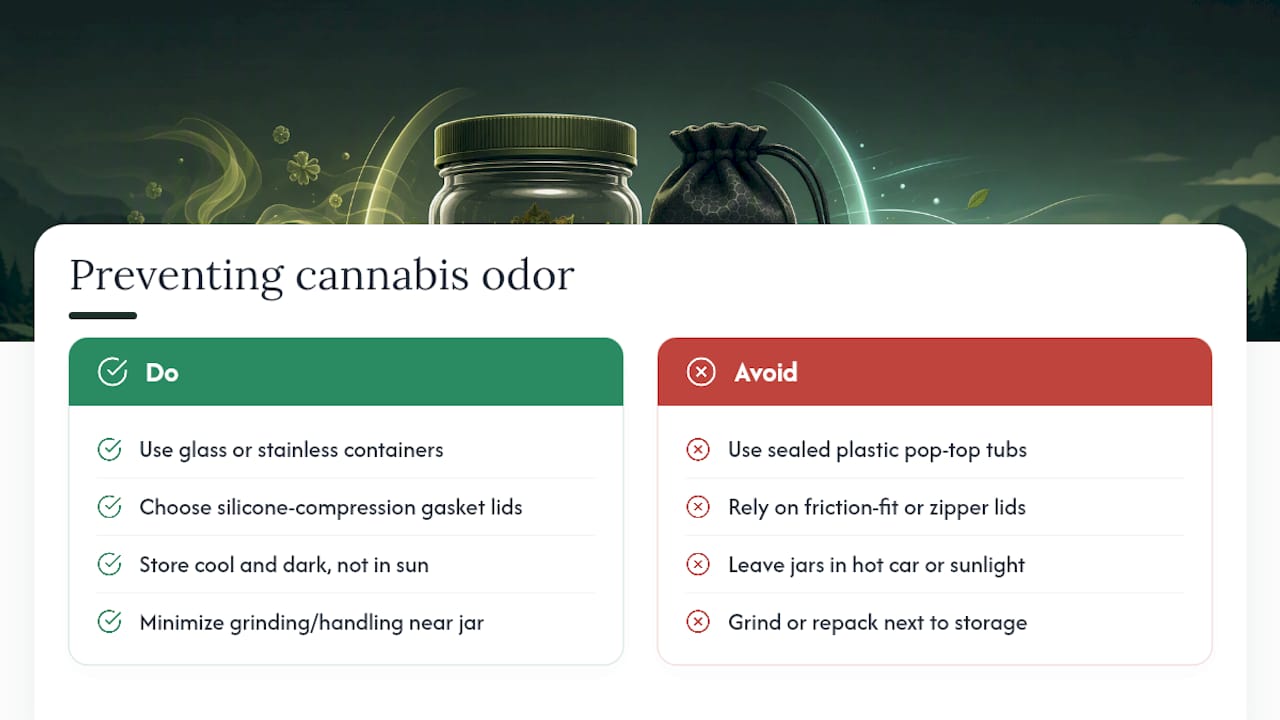
Material choice determines whether those terpenes stay put or slip through. Glass and stainless steel are non-porous, so molecules can’t migrate through the container wall itself. Plastic is a different story. Even “sealed” plastic tubs allow slow terpene diffusion through the polymer over time, which is why a lot of dispensary pop-top containers smell faint even when closed. If you care about long-term freshness as much as odor, understanding how terpenes behave under different storage conditions explains a lot about why some flower goes flat while other batches stay potent for months.
The seal matters as much as the material. A friction-fit lid or a standard zipper leaves microscopic gaps. Silicone compression gaskets, the kind found on canning jars and vacuum canisters, physically press against the glass or metal to close those gaps. That’s the mechanical difference between a container that’s “closed” and one that’s actually sealed.
Odor emission also isn’t constant. Research on cannabis odor troubleshooting found that specific handling moments, trimming, grinding, and repackaging, spike certain odorants far above baseline, meaning most odor escapes happen during active handling rather than while flower simply sits sealed. That’s a useful thing to know: your grinder and rolling tray are often bigger smell risks than your storage jar.
Heat compounds all of this. Warm air increases terpene off-gassing, and a seal that holds fine at room temperature can leak under enough internal pressure. Leaving a jar in a hot car doesn’t just smell worse, it can outright overwhelm a gasket that was never tested at those temperatures.
How Do You Build a Smell-Proof Storage and Travel Kit?
For home storage:
- Choose a UV-blocking or opaque glass jar with a silicone gasket lid, sized to how much flower you actually keep on hand.
- Add a small humidity pack (58 to 62 percent range) inside the jar to keep flower from drying out or growing mold.
- Store jars in a dark cabinet, away from windows, stove heat, or radiators.
- Line the shelf with a carbon pouch as a passive backup layer for the room itself.
For travel:
- Pack flower into a small silicone container or the same gasket-sealed jar you use at home.
- Slide that container into a carbon-lined pouch, like the kind Herb Guard or OZCHIN make.
- Put the whole thing inside a rigid outer case (an INFINITKIN-style locking box works well here) to prevent crushing and add a third barrier.
- Keep the case in the passenger cabin, not the trunk, and out of direct sun. Trunks run hotter and get more heat cycling than the cabin.
For concentrates and edibles, use silicone containers or sealed tins nested inside the same layered system rather than treating them as an afterthought. Wax and rosin especially benefit from non-stick silicone, since they’ll bond to plastic and are nearly impossible to fully clean out of a porous surface. If you’re carrying baked goods or gummies, a dedicated storage approach for edibles keeps them fresh without cross-contaminating flavors from your flower.
Maintenance takes two minutes and saves you from carrying a stinking bag without realizing it. Check jar threads monthly for kief buildup, wipe gaskets with a dry cloth (never soak silicone in solvent), and do a quick sniff test after sealing. If you can smell anything from six inches away with the container closed, something’s wrong with the seal, not the container’s rating.
Pro Tip: Keep a spare gasket on hand for your primary jar. Silicone degrades faster than glass, and a $3 replacement ring often fixes a “failed” container that seemed fine a year ago.
Does Smell Proofing Actually Work While Traveling?
Placement does more work than most people expect. A carbon-lined case sitting in a hot trunk works against you twice over, heat accelerates terpene release exactly when your barrier needs to be at its best. Keeping your kit in the passenger cabin, ideally under a seat or in a bag rather than an open cupholder, keeps temperatures lower and keeps the whole setup out of sight.
A few habits matter more than any product:
- Never leave loose flower or a grinder sitting in a cup holder or unzipped bag pocket, even briefly.
- Use a case with a non-descript exterior. A container that visibly says “smell proof” defeats the point of discretion.
- Empty and wipe your grinder before a trip. Residue in the threads is a surprisingly strong odor source that has nothing to do with your container.
- Don’t stack multiple loosely-sealed containers together, hoping the smell “cancels out.” It doesn’t.
Here’s the part that matters most: no consumer-grade container reliably defeats a trained detection dog. Canine detection operates on a different threshold than the human nose, and marketing claims that promise otherwise are overstating what carbon and glass can physically do. Smell proofing is about everyday discretion and keeping flower fresh, not about beating professional-grade detection. Rules around possession and transport also vary by state and even by city, so check your local regulations rather than assuming a sealed container changes your legal standing.
How Do You Test and Maintain a Smell-Proof Setup?
A simple nose test tells you fast whether your system is actually working. Seal your container the normal way, hold it about six inches from your face, and take a slow breath in through your nose. Repeat at your pocket, your bag’s exterior, and inside a closed car. Any detectable smell at that range means the seal, not the concept, has failed.
Cleaning keeps performance consistent over months of use:
- Wipe jar rims and threads with a dry or lightly damp cloth. Skip abrasive scrubbers, which scratch glass and create micro-grooves where residue collects.
- Spot-clean carbon bag interiors with a barely damp cloth and let them air out fully before repacking.
- Never use alcohol or harsh solvents on silicone gaskets. It breaks down the material faster and can void a compression seal within months.
Activated carbon has a finite lifespan. It adsorbs odor molecules into microscopic pores until those pores fill up, at which point the liner stops working even though it still looks fine. Some carbon products can be recharged by airing them out in direct sunlight for a few hours, but a liner that’s been in daily use for over a year is usually due for replacement, not a recharge.
Pro Tip: Write the purchase date on your carbon bag’s tag with a marker. It’s the easiest way to track when a liner is actually due for replacement instead of guessing.
What Should You Check Before Buying Smell-Proof Storage?
A quick mental checklist saves you from buying something that photographs well but performs poorly.
Look for:
- A non-porous body: glass or stainless steel, not thin plastic.
- A named silicone compression gasket, not just “airtight lid” in the description.
- Explicit mention of activated carbon lining, ideally with a note on thickness or replacement.
- Covered, double-stitched zippers rather than a single exposed track.
Red flags to skip:
- Vague phrasing like “smell-resistant” or “odor-blocking technology” with no material specifics.
- Thin, flexible plastic marketed as a jar substitute.
- No mention of gasket material anywhere in the listing.
- Carbon lining claims with no detail on thickness, weight, or replacement guidance.
Budget guidance is simple: spend where the seal and the carbon actually are. A $15 mason jar with a $3 gasket upgrade beats a $40 container with a vague “airtight” claim and no gasket described at all. The triad of material, seal, and carbon is what separates a container that works from one that just looks the part in a product photo.
What Actually Matters Once You Start Living With This System
Most guides treat smell proofing like a shopping problem: buy the right jar, buy the right bag, done. That’s backwards. The container matters less than the habits around it, and I’d argue the habits are where almost everyone quietly fails.
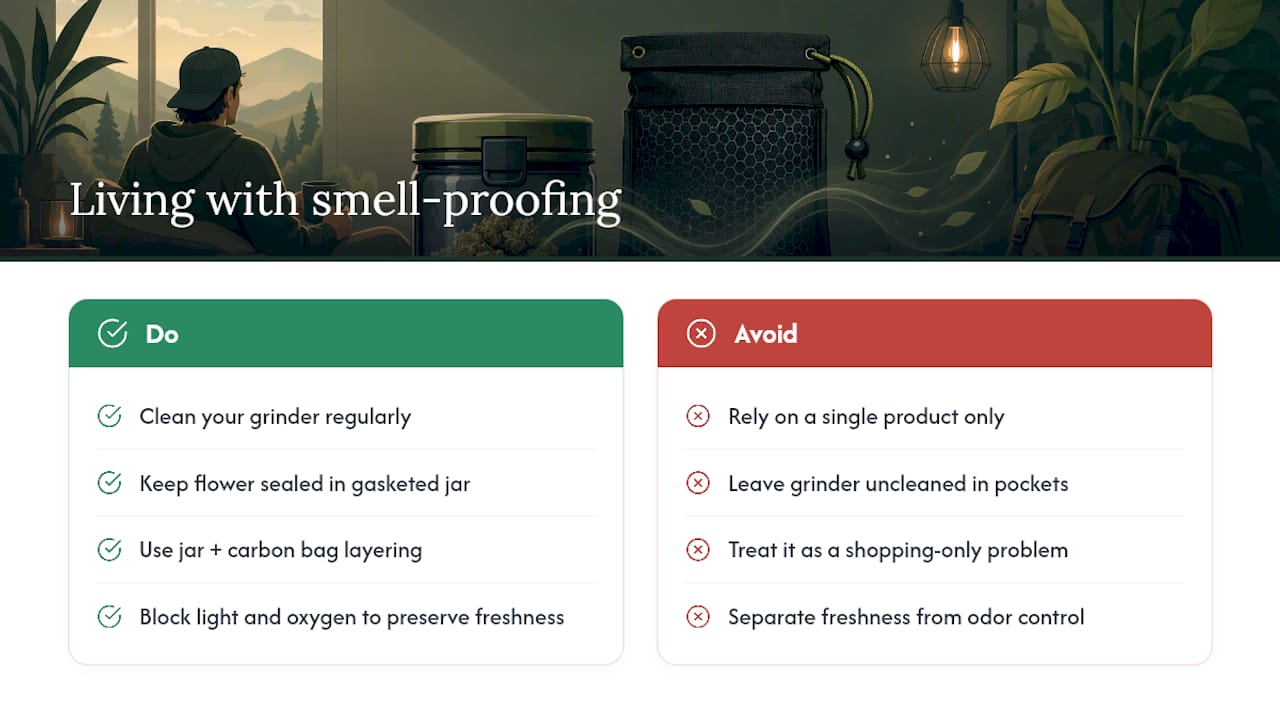
Here’s what gets missed constantly: people buy a $60 carbon-lined case and then leave their grinder sitting uncleaned in a backpack pocket for three weeks. The case was never the problem. The residue caked into grinder threads and rolling papers is often a stronger, more persistent odor source than flower sitting properly sealed in a jar.
The other thing worth saying plainly: freshness and odor control are the same fight, not two separate ones. A gasket that keeps smell in is also keeping oxygen and light out, which is exactly what preserves terpenes and potency over time. The flower selection available from the dispensary emphasizes sourcing lab-tested product and advising customers on storage that protects both discretion and quality. In small NYC apartments, where a hallway smell can become a roommate conversation fast, the layered jar-plus-carbon-bag approach is consistently what customers report actually solving the problem, not a single clever product.
— Jake
Where to Find Lab-Tested Flower Worth Storing Properly
Good storage only pays off if what’s inside the jar is worth preserving. The dispensary offers lab-tested flower, pre-rolls, vapes, and edibles from curated brands, avoiding the need to store product of uncertain quality or origin.

If you’re new to judging flower quality, Say Less breaks down exactly what separates top-shelf flower from the rest, covering the trichome density and terpene content that determine whether a jar’s worth of flower is even worth the effort you’re putting into storing it. Options for delivery and in-store pickup in the area let customers obtain properly cured, lab-tested cannabis products and have their storage system ready before it ever needs a second thought. Browse the current menu at Say Less NYC and order for pickup or delivery today.
Sources
- Following the smell: terpene emission profiles through the cannabis life-cycle
- “Skunky” Cannabis: Environmental Odor Troubleshooting and the “Need-for-Speed” — ACS Omega
- Smell Proof Container Guide: Keep Your Stash Fresh & Discreet – Cubbi
- Smell Proof Containers — Amazon