
Most edible highs last about 6 to 8 hours, with peak intensity hitting somewhere between the 2 and 4 hour mark. That’s the range most healthy adults with average tolerance can expect from a standard 5 to 10 mg dose. But the window swings wider than that in practice. Onset alone can take between 30 minutes and 2 hours, and blood THC from an edible typically peaks around the 3 hour mark, long after inhaled cannabis would have already peaked and started fading.
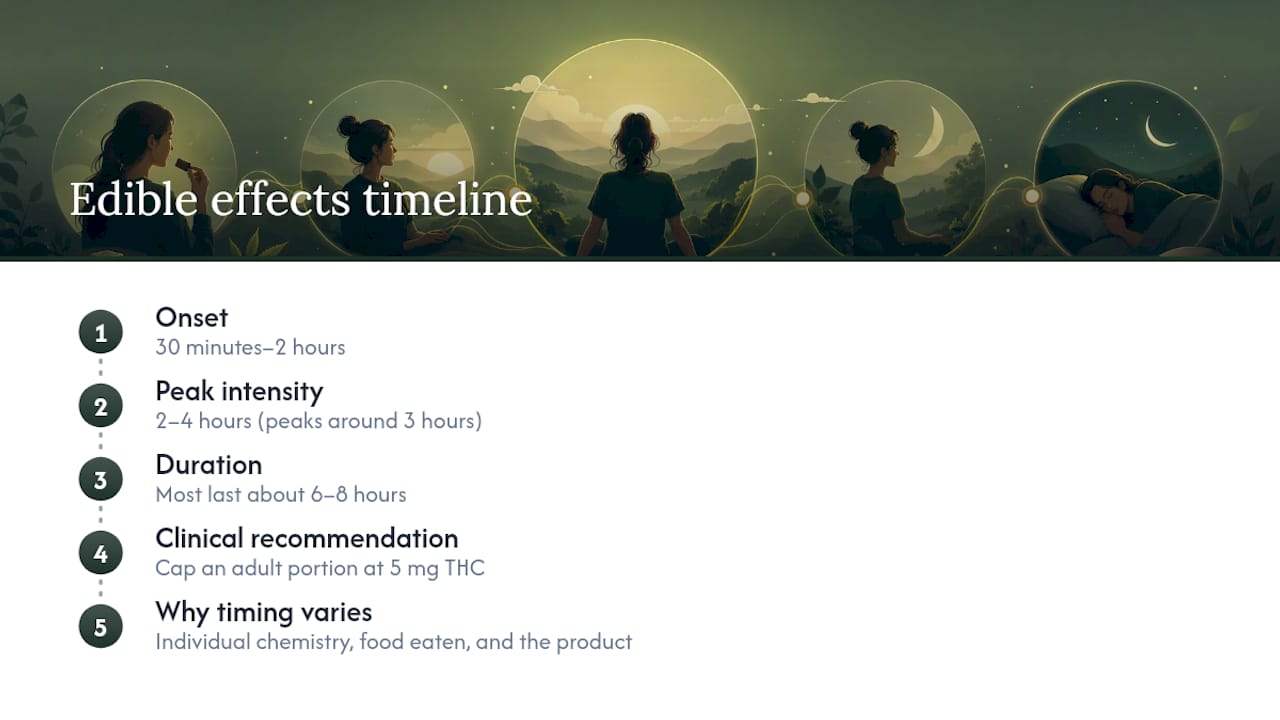
Clinical panels recommend capping an adult portion at 5 mg THC precisely because that delay catches people off guard. You eat a gummy, feel nothing after 45 minutes, eat another, and then get hit with both doses at once, right around hour two or three. Individual body chemistry, what you ate that day, and the product itself all shift these numbers. The rest of this guide breaks down why, and what to do if you’ve taken more than you meant to.
Key Takeaways
An edible high typically lasts 6 to 8 hours with peak effects between 2 and 4 hours, but onset delay and product variability make dosing patience the single biggest safety factor.
| Point | Details |
|---|---|
| Average duration | Most edible highs run 6 to 8 hours, with peak intensity between 2 and 4 hours after ingestion. |
| Onset takes time | Effects typically start 30 minutes to 2 hours after eating, so early impatience is the top cause of overconsumption. |
| Dose size matters | A 5 mg portion is the clinically recommended standard adult serving; 10 mg is a common moderate dose. |
| Watch for emergency signs | Severe vomiting, breathing trouble, chest pain, or unresponsiveness require calling Poison Control or 911 immediately. |
| Choose lab-tested products | Saylessny’s curated edibles, including brands like CRU Cannabis, come with lab reports so dosing stays predictable. |
Table of Contents
- How Long Does It Take Edibles to Kick In and Why?
- How Long Until You Feel an Edible, and When Does It Peak?
- How Long Do Edibles Last on Average?
- What Factors Change How Long an Edible Lasts?
- How Much THC Is in a Typical Edible?
- Edibles vs. Smoking: How Do the Effects Compare?
- What Are the Real Risks and Warning Signs With Edibles?
- What Should You Do if an Edible Hits Too Hard?
- How Long Does THC From Edibles Stay Detectable on a Drug Test?
- Why Lab-Tested Edibles Matter for Predictable Effects
- Frequently Asked Questions
- Sources
How Long Does It Take Edibles to Kick In and Why?
Smoking or vaping sends THC straight into your bloodstream through your lungs. You feel it in minutes, it peaks fast, and it’s gone in a couple of hours. Edibles work through an entirely different route, and that difference explains almost everything about why edibles last so much longer.

When you swallow a gummy or a piece of chocolate, THC has to survive your stomach and get processed by your liver before it reaches your bloodstream at all. That’s called first-pass metabolism, and it’s not a minor technicality. Your liver converts THC into a metabolite called 11-hydroxy-THC, which crosses the blood-brain barrier more efficiently than regular THC and can produce a stronger, longer-lasting subjective effect than the same dose smoked.
That’s the mechanism behind three practical differences:
- Onset takes 30 minutes to 2 hours instead of minutes.
- The active compound driving the high (11-OH-THC) sticks around longer than inhaled THC.
- Duration stretches to 6 to 8 hours or more, compared to 2 to 4 hours for smoking.
Peak blood THC from edibles lands around 3 hours after ingestion in most cases, though controlled testing on individual commercial products has found time-to-peak ranging from 35 to 90 minutes for early plasma concentration, depending on the specific product’s formulation.
How Long Until You Feel an Edible, and When Does It Peak?
- 0 to 30 minutes: Usually nothing, though some sensitive users or fast-absorbing products (tinctures, drinks) may notice early effects.
- 30 minutes to 2 hours: Onset for most people. This is the window where impatience causes trouble.
- 2 to 4 hours: Peak effects. Cognitive and physical intensity are at their highest here.
- 4 to 8 hours: Gradual decline. Most of the acute high fades during this stretch.
- 8 to 12+ hours: Residual grogginess or mild effects can linger, especially with higher doses.
Pro Tip: Wait a full 2 hours, minimum, before deciding you need more. If you still feel nothing at that point, it’s reasonable to take a small additional amount, but never double a dose inside that first hour just because you’re impatient.
Format matters here too. Sublingual tinctures and THC beverages tend to absorb faster than chewables or baked goods, since some of the compound gets picked up through the mucous membranes under your tongue before it even reaches your stomach. A baked good with a fatty ingredient list, on the other hand, often digests more slowly and can delay onset even further.
How Long Do Edibles Last on Average?
For most adults with a moderate tolerance, an edible high runs 6 to 8 hours from first onset to feeling essentially back to normal, with the most intense 2 hours sitting in that 2 to 4 hour peak window. That’s the number worth anchoring to if you’re planning your evening around a dose.
Lower-tolerance users, people who are new to cannabis, or anyone particularly sensitive to THC often report the experience running longer. Effects can persist 8 to 12 hours, and some people describe mild residual fog, drowsiness, or a “hangover” feeling that lingers up to 24 hours later. One government fact sheet on edible safety notes that full effects can peak within about 4 hours and linger with residual effects into the next day, particularly at higher doses.
The gap between when THC blood levels peak and when someone feels fully “back to normal” is not the same thing. Subjective effects and impairment can outlast the number the lab test would show, especially after an oral dose.
Extreme-duration cases exist too, and they’re worth naming plainly:
- Very high doses (50 mg or more) can produce effects lasting well past 12 hours, sometimes into a second day.
- Mixing with alcohol or sedatives intensifies and extends the experience unpredictably.
- Pediatric ingestion is its own category entirely, often requiring emergency evaluation regardless of how “mild” the product seemed.
If you eat an edible and the effects are still noticeably strong after 12 hours, that’s outside typical range, and worth paying attention to rather than just riding out.
What Factors Change How Long an Edible Lasts?
No two people process the same gummy identically. Several variables stack together to determine both onset speed and total duration:
- Dose (mg THC): The most obvious lever. Higher milligram counts mean longer, more intense effects, plain and simple.
- Tolerance and frequency of use: Regular users often report shorter, more predictable experiences than someone trying cannabis for the first time in months.
- Body composition and metabolism: THC is fat-soluble, and metabolic rate affects how quickly your liver processes it into active metabolites.
- Sex: Some pharmacokinetic research suggests hormonal differences can influence absorption speed, though this varies by individual.
- Stomach contents: Eating an edible on a full stomach, especially one with fat, tends to increase bioavailability and can delay onset while intensifying the eventual peak.
- Product formulation: A gummy, a chocolate, and a beverage with the identical labeled dose can behave differently because of how each matrix breaks down in digestion.
Pro Tip: Stick to lab-tested products with consistent, verified dosing, and never take a second dose within 24 hours of the first unless you fully understand how the initial dose affected you.
Mixing edibles with alcohol or other sedatives deserves its own warning. Co-use doesn’t just add effects together, it tends to amplify impairment and duration in ways that are hard to predict, and it raises the risk of nausea, dizziness, and poor judgment about how much more to consume.
How Much THC Is in a Typical Edible?
Serving sizes vary by state and brand, but a few benchmarks show up consistently across dispensary menus and clinical guidance:
- Microdose (2.5 mg or less): Barely perceptible for most users, useful for building tolerance or daytime use.
- Low dose (5 mg): The standard portion recommended by clinical toxicology panels and the figure NIDA-affiliated researchers have pushed to formalize as a research standard unit.
- Common recreational dose (10 mg): A noticeable, moderate high for most adults with some tolerance.
- Strong dose (20 to 30 mg or more): Can produce intense, sometimes overwhelming effects, particularly for infrequent users.
Reading the label matters as much as picking the dose. Look for:
- A clear milligram count per serving, not just per package.
- A batch number tied to a third-party lab certificate of analysis.
- Total package THC content, so you know how many servings you’re actually holding.
If a product doesn’t list dosing clearly or lacks any lab documentation, treat that as a reason to skip it, not a minor inconvenience.
Edibles vs. Smoking: How Do the Effects Compare?
- Onset: Minutes for smoking or vaping versus 30 minutes to 2 hours for edibles.
- Duration: 2 to 4 hours for inhaled cannabis versus 6 to 8 hours (or more) for edibles.
- Peak intensity: Edibles can feel stronger per milligram because of 11-OH-THC formation in the liver, something inhaled cannabis largely bypasses.
- Dosing predictability: Inhaled effects are easier to titrate hit by hit; edibles require patience since you can’t “back off” once swallowed.
Because impairment lasts so much longer after an edible, waiting to drive or operate machinery needs to stretch well beyond how you’d judge recovery from smoking.
What Are the Real Risks and Warning Signs With Edibles?
The delayed onset that makes edibles distinctive is also the mechanism behind most edible-related emergency room visits. Someone eats a dose, feels nothing, eats more, and ends up with far more THC in their system than intended by the time everything kicks in together.
Pediatric ingestion is a separate and serious category. Edibles that resemble candy or baked goods are a documented leading cause of severe cannabis toxicity in young children, and accidental exposures often involve products left in reach without child-resistant packaging.
Watch for these signs that require immediate medical attention, in yourself or someone else:
- Severe, repeated vomiting.
- Difficulty breathing or extreme drowsiness that’s hard to rouse from.
- Chest pain or a racing, irregular heartbeat.
- Confusion, paranoia, or psychotic symptoms that don’t resolve.
- Any symptom in a child or pet after suspected ingestion, regardless of severity.
If a child has potentially eaten a cannabis edible, call Poison Control or emergency services immediately rather than waiting to see if symptoms develop. Delayed onset means early calm is not reassuring.
Store edibles the way you’d store any medication you don’t want a child or pet finding: in original, labeled, child-resistant packaging, out of reach, and never in a container that looks like regular food or candy.
What Should You Do if an Edible Hits Too Hard?
- Stay put and stay calm. Anxiety amplifies the subjective intensity of a THC high; panicking makes it feel worse than it is.
- Move somewhere comfortable and familiar. A quiet, low-stimulation space helps more than anything else.
- Hydrate with water, and avoid caffeine or more cannabis.
- Focus on slow breathing or a simple distraction like music or a show you already know well.
- Avoid alcohol or other drugs, and only take CBD or any prescribed medication if a clinician has specifically advised it for this situation.
- Call Poison Control or 911 if you notice chest pain, breathing trouble, unresponsiveness, or symptoms in a child or pet.
Symptoms typically start easing within a few hours as blood levels come down from peak, though full recovery to baseline can take the better part of a day. Uncomfortable does not usually mean dangerous, but trust the emergency signs above over guesswork.
How Long Does THC From Edibles Stay Detectable on a Drug Test?
- Urine: Days to several weeks, depending on frequency of use and body fat.
- Blood: Parent THC often clears within a day, but metabolites can linger longer, and blood levels correlate poorly with how intoxicated someone actually feels after an oral dose.
- Saliva: Typically a shorter window than blood, often within 24 to 72 hours.
- Hair: Can detect use going back roughly 90 days, though this reflects long-term patterns, not a single edible.
A positive test days later says nothing about whether someone is currently impaired. That disconnect is exactly why pharmacokinetic researchers caution against using blood THC alone as an intoxication marker for oral cannabis.
Why Lab-Tested Edibles Matter for Predictable Effects
Inconsistent labeling and marketing that makes edibles look like ordinary candy are known contributors to both accidental overconsumption and pediatric exposure, according to federally funded research into edible packaging and risk perception. The fix isn’t complicated. It’s choosing products that show their work.
When you’re shopping, look for:
- A certificate of analysis from a third-party lab, not just a brand’s own claims.
- Consistent portion sizes, ideally aligned with the 5 mg guidance clinical panels recommend.
- Child-resistant, opaque packaging that doesn’t resemble regular snacks.
- Clear total THC per package alongside per-serving dosing, so nothing gets miscounted.
Saylessny’s hybrid THC gummies and curated edible selection are built around exactly this kind of transparency, giving you a dose you can actually trust before you eat it.
A Practical Note on Trusting What You Buy
Years spent watching how people actually use cannabis, not just how the label says they should, teaches you one thing fast: unpredictability is the enemy, not potency. The products that cause problems are rarely the strong ones. They’re the ones nobody can accurately dose.
Start low, go slow, and if you’re not sure what you’re holding, ask someone who can show you the lab results before you eat it.
Skip the Guesswork With Lab-Tested Edibles From Saylessny
Reading pharmacokinetic charts only gets you so far when the gummy in front of you doesn’t list a real dose. Saylessny keeps a curated menu of edibles from brands like CRU Cannabis with lab reports available for every batch, so the 5 mg or 10 mg on the package is the number actually in the product.

Same-day delivery and in-store pickup across The Bronx and NYC mean you don’t have to settle for a mystery edible from somewhere with no testing history. Browse the current selection of tested gummies, chocolates, and drinks, check the lab certificates for yourself, and place an order for pickup or delivery today.
Frequently Asked Questions
How long do edibles last on average?
Most edible highs last 6 to 8 hours from onset to baseline, with the strongest effects concentrated in the 2 to 4 hour peak window after ingestion.
How long do edibles take to kick in?
Onset typically starts 30 minutes to 2 hours after eating, though sublingual products and beverages can act faster than baked goods or gummies.
Why do edibles last longer than smoking?
Oral THC passes through your liver first, converting into 11-OH-THC, a metabolite that crosses into the brain efficiently and extends both intensity and duration compared to inhaled cannabis.
How long does edible potency stay consistent on the shelf?
Unopened, properly stored edibles generally retain potency for the manufacturer’s stated shelf life, often several months to a year, though heat and light exposure can degrade THC over time.
What should I do if an edible feels too strong?
Stay in a calm, comfortable space, hydrate, avoid mixing with alcohol or other drugs, and call Poison Control or 911 if you notice chest pain, breathing difficulty, or unresponsiveness.
This article is general information, not a substitute for advice from a qualified doctor. Consult a qualified healthcare professional about your own circumstances before acting on anything here.
Sources
- Cannabis and poisoning | CDC
- Pharmacokinetic and pharmacodynamic considerations for cannabinoids (PMC5260817)
- Pharmacokinetic investigation of commercial edible marijuana products in humans (PMC8398280)
- ACMT position statement revision: Preventing cannabis exposures in children