
A structured tolerance break can lower THC tolerance for many regular users, and 21 days is the standard recommended duration backed by university health programs and clinical research. If you’re consuming cannabis daily or near-daily and notice you need significantly more to feel the same effect, a T-break is likely worth doing. The biology is straightforward: your CB1 receptors have downregulated from repeated THC exposure, and abstinence gives them time to recover.
Who benefits most: daily or near-daily users whose tolerance has climbed noticeably over weeks or months.
Who should consider medical support first: anyone with heavy physical dependence, a history of severe anxiety or depression, or psychiatric comorbidities that cannabis has been managing.
Shorter alternatives if 21 days feels impossible:
- A short break of a couple of days offers a temporary sensitivity bump, not a full reset.
- A taper (reducing dose by roughly 25% every 3–4 days) works better than cold turkey for people with significant dependence.
Your immediate 3-step micro-plan:
- Set a start date within the next 7 days and tell one person.
- Remove or store your cannabis and paraphernalia out of easy reach.
- Write down three activities you’ll do instead during your usual use times.
Key Takeaways
A 21-day structured T-break, built around physical, emotional, and behavioral weekly phases, is the most evidence-backed method to lower THC tolerance and reset cannabis sensitivity for regular users.
| Point | Details |
|---|---|
| 21-day standard | Three weekly phases (physical, emotional, behavioral) backed by university health programs and clinical research. |
| Peak withdrawal timing | Symptoms typically peak around days 2–6 and decline over roughly two weeks; sleep issues may persist longer. |
| Structured guides work | Guide users completed a 21-day break at 84% vs. 57% for non-users in one study. |
| CB1 receptor recovery | Receptors begin recovering within days but show substantial normalization at around 4 weeks. |
| Restart rule | Begin at roughly half your pre-break dose and wait the full effect window before consuming more. |
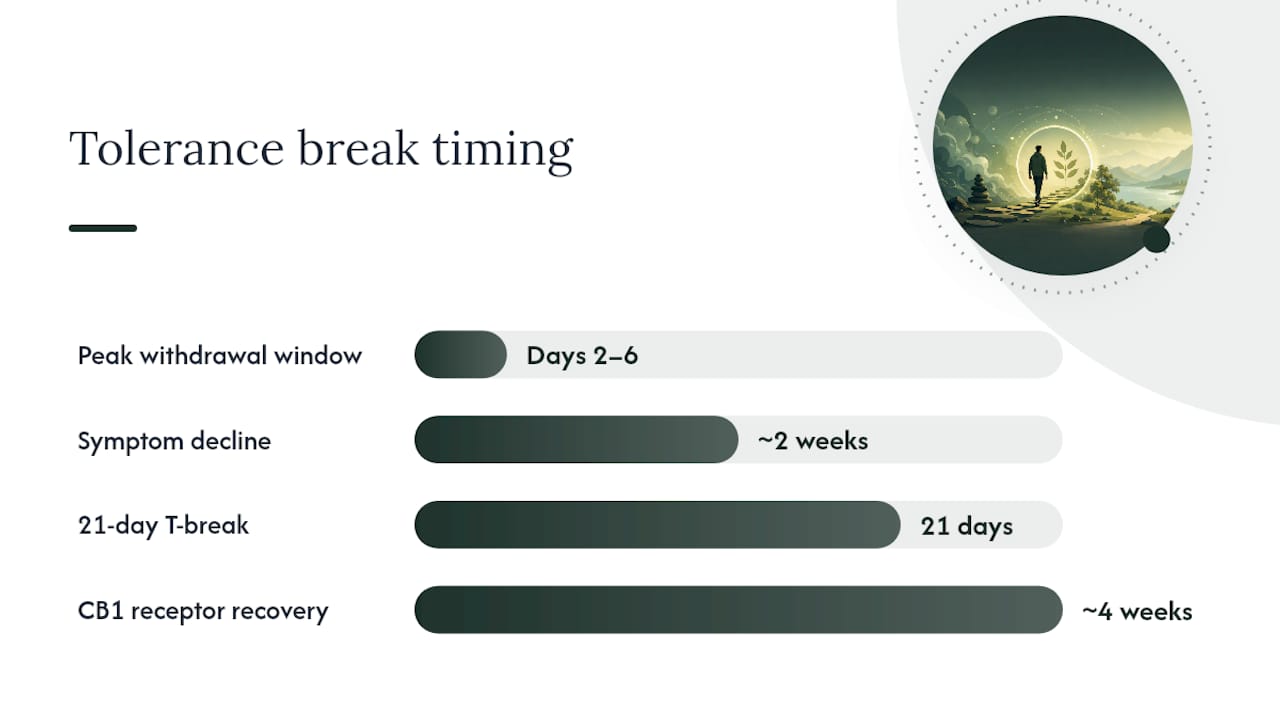
Table of Contents
- Your 21-Day T-Break Plan at a Glance
- What to Expect Each Week: A Detailed Walkthrough
- Why Tolerance Builds and What the Science Says About Recovery
- Practical Tips That Actually Improve Your Completion Rate
- How to Restart Cannabis Use Without Rebuilding Tolerance Fast
- A Note From Saylessny
- Sources
Your 21-Day T-Break Plan at a Glance
The 21-day T-break workbook format used by university health centers divides the break into three weekly phases: physical (Week 1), emotional (Week 2), and behavioral (Week 3). Here’s how that translates into a daily checklist you can actually use.
Week 1: Physical focus (days 1–7)
- Sleep 7–9 hours; set a consistent bedtime and wake time.
- Drink at least 64 oz of water daily.
- Do 20–30 minutes of light movement (walk, stretch, bike).
- Log your urges: time, trigger, intensity on a 1–10 scale.
- Check in with your accountability person or app.
Week 2: Emotional focus (days 8–14)
- Add a 10-minute mindfulness or breathing session each morning.
- Schedule at least two social activities that don’t involve cannabis.
- Journal for 5 minutes each evening: what went well, what was hard.
- Identify two hobbies or creative outlets and spend time on one daily.
- Continue sleep hygiene and hydration from Week 1.
Week 3: Behavioral focus (days 15–21)
- Map your three highest-risk triggers and write a specific response plan for each.
- Redesign at least one daily ritual that was previously tied to cannabis use.
- Decide your restart plan: controlled reduction, continued abstinence, or scheduled mini-breaks.
- Celebrate completing each week — a concrete reward, not just a mental note.
- Review your urge log and note the trend.
Shorter alternatives
A 7-day break reduces acute withdrawal and gives receptors a partial reset. A 14-day break covers the window when most withdrawal symptoms resolve. Neither matches the full behavioral rewiring of 21 days, but both beat doing nothing.
Tracking tools: a simple paper calendar, a habit-tracking app like Streaks or Habitica, or the University of Maryland’s interactive T-break workbook all work. The key is daily logging, not the platform.
When to pause and get help: if you experience severe anxiety, chest pain, sustained inability to sleep for more than 3 nights, or thoughts of self-harm, stop the self-directed plan and contact a clinician.
What to Expect Each Week: A Detailed Walkthrough
Week 1: The physical grind (days 1–7)
The first week is the hardest, and knowing that in advance helps. Withdrawal symptoms typically peak around days 2–6 and commonly include irritability, decreased appetite, restlessness, and disrupted sleep. Sleep is often the most disruptive symptom because THC suppresses REM sleep, and when you stop, REM rebounds hard.
Concrete actions for Week 1:
- Go to bed and wake at the same time every day, even on weekends.
- Avoid screens for 30 minutes before bed; try reading or light stretching instead.
- Short naps (20 minutes max) are fine if fatigue is severe, but avoid napping after 3 PM.
- Light exercise — even a 20-minute walk — reduces irritability measurably.
- CBD-only products may ease physical discomfort without reintroducing THC; check Saylessny’s menu for sleep-supportive cannabinoid options if needed.
Pro Tip: Plan your first 10 days more carefully than the rest. Research on cannabis withdrawal consistently shows this is the highest-risk window for relapse. Pre-schedule activities for your three most common use times — after work, before bed, and weekend afternoons — before Day 1 starts.
Week 2: The emotional layer (days 8–14)
Physical symptoms ease for most people by Day 8, but emotional difficulty often peaks here. Anxiety, low mood, and a general flatness are common. This is Cannabis Withdrawal Syndrome (CWS), a recognized clinical entity in the DSM-5, not a personal weakness.
Strategies that work:
- Mindfulness apps (Headspace, Insight Timer) give structure to the 10-minute daily practice.
- Journaling prompts: “What am I actually feeling right now?” and “What would I normally use cannabis to avoid?” are more useful than open-ended diary entries.
- Structured social time matters. Isolation amplifies emotional withdrawal; even a 30-minute call with a friend shifts the pattern.
- Identify the emotional triggers that drove use (stress, boredom, social anxiety) and write one specific coping response for each.
Week 3: Rewiring behavior (days 15–21)
By Week 3, acute symptoms have largely resolved for most users. The work now is behavioral: breaking the automatic associations between situations and cannabis use. This is where the University of Maryland’s daily-prompt workbook earns its value — structured prompts replace passive willpower with active micro-decisions.
| Day range | Primary focus | Key action |
|---|---|---|
| Days 1–7 | Physical symptoms | Sleep hygiene, light exercise, urge logging |
| Days 8–14 | Emotional regulation | Mindfulness, journaling, social scheduling |
| Days 15–21 | Behavioral rewiring | Trigger mapping, ritual redesign, restart planning |
Common Week 3 substitutions for cannabis use moments:
- After-work decompression: a 15-minute walk, a cold shower, or a non-cannabis herbal tea ritual.
- Social settings: sparkling water with lime, or simply being honest with close friends about the break.
- Creative time: music, drawing, cooking — activities that engage the same reward circuitry.
Why Tolerance Builds and What the Science Says About Recovery
CB1 receptors and why they matter
THC binds primarily to CB1 receptors in the brain. With repeated exposure, those receptors desensitize and downregulate — they become less responsive and fewer in number at the cell surface. A protein called GASP1 plays a role in this trafficking process, pulling receptors away from where they can be activated. The result is tolerance: the same dose produces less effect. CB1 receptor function begins recovering within days of abstinence and shows substantial normalization across roughly 3–4 weeks, which is the neurobiological basis for the 21-day recommendation.
Key finding: CB1 receptor recovery is not instantaneous. Early days of abstinence begin the process, but meaningful restoration toward baseline takes multiple weeks — which is why a 48-hour break feels different from a 21-day one.
Clinical withdrawal timeline
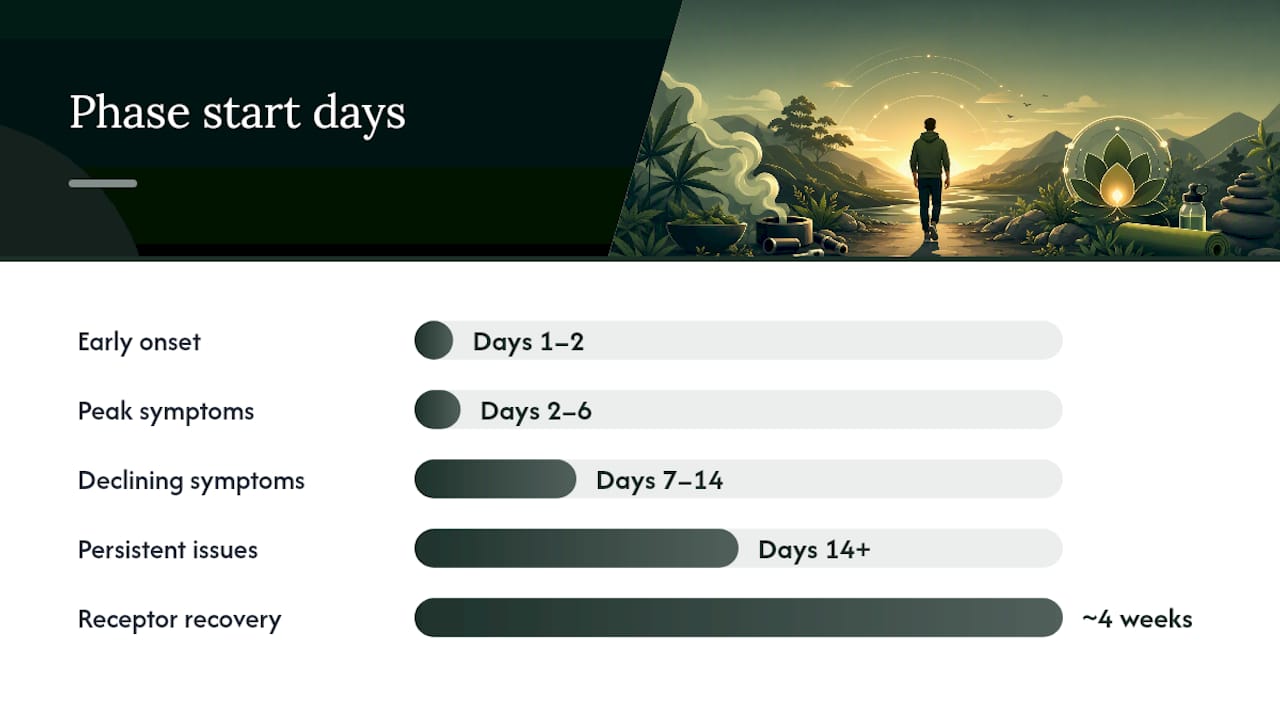
| Phase | Timing | Common symptoms |
|---|---|---|
| Early onset | Days 1–2 | Irritability, anxiety, decreased appetite |
| Peak symptoms | Days 2–6 | Insomnia, mood swings, restlessness, nausea |
| Declining symptoms | Days 7–14 | Gradual improvement in mood and appetite |
| Persistent issues | Days 14+ | Sleep disturbances may continue beyond 2 weeks |
| Receptor recovery | ~4 weeks | CB1 function normalizing toward baseline |
Cannabis Withdrawal Syndrome is recognized in the DSM-5, which means it has operationalized diagnostic criteria. Acknowledging this matters practically: withdrawal symptoms are a physiological driver of relapse, not a sign of weak willpower. Planning around them rather than against them is the more effective approach.
When to seek medical help: severe anxiety that doesn’t improve after Day 7, sustained suicidal ideation, inability to function at work or in relationships, or a history of seizures. Small clinical trials have tested gabapentin and THC-analog substitution (dronabinol, nabiximols) for severe Cannabis Withdrawal Syndrome symptom relief, though these remain options for severe cases under medical supervision rather than standard outpatient prescriptions.
This article is general information, not medical advice. If you have concerns about dependence or withdrawal severity, consult a qualified healthcare provider.
Practical Tips That Actually Improve Your Completion Rate
Preparation is where most T-breaks are won or lost. A structured guide correlates with significantly higher 21-day completion rates in young adults — in one study, participants who used the guide heavily completed the break at 84% versus 57% for non-users. The difference is active micro-planning versus passive intention.
Before you start
- Write a specific goal: “lower tolerance so a half-gram session feels like a full gram did six months ago” beats “take a break.”
- Remove cannabis and paraphernalia from your immediate environment or give them to a trusted person.
- List five replacement activities for your three highest-use times.
- Tell one person — a friend, therapist, or online community — and ask them to check in on Day 7 and Day 14.
During the break
- Use urge-surfing: when a craving hits, set a 10–20 minute timer and do something else. Most urges peak and pass within that window.
- Keep a simple log: date, time, trigger, intensity (1–10), and what you did instead. Patterns become obvious within a week.
- Prioritize protein and complex carbs during Week 1 — appetite disruption is real, and blood sugar swings amplify irritability.
- Avoid alcohol as a substitute. It doesn’t reset tolerance and often leads back to cannabis use.
After completing the break
- Reflect before restarting: did the break change how you feel about frequency or dose? Write it down.
- Celebrate the milestone concretely — a meal out, a purchase you’d been putting off, something tangible.
- Plan your restart before Day 21, not after. Ambiguity at the finish line is a relapse risk.
Pro Tip: If you slip during the break, don’t treat it as a failure that ends the attempt. Research on behavior change consistently shows that a nonjudgmental reset — acknowledging the slip, identifying the trigger, and recommitting the same day — outperforms quitting the effort entirely. Log what happened and keep going.
Relapse recovery checklist
- Acknowledge the slip without self-judgment.
- Identify the specific trigger (time, place, emotion, person).
- Write one change to your plan that addresses that trigger.
- Recommit to the break starting the next morning.
- Tell your accountability person.
How to Restart Cannabis Use Without Rebuilding Tolerance Fast
The break only holds its value if you restart thoughtfully. Returning to your previous dose and frequency immediately will rebuild tolerance within weeks.
Start low, go slow
- Begin with a reduced dose compared to your usual pre-break amount.
- Wait the full effect window before consuming more: 15–30 minutes for inhalation, 90 minutes for edibles.
- Use the first two weeks back as a sensitivity calibration period, not a return to normal.
Product choices that help
Lower-THC or balanced THC:CBD products reduce the speed of tolerance rebuilding. Microdosing strategies — small, measured amounts that produce a mild effect rather than a strong one — extend the benefit of the break. Methods that allow precise dosing (vapes with small increments, measured-dose edibles) give you more control than a joint you’re sharing socially. For minor cannabinoid options that don’t drive CB1 downregulation as aggressively, CBC and Delta-9 THCV products are worth exploring.
Behavioral guardrails
- Set a personal monthly consumption cap and track against it.
- Build at least two non-use days per week into your routine from the start.
- Schedule a 3-day mini-break every 4–6 weeks to prevent gradual tolerance creep.
- Avoid using cannabis as the default response to stress, boredom, or sleep trouble — those are the patterns that drove tolerance up in the first place.
Pro Tip: Keep a 2–4 week sensitivity log after restarting: note dose, method, time, and subjective effect (1–10). Most people are surprised how quickly they can see the dose-response relationship shift. That data also tells you when a mini-break is needed before tolerance climbs again.
A Note From Saylessny
At Saylessny, we see customers at every stage of this process — people taking a break, people restarting carefully, and people figuring out what “using responsibly” actually means for them. Our staff can walk you through lower-THC options, CBD-forward products, and precise-dosing formats from lab-tested brands when you’re ready to restart. Every product on our menu is licensed and lab-tested, so you know exactly what you’re working with. When you’re ready to come back, browse our menu or order online and ask about lower-potency options — we stock them specifically for situations like this.

Sources
- Feasibility and utility of a structured guide for cannabis tolerance breaks in young adults
- Cannabis withdrawal in chronic, frequent cannabis smokers during sustained abstinence within a closed residential environment
- T-Break Guide | Center for Health and Wellbeing
- T-Break – UMD Health Center – University of Maryland
This article is general information, not a substitute for advice from a qualified doctor. Consult a qualified healthcare professional about your own circumstances before acting on anything here.