
When you walk into a dispensary, it is tempting to scan the menu for the highest THC percentage available. However, choosing cannabis based only on potency is like buying a bottle of wine based only on its alcohol content—you miss out on the flavor, the character, and the specific “vibe” of the experience. At Say Less, we believe that understanding terpenes is the key to finding the perfect high for your lifestyle.
The Potency Trap: Why High THC Doesn’t Equal a Better Experience
For years, the cannabis industry has focused on a “more is better” approach to THC. This has led many consumers to believe that a 30% THC strain is inherently superior to a 20% strain. In reality, a high THC percentage measures the strength of the “engine,” but it doesn’t tell you where the car is going.
The “Grain Alcohol” Comparison
Think of THC like the proof in a bottle of spirits. Grain alcohol has a very high proof, but most people don’t enjoy drinking it straight because it lacks flavor and nuance. Similarly, flower with ultra-high THC but low terpene content often feels “flat.” You might feel a heavy head sensation, but the experience lacks the depth, mood-lifting qualities, or physical relaxation that makes cannabis enjoyable.
Avoiding the “Green-Out”
High THC without the modulating effects of terpenes can actually be counterproductive. Without other compounds to “steer” the high, pure THC can lead to a “ceiling effect” where you simply feel anxious, jittery, or paranoid. By prioritizing the whole plant rather than just one number, you can avoid these negative side effects and enjoy a more manageable, pleasant session.
What Are Terpenes? (The Soul of the Plant)
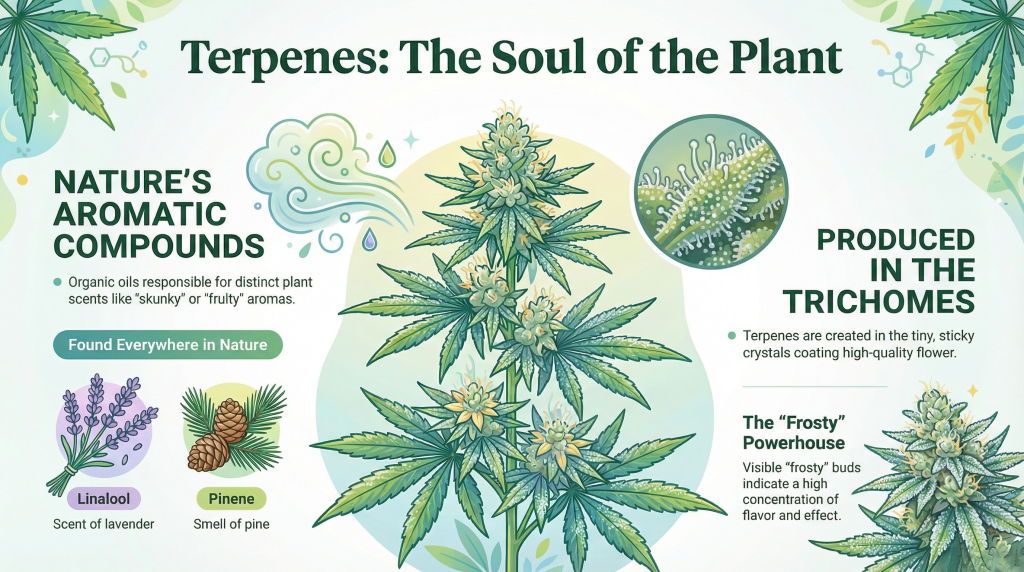
Terpenes are organic, aromatic compounds found in the oils of the cannabis plant. They are responsible for the distinct scents you recognize, like the “skunky” smell of a classic OG or the “fruity” zest of a tropical hybrid.
- Nature’s Aromatherapy: Terpenes aren’t just in cannabis; they are everywhere in nature. The relaxing scent of lavender comes from the Terpene Linalool, while the refreshing smell of a pine forest comes from Pinene.
- The Terpene Factory: These oils are produced in the trichomes—the tiny, sticky crystals that coat the surface of high-quality flower. When you see “frosty” buds at Say Less, you’re looking at a powerhouse of flavor and effect.
The Entourage Effect: The Power of Teamwork
The “Entourage Effect” is the theory that cannabis compounds work better together than they do in isolation. When THC, CBD, and terpenes are consumed together, they create a synergy that produces a more significant effect than any of them could achieve alone.
Maximizing Bioavailability
Recent research suggests that terpenes do more than just provide flavor; they actually change how your body processes cannabinoids. Some terpenes, such as Myrcene, are believed to increase the permeability of the blood-brain barrier.
In simple terms, this means the “gate” between your bloodstream and your brain opens a little wider, allowing THC to enter more efficiently. This explains why a 20% THC strain with a high terpene count often feels “stronger” and more effective than a 30% strain that has been stripped of its natural oils.
The Say Less Guide to Common Terpenes
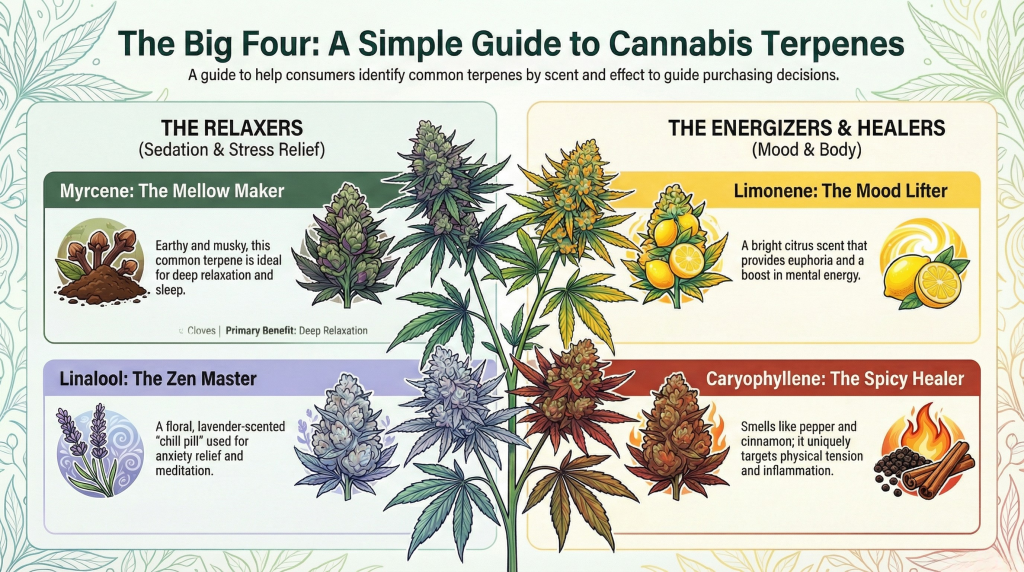
To help you shop smarter, it helps to know the “Big Four” terpenes you’ll likely encounter on our shelves.
Myrcene (The Mellow Maker)
This is the most common terpene in cannabis. It has an earthy, musky aroma similar to cloves.
- The Vibe: Deep relaxation and “couch-lock.”
- Best For: Unwinding after a long day or getting a solid night’s sleep.
Limonene (The Mood Lifter)
Recognizable by its bright, citrusy scent.
- The Vibe: Euphoria, stress relief, and a boost in mental energy.
- Best For: Socializing, creative projects, or a “wake and bake” session.
Caryophyllene (The Spicy Healer)
This terpene smells like black pepper and cinnamon. It is unique because it is the only terpene that also acts like a cannabinoid.
- The Vibe: Physical comfort and calm.
- Best For: Managing inflammation or easing localized physical tension.
Linalool (The Zen Master)
Linalool is the floral, lavender-scented terpene often found in calming hybrids. It is essentially nature’s “chill pill.”
- The Vibe: Severe anxiety relief and sedation.
- Best For: Quieting “the noise” in your head after a stressful Bronx commute or settling into a meditative state.
Beyond Terpenes: The VSC Factor
Have you ever opened a jar of flower that smelled incredibly “skunky” or like “pure gas,” only to look at the lab results and see low terpene levels? That’s because of Volatile Sulfur Compounds (VSCs).
VSCs are a newly discovered family of compounds in cannabis that are responsible for the pungent, “loud” aromas that terpenes alone cannot create. These compounds are extremely potent and can be detected by the human nose even in tiny amounts.
VSCs are also a major indicator of freshness. Because they are so volatile, they are the first things to disappear if the flower is old or has been stored poorly. If your weed has that signature “gas” smell, it’s a sign that the VSCs—and the experience they provide—are still intact.
How to Shop Smarter at Say Less
At Say Less, we want you to leave with more than just a bag; we want you to leave with the right experience.
Reading a Certificate of Analysis (COA)
In New York, every legal product comes with a lab report called a COA. While many people only look at the THC percentage, you should look for the Terpene Weight %.
- A “good” terpene percentage is generally between 1.5% and 4%.
- If a product has 30% THC but only 0.5% terpenes, it will likely be a harsh, uninspired smoke.
The “Nose Knows” Test
Your body has a built-in radar for what it needs. If a strain smells incredible to you, your brain is likely signaling that those specific terpenes are compatible with your chemistry. Don’t be afraid to ask our Cannabis Educators for recommendations based on “the nose” rather than just the numbers.
Preserving the Profile: Storage and Consumption
Once you’ve found the perfect terpene-rich flower, you need to protect it. Terpenes are delicate; they evaporate easily when exposed to the “Three Enemies”: Heat, Light, and Air.
Best Storage Practices
- Glass is King: Never leave your flower in a plastic baggie. Plastic is porous and carries a static charge that can pull the trichomes (and terpenes) right off your bud. Use airtight glass jars.
- Temperature Control: Keep your jars in a cool, dark place. If it’s too hot, those precious VSCs and terpenes will “flash off,” leaving you with hay-smelling, ineffective flower.
Vaporization vs. Combustion
If you want to truly experience terpenes, consider a dry-herb vaporizer. Combustion (lighting a joint with a flame) reaches temperatures over 600°C, which instantly destroys many delicate terpenes. Vaporizing at lower temperatures (between 160°C and 200°C) allows you to taste the nuances of the plant and feel the full spectrum of effects.
Conclusion: Mean More, Say Less
The next time you’re at the dispensary, remember that THC is just one part of a very big picture. By focusing on terpenes, VSCs, and the Entourage Effect, you can tailor your cannabis use to your specific needs—whether that’s finding focus, easing pain, or simply enjoying the best flavors New York has to offer.
Stop by Say Less in the Bronx today. Our Cannabis Educators are ready to help you look past the percentages and find the terpene profile that speaks to you.
People Also Ask (FAQ)
1. Does a higher terpene percentage make me higher? Not necessarily “higher” in a dizzying sense, but it makes the high more intense and longer-lasting. High terpenes improve “bioavailability,” helping your body use the THC more effectively.
2. Can I find terpenes in things other than cannabis? Yes! Terpenes are in almost every plant. For example, Limonene is in lemons, and Pinene is in rosemary. The cannabis plant simply produces a high concentration of many different terpenes at once.
3. What is a “good” terpene percentage for flower? Most high-quality flower sits between 2% and 4% total terpenes. Anything above 1.5% is generally considered a flavorful, high-quality product.
4. Why does my weed smell like hay? This usually means the terpenes have evaporated due to age, heat, or poor drying and curing processes. This flower will likely have a “flat” effect, regardless of its THC percentage.
5. How do I find the terpene profile on a Say Less product? You can ask our team for the COA (Certificate of Analysis) or check the QR code on the packaging. We pride ourselves on transparency and love talking through the lab results with our community!