
Weed delivery minimums in NYC generally fall within a moderate range, as dispensaries balance the cost of running a route against New York State’s prepayment and inventory rules. Under state regulation, delivery workers can’t leave the shop without orders covering a set share of what they’re carrying, so a $10 order alone rarely pencils out. If your cart is light, pickup or bundling a couple of items usually solves the problem.
TL;DR:
- Delivery minimums in NYC are generally set around $10-$50, optimizing for route economics and prepayment compliance rather than profit.
- State regulations require at least 30 percent of a delivery’s product value to be pre-ordered and paid for before departure, preventing on-demand delivery like food apps.
- Licensed dispensaries must follow strict address, operating hours, vehicle, and staffing rules, which influence minimum order amounts.
- Verifying a legitimate delivery service involves checking the dispensary’s official license, lab-tested labels, and online prepayment systems, avoiding cash-only scams.
- Customers can bypass minimums by combining items, sharing orders, or choosing pickup, and should always verify dispensary licenses before purchasing.
Table of Contents
- Why weed delivery minimum NYC policies exist in the first place
- What New York State rules actually control about delivery
- How do you verify a legal weed delivery service in NYC?
- Smart ways to hit (or skip) the delivery minimum
- Say Less on running compliant, convenient delivery in the Bronx
- Why minimums frustrate customers more than they should
- Order from Say Less and skip the guesswork on minimums
- Where these rules come from
- Sources
Why weed delivery minimum NYC policies exist in the first place
Most licensed dispensaries in the city set delivery minimums at modest levels, with delivery fees commonly charged but often waived once your cart clears a certain threshold. Those numbers aren’t arbitrary. A driver making one stop for a $12 pre-roll loses money the moment you factor in gas, time, and the paperwork every legal sale requires.
Route economics drive most of it. A single delivery vehicle can only carry so much product, and every stop eats into the driver’s shift. Dispensaries that skip minimums either eat the loss or stretch drivers thin, which slows down everyone’s order.
There’s also a compliance angle most customers never think about. Cash-on-delivery sounds convenient, but it creates accounting headaches under state inventory tracking. That’s why nearly every licensed operator asks you to prepay online:
- Digital prepayment ties each item to a paid order before the driver ever leaves the building.
- It simplifies the inventory reconciliation dispensaries must keep for state audits.
- It reduces cash-handling risk for delivery staff working alone in a vehicle.
Minimums, in other words, aren’t a money grab. They’re the price of running a compliant, insured delivery operation in a city where a driver might make four or five stops in a two-hour window.
What New York State rules actually control about delivery
The dollar figure on a dispensary’s minimum isn’t set by Albany. What is set by Albany are the operational rules that make those minimums almost unavoidable. Regulation 9 NYCRR §123.20 requires every delivery licensee to keep a written delivery plan, cap how much product rides in a vehicle, and limit how many delivery workers a business can employ.
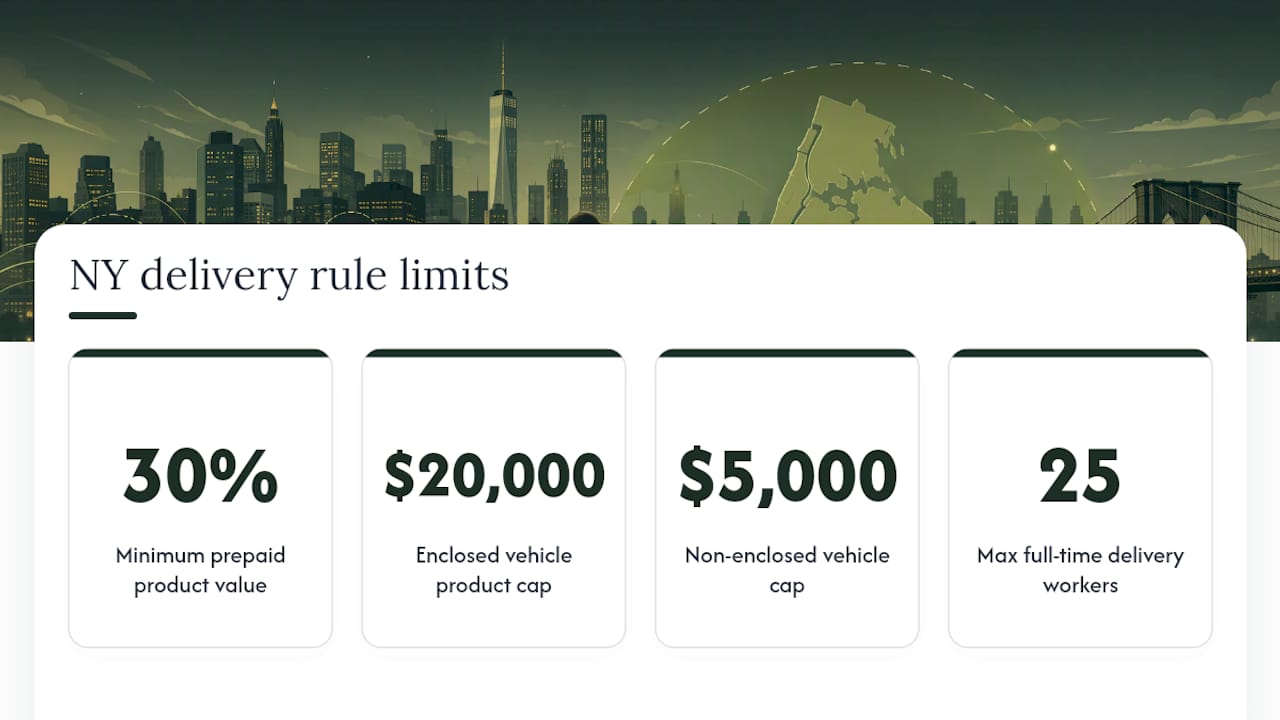
The 30% rule is the big one. Before a delivery employee can leave the dispensary, at least 30% of the value of the products in their possession must already be ordered and paid for. A driver can’t just cruise around with a trunk full of flower hoping for walk-up orders. That single requirement is why on-demand, instant weed delivery in the way food delivery apps work simply doesn’t exist here.
Vehicle and staffing caps compound it. Enclosed delivery vehicles top out at $20,000 in product value, non-enclosed vehicles at $5,000, and a dispensary can employ no more than 25 full-time-equivalent delivery workers. That’s not a lot of room to run loose, low-value orders profitably across five boroughs.
Address rules matter just as much as the money side. Under OCM’s consumer guidance, deliveries can only go to a genuine residential or private business address. Public spaces, schools, day care centers, houses of worship, and motor vehicles are all off-limits, no exceptions.
Hours matter too. OCM guidance spells out operating windows, staff training requirements, and the written delivery service plan every licensed shop has to keep on file and produce for inspection. Some municipalities layer additional restrictions on top, which is part of why delivery windows can shrink or shift depending on where in the city you’re ordering from.
How do you verify a legal weed delivery service in NYC?
Illicit “gray market” delivery still operates in New York, often mimicking legitimate storefronts closely enough to fool a casual buyer. A few quick checks separate a licensed operator from a risk.
- Run the dispensary through the official OCM verification tool before you order anything.
- Check that product labels carry the universal cannabis symbol, which signals the item passed required lab testing.
- Confirm the site requires age verification and prepayment at checkout, not cash handed over at the door.
- Ask whether the business has a written delivery plan on file, since state rules require one.
Watch for warning signs on the other side, too: cash-only doorstep transactions, a business listing with no verifiable address, or a driver showing up in an unmarked vehicle with no ID badge. Legitimate delivery drivers are dispensary employees, not gig contractors, and tipping is welcome but never required.
Pro Tip: Bookmark the OCM verification tool on your phone. It takes ten seconds to check a license before you hand over your address, and it’s the single best defense against an illegal operator posing as a real shop.
Smart ways to hit (or skip) the delivery minimum
Pickup remains the easiest way around any minimum entirely. Walk in, grab exactly what you want, skip the fee. But if delivery is what you actually need, a few tactics make the math work in your favor.
- Pair a smaller item with something you’d buy anyway, like an edible alongside a pre-roll pack, to clear the threshold without overbuying.
- Split an order with a roommate or friend, staying mindful of New York’s legal possession limits of up to 3 ounces of flower or 24 grams of concentrate per person.
- Check a dispensary’s site for curated bundles built specifically to land near the minimum, which often beats piecing together the same total item by item.
- Confirm accepted payment methods before checkout. Some shops process only certain digital payment types for delivery, which can trip up an order at the last step.
Timing your order also helps. Ordering during off-peak hours, rather than right after work when every route in the borough is backed up, cuts your odds of a delay caused by a driver already at their vehicle inventory cap.
Say Less on running compliant, convenient delivery in the Bronx
Every rule covered above shapes how Say Less actually runs delivery day to day. As the Bronx’s recreational dispensary, we built our ordering system around New York’s prepayment and inventory requirements from day one, not as an afterthought bolted onto a workaround.
Every product on our menu, from flower to vapes to edibles, carries lab-tested results and the universal symbol required under state law. Customers who want to explore cannabis without wondering whether what’s in the bag matches what’s on the label get a straightforward, documented answer every time.
Why minimums frustrate customers more than they should
Here’s the part most guides skip: delivery minimums feel like a business decision, but they’re really a regulatory artifact wearing a business decision’s clothes. New York didn’t set out to force a $50 threshold on your Tuesday night order. The minimum is just the shape that mechanism takes once it hits a real balance sheet.
That distinction changes how you should think about a “high” minimum. A shop charging $75 isn’t necessarily greedier than one charging $40. It might be running fewer, larger routes because its vehicle inventory cap is tighter, or its delivery staff count is lower relative to demand. Judging a dispensary purely on its minimum, without asking whether its licensing and lab testing check out, gets the priorities backward. The number on the checkout screen matters less than whether the product behind it is what the label says it is.
If you take one thing from this: verify the license before you compare the price.
— Jake
Order from Say Less and skip the guesswork on minimums
You’ve got other ways to get weed delivered in the city, but most delivery services ask you to gamble on whether the license and lab results behind them are real. Say Less skips that gamble. We’re a licensed Bronx dispensary with lab-tested inventory across flower, vapes, edibles, and concentrates, and our online ordering system is built to make hitting the delivery minimum painless rather than annoying.

Want an easy way to clear the threshold without buying more than you planned? Check out CRU’s infused pre-roll packs or browse our curated edible picks, both sized well for pairing with a smaller item to reach the minimum in one trip. Prefer to skip delivery entirely? Pickup is always an option at checkout. Just have your ID ready and double check your delivery address falls within our service area before you confirm the order.
Where these rules come from
Read the source rules directly rather than taking any dispensary’s word for it:
- 9 NYCRR §123.20: the regulation setting prepayment, vehicle, and staffing rules.
- NY OCM Consumers page: license verification and the universal symbol.
- OCM delivery FAQ (PDF): eligible delivery addresses.
- OCM retail dispensary guidance (PDF): hours, staffing, and delivery plans.
This article is general information, not a substitute for advice from a qualified lawyer. Consult a qualified legal professional about your own circumstances before acting on anything here.
Sources
- Cannabis delivery FAQ for consumers (NY OCM, 3.10.23)
- Consumers (NY OCM)
- 9 NYCRR § 123.20 — Delivery operations (LII)
- Guidance for adult-use retail dispensaries (NY OCM, 3.11.24)