
The best-supported nightly dose from human trial data is 20 mg CBN, which reduced nighttime awakenings without adding next-day grogginess. Start lower if you’re new to it, somewhere around 2 to 10 mg, and work up gradually. Check with a doctor if you’re on sedatives, blood thinners, or anything metabolized by the liver, and skip mixing CBN with alcohol.
TL;DR:
- The optimal dose supported by human trials is 20 mg of CBN taken nightly, which reduces nighttime awakenings without causing next-day grogginess.
- Lower doses of 2 to 10 mg can be used to assess tolerance before gradually increasing to the evidence-backed 20 mg.
- Combining CBN with CBD at doses tested in studies does not provide additional sleep benefits over CBN alone.
- Oral formats like gummies or softgels require 30 to 90 minutes to take effect, while sublingual tinctures act faster, within 20 to 45 minutes.
- People on sedatives, blood thinners, or with liver conditions should consult a doctor before using CBN due to possible drug interactions.
Table of Contents
- What Does the Research Say About CBN Dosage for Sleep?
- How Much CBN Should You Actually Take?
- Does It Matter If You Take CBN as a Gummy or a Tincture?
- What Side Effects and Interactions Should You Watch For?
- How Do You Find Your Personal Effective Dose?
- The Gap Between Marketing Claims and Trial Data
- How Say Less Can Help You Find Your Dose
- Sources
- FAQ
What Does the Research Say About CBN Dosage for Sleep?
Most of what people repeat about CBN dosage for sleep is guesswork dressed up as fact. The actual clinical picture is narrower and more interesting than the marketing suggests, and it starts with one trial that finally gave researchers a real number to work with.
A randomized, double-blind, placebo-controlled trial tested 20 mg of CBN nightly against placebo and found it reduced the number of nighttime awakenings and overall sleep disturbance without increasing daytime fatigue. The numbers were modest but real: participants averaged 0.50 fewer awakenings per night and scored 1.36 points lower on the PROMIS sleep disturbance scale compared to placebo. Worth noting, the primary sleep quality outcome didn’t reach statistical significance (p = .082), but the secondary measures, awakenings and disturbance scores, did. That distinction matters if you’re trying to gauge how confident to be in the result: this is solid signal, not a slam dunk.
The same trial tested whether adding CBD to the 20 mg CBN dose improved things further. It didn’t. Trial arms combining 20 mg CBN with CBD doses ranging from 10 to 100 mg showed no additive benefit over CBN alone for the key sleep outcomes. If a product markets itself as a “CBN and CBD sleep synergy formula,” the trial data at this dose range doesn’t back that claim up.
A separate, larger trial looked at higher doses using a proprietary softgel formulation called TruCBN. Researchers tested 25 mg, 50 mg, and 100 mg oral CBN against both placebo and 4 mg of melatonin. All three CBN doses improved PROMIS sleep disturbance scores versus placebo, and the effects were comparable to melatonin. Side effects across the CBN groups were mild and similar to each other, which suggests dose escalation from 25 mg to 100 mg didn’t dramatically change the tolerability profile in that study.
Then there’s the CUPID study, a protocol built to test single oral doses of 30 mg and 300 mg CBN using polysomnography (PSG), the gold-standard objective measure of sleep architecture, plus next-day neurobehavioral testing. This is a crossover design with a two-week washout period between doses, and the 300 mg arm exists specifically to answer a mechanistic question: does a very high single dose measurably change sleep architecture and next-day function? It’s a proof-of-concept protocol, not a recommendation anyone should replicate at home.
A few things temper how much weight any single number here should carry:
- Sample sizes are small to moderate. These are not thousand-person trials; effect estimates carry real uncertainty.
- Formulations vary. A TruCBN softgel and a generic CBN tincture are not guaranteed to behave the same way in your body.
- Trial durations are short. Most studies run days to a few weeks, not months, so long-term effects and tolerance patterns remain largely unknown.
- Sponsorship matters. The TruCBN trial was tied to the product’s manufacturer, which doesn’t invalidate the data but is worth knowing when you read the results.
Statistic Callout: In the primary randomized trial, 20 mg nightly CBN cut awakenings by an estimated 0.50 per night and lowered PROMIS sleep disturbance scores by 1.36 points versus placebo, with no increase in reported daytime fatigue.
Dose selection across these studies isn’t arbitrary, but it also isn’t derived from a clean human dose response curve the way something like melatonin is. Researchers often scale doses from preclinical binding data or prior cannabinoid trial designs, which is part of why you see such a wide spread, from 15 mg to 300 mg, across the literature.
How Much CBN Should You Actually Take?
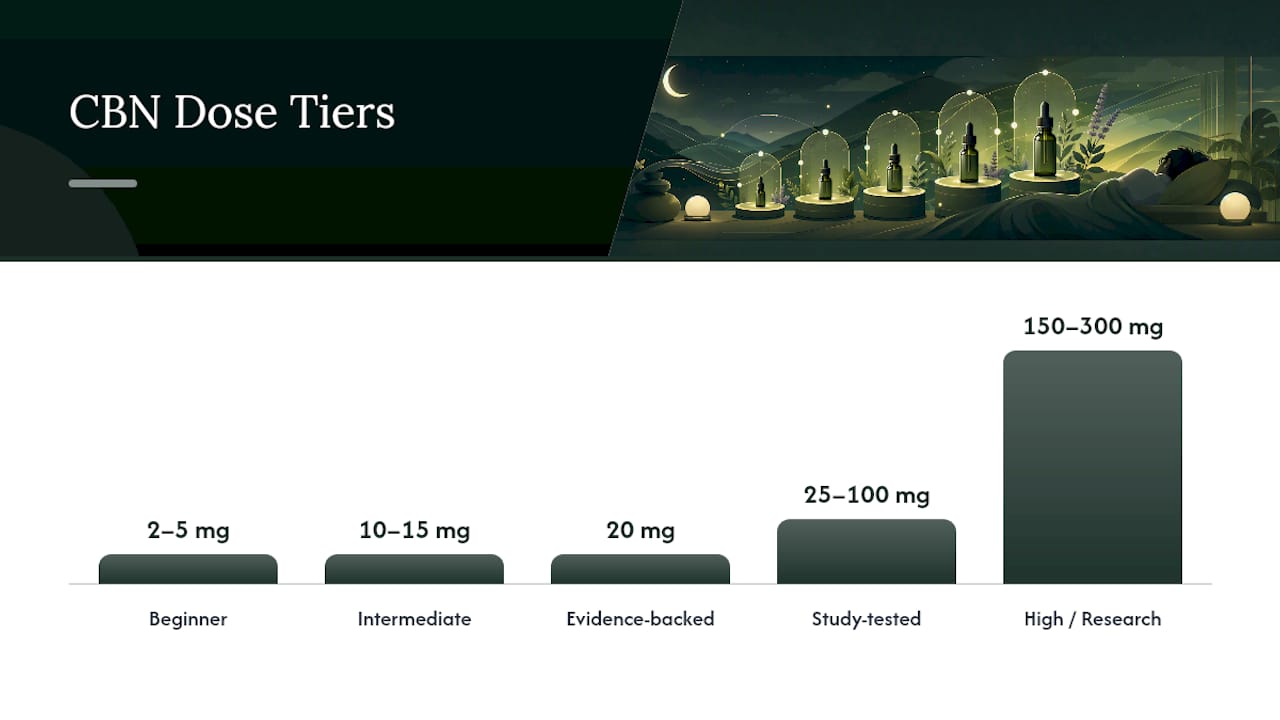
Given the trial landscape, the smartest approach breaks doses into tiers rather than chasing one magic number. Here’s how the evidence and common practice line up:
- Beginner conservative start (2 to 5 mg). If you’ve never taken CBN, or you’re sensitive to cannabinoids generally, this is where to begin. It won’t match the trial-tested 20 mg effect, but it lets you assess tolerance before going further.
- Intermediate range (10 to 15 mg). A reasonable second step once you’ve confirmed no adverse reaction at the lower tier and you’re not seeing enough benefit yet.
- Evidence-backed dose (20 mg). This is the number with the strongest randomized controlled trial support for reducing nighttime awakenings and disturbance, taken nightly rather than sporadically.
- Study-tested product range (25 to 100 mg). Backed by the TruCBN trial, this range showed melatonin-comparable improvements, though it’s a higher dose than most over-the-counter guidance defaults to.
- High or research range (150 to 300 mg). This territory belongs to clinical research protocols like CUPID, not home use. Single doses this high require PSG monitoring and next-day functional testing that you simply can’t replicate outside a study setting.
A practical starter plan looks like this: pick your baseline tier, take that exact dose nightly for three to seven nights, and resist the urge to judge results after one night. CBN, like most sleep interventions, needs a short run to show its real pattern. If you’re not seeing benefit after a week and haven’t had adverse effects, increase by 5 mg and repeat the observation window. Never jump more than 20 mg in a single increase without talking to a doctor first, especially once you’re above the 20 mg evidence-backed threshold.
On frequency: nightly dosing is what the trials tested, not as-needed use. If you’re taking CBN sporadically hoping for the same effect a nightly 20 mg dose produced in trials, you’re working from a different premise than the evidence supports. As-needed use might still help occasionally, but don’t expect it to mirror trial results.
Know when to stop. If you hit noticeable next-day grogginess, GI discomfort, or any effect that disrupts your day, drop back to the previous tier or stop entirely and reassess. If you’ve given a dose a full week at a stable level with zero benefit and no side effects, that dose likely isn’t your answer, and going higher without medical guidance isn’t the move. That’s the point to consult a clinician rather than self-escalate.
Pro Tip: Keep your dose and timing identical for the full observation window. Changing both the amount and the time you take it in the same week makes it impossible to tell which variable actually moved the needle.
Does It Matter If You Take CBN as a Gummy or a Tincture?
The same milligram amount can feel like two different doses depending on how you take it, and that catches a lot of first-time users off guard.
Oral formats like gummies and softgels go through your digestive system and liver before hitting your bloodstream, which delays onset to roughly 30 to 90 minutes or longer. That’s also the format used in most of the clinical trials, including the TruCBN softgel study, so if you want your experience to track closest to the published research, oral dosing is your best match.
Sublingual tinctures, held under the tongue, absorb partly through the mucous membranes and bypass some of that digestive delay. Expect onset closer to 20 to 45 minutes. Inhaled formats act fastest of all, but they’re uncommon for CBN specifically since precise milligram dosing is harder to control by inhalation, and most sleep-focused CBN research has stuck to oral or sublingual routes for that reason.
A few practical timing rules to work with:
- Oral gummies or softgels: take 60 to 90 minutes before your intended sleep time.
- Sublingual tinctures: take 20 to 45 minutes before bed.
- Eating a full meal beforehand slows oral absorption further, so a heavy dinner right before your dose can push onset later than expected.
- The same 20 mg dose may feel different across brands because formulation, carrier oil, and whether the product uses nanoemulsion technology all affect how much actually reaches your bloodstream.
If you’re experimenting with different products, our edible dosage guide walks through how to compare milligram amounts across formats so you’re not guessing at equivalency.
What Side Effects and Interactions Should You Watch For?
The side effect profile reported in trials is mild but real, and it’s worth knowing before you start rather than after a rough night.
Across the studies, the most commonly reported effects were mild grogginess or residual drowsiness, occasional vivid dreams, mild gastrointestinal upset, and headaches. None of these were flagged as severe in the trial populations, and importantly, the 20 mg dose specifically did not increase daytime fatigue compared to placebo, which is a meaningful reassurance for anyone worried about morning impairment.
That reassurance has limits. Higher doses, or combining CBN with alcohol or other sedatives, plausibly raise impairment risk even though the trials didn’t test that combination directly. Treat that gap in the data as a reason for caution, not permission.
- Grogginess or residual drowsiness, typically mild in trial reports.
- Vivid dreams, reported by some participants across studies.
- Mild gastrointestinal upset, including nausea or stomach discomfort.
- Headaches, generally mild and self-limited.
Statistic Callout: The 20 mg trial found no statistically significant increase in daytime fatigue versus placebo, a notable finding for a sleep aid where next-day impairment is often the biggest concern.
CBN is processed through liver enzymes in the cytochrome P450 (CYP) family, the same system that metabolizes a huge number of prescription drugs. That creates real potential for interaction, particularly with sedatives, anticoagulants, and anticonvulsants, where altered metabolism could change how strongly those medications act. If you’re on any prescription medication, especially in those categories, talk to a clinician before adding CBN rather than assuming it’s inert. NCCIH’s overview of cannabinoids echoes this caution, noting that high-quality human data on minor cannabinoids remains limited.
Extra caution applies to older adults, who metabolize compounds more slowly and may feel effects more strongly at the same dose. The same goes for pregnant or nursing people, who should avoid CBN given the near total absence of safety data in that population, and anyone with liver disease, since that’s the organ doing most of the metabolic work.
How Do You Find Your Personal Effective Dose?
Finding your number is a process, not a guess, and it works best when you treat it like a small personal experiment rather than trial and error in the dark.
- Pick a starting tier based on your cannabinoid experience, typically 2 to 5 mg for beginners or 20 mg if you want to start at the evidence-backed dose directly.
- Take the same dose nightly for three to seven nights. Don’t change the amount mid-week.
- If there’s no benefit and no side effects, increase by 5 mg and repeat the observation window.
- Never jump more than 20 mg in a single increase without medical advice, particularly once you’re above 20 mg.
- Stop and reassess if you hit meaningful side effects at any point, rather than pushing through them.
While you’re testing, track more than just how tired you feel the next morning. Useful metrics include:
- Number of nighttime awakenings, even rough estimates count.
- Perceived sleep quality on a simple 1 to 10 scale.
- Daytime alertness and your actual ability to function at work or with family.
- Any unusual dreams, GI symptoms, or headaches.
A basic sleep diary or a phone sleep tracker gives you data to compare week over week instead of relying on memory, which tends to be unreliable when you’re sleep-deprived in the first place. If you’ve titrated carefully through the 20 mg range and beyond and still aren’t seeing benefit, or if your situation involves chronic insomnia that hasn’t responded to standard interventions, that’s the point to loop in a clinician. Some higher-dose research, like the CUPID protocol testing 30 and 300 mg doses under PSG monitoring, exists specifically for cases that need more oversight than home titration can offer, and ClinicalTrials.gov lists active studies for readers curious about future data or enrollment.
The Gap Between Marketing Claims and Trial Data
Here’s where I’ll push back on how CBN gets sold. Most product pages treat 20 mg as a floor, implying more is simply better. The trial data doesn’t support that framing. The 20 mg dose is the one with the strongest randomized controlled trial backing for reducing awakenings, while the higher-dose studies, such as TruCBN’s 25 to 100 mg range and the CUPID 300 mg protocol, address different research questions.: one tests a specific commercial formulation, the other is proof-of-concept research under clinical monitoring, not a home dosing target.
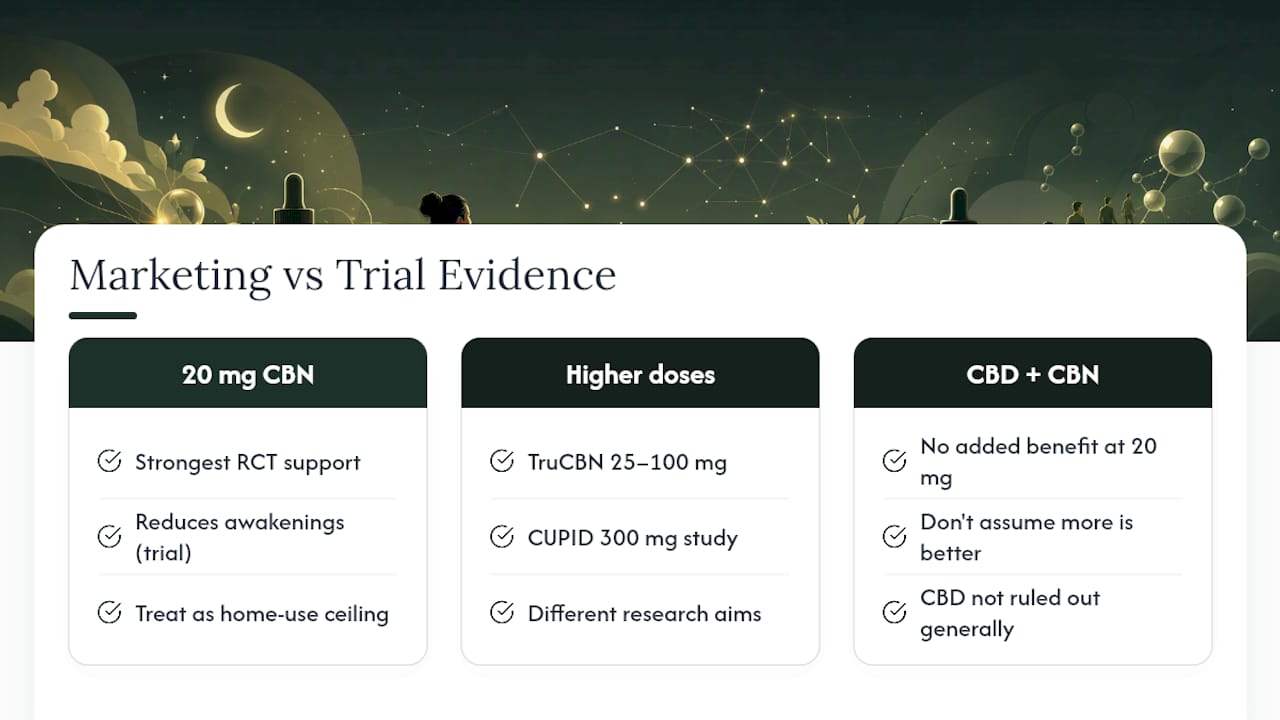
The other overlooked point: adding CBD to CBN at tested doses didn’t help. If you’re paying a premium for a “full spectrum sleep blend,” the one trial that tested this combination directly found no additive benefit at 20 mg CBN. That’s not a reason to avoid CBD generally, but it’s a reason to stop assuming more cannabinoids automatically means a better night’s sleep.
What I’d prioritize first: start low, hold each dose for a full week before judging it, and treat 20 mg as your realistic evidence-backed ceiling for home use rather than a starting point to build up from.
— Jake
How Say Less Can Help You Find Your Dose
Getting your CBN dosage for sleep right depends on starting with a product you can actually trust the milligram count on, and that’s where lab-tested sourcing makes a real difference over guessing with an unlabeled tincture. Lab-tested edibles and tinctures are available, and in-store staff can provide guidance on product forms, from softgels to sublingual oils, to help customers match dose and format to their titration plan.

If you’re building out a starter tier or comparing milligram amounts across product types, our edible dosage guide breaks down conversions in plain terms, and our best edibles NYC picks highlight lab-tested options worth starting with. Orders for pickup or delivery can be placed, and staff are available to provide guidance on selecting a CBN dose appropriate for your needs.
This article is general information, not a substitute for advice from a qualified doctor. Consult a qualified healthcare professional about your own circumstances before acting on anything here.
Sources
- A double-blind, randomized, placebo-controlled study of the safety and effects of CBN with and without CBD on sleep quality
- A Randomized, Double-Blind, Placebo-Controlled Trial to Assess the Effectiveness and Safety of Melatonin and Three Formulations of Floraworks Proprietary TruCBN™ for Improving Sleep
- Cannabinol (CBN; 30 and 300 mg) effects on sleep and next-day function in insomnia disorder (‘CUPID’ study)
FAQ
What is the best CBN dosage for sleep?
The dose with the strongest randomized trial support is 20 mg nightly, which reduced nighttime awakenings without increasing daytime fatigue, though beginners often start lower around 2 to 10 mg first.
How long does it take for CBN to work for insomnia?
Oral gummies and softgels typically take 30 to 90 minutes to take effect, while sublingual tinctures act faster, usually within 20 to 45 minutes.
Can you take too much CBN for sleep?
Research protocols have tested single doses up to 300 mg under clinical monitoring, but that’s not a home dosing target; jumping above 20 mg without medical guidance isn’t recommended.
Does adding CBD to CBN improve sleep results?
No. Trial arms combining 20 mg CBN with 10 to 100 mg CBD showed no additive benefit over CBN alone for reducing awakenings or sleep disturbance.
Is CBN safe to take every night?
The 20 mg trial dosed nightly and reported mild side effects like drowsiness or vivid dreams, but anyone on sedatives, anticoagulants, or anticonvulsants should check with a clinician first due to potential CYP-mediated interactions.