
A vape usually feels stronger than a joint. Two things drive that: how much THC reaches your blood per puff, and how much THC is in the product to begin with. A joint burns flower that is mostly under 30% THC and loses a lot of it to smoke. A cartridge holds an oil that is often 70% THC or more, and a vaporizer delivers it without burning. Once you know the difference, you can pick the format and the dose you want. Our team at Say Less NY works with both formats in the Bronx, and it comes down to how you plan your first few puffs.
TL;DR
- At the same dose, vaporized cannabis produced higher peak blood THC and stronger effects than smoked cannabis in a Johns Hopkins trial.
- Cartridge oil is typically far more concentrated than flower, so one puff of a cart and one puff of a joint are not the same amount of THC.
- Both routes act fast, within minutes, and fade in roughly 2 to 4 hours, so the safe move is one puff, then wait.
- Tolerance changes everything: daily users feel less from the same dose, newcomers feel more.
- Lab-tested, traceable products let you know the THC number you are actually dosing from.
Table of Contents
- Why “potency” means two different things
- What the research says about vaping vs smoking
- Why a joint loses THC before it reaches you
- Joint, dry-herb vape, cartridge: the dose math
- How fast it hits and how long it lasts
- Tolerance changes the answer
- A simple way to dose a vape or a joint
- Picking your format
- Why lab-tested products make potency readable
- Our perspective
- Get the right format delivered
- FAQ
- Sources
Why “potency” means two different things
When people ask which is stronger, they usually mix up two measurements.
Product potency is the THC percentage on the label. Flower in a regulated market is usually under 30% THC. Vape oil and concentrates sit much higher. A 2023 review in Drug and Alcohol Review found that e-liquid cartridges commonly contain 40 to 95% THC, often above 80%, and solid concentrates above 90%, against dried flower that is usually below 30%.
Delivered potency is how much THC your body actually absorbs. That depends on how the product is used: how hot it gets, how much escapes as smoke, how deep you inhale and how long you hold.
A joint can have a lower label number and still hit hard if you smoke a lot of it. A cart can have a high label number and feel gentle if you take a single puff. The label tells you what is in the product. Your puffs decide what ends up in you.
What the research says about vaping vs smoking
The best-known comparison is a 2018 Johns Hopkins crossover trial of 17 healthy adults who rarely used cannabis. Each person took smoked and vaporized cannabis at matched doses. At the 25 mg dose, peak blood THC was 14.4 ng/mL vaporized versus 10.2 ng/mL smoked, and average drug-effect ratings were 78 versus 66 on a 100-point scale.
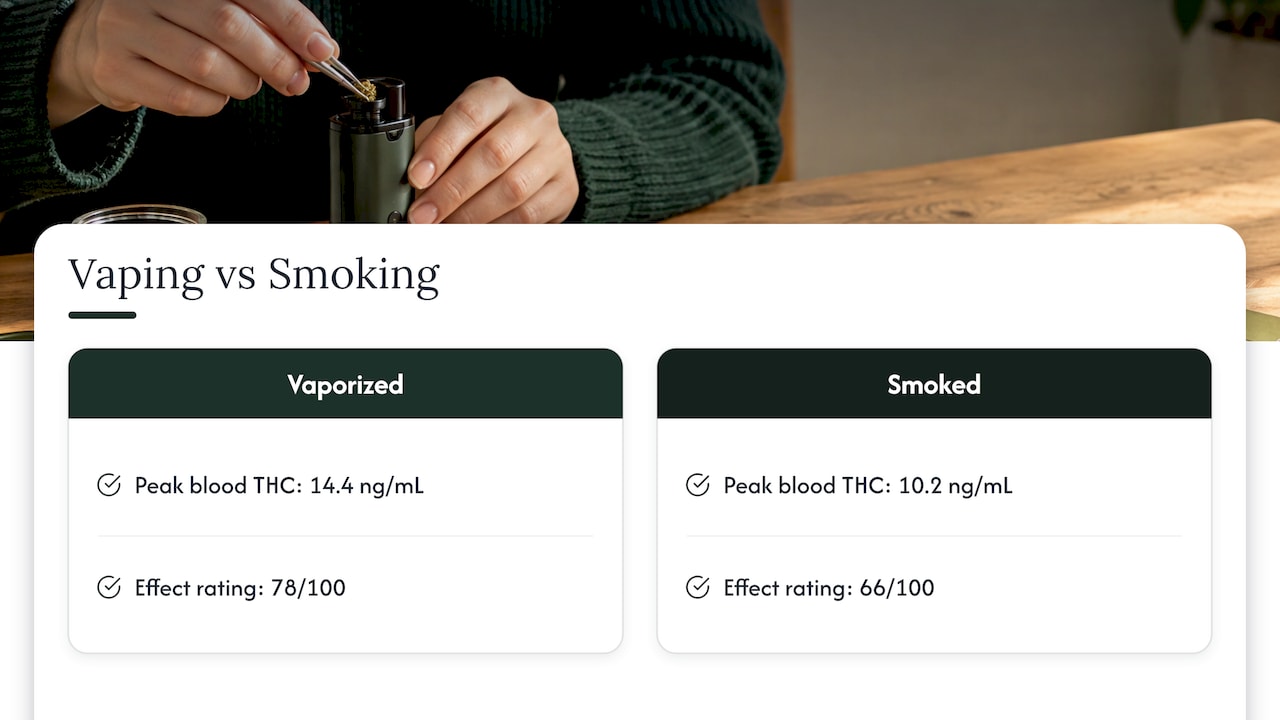
The Johns Hopkins Medicine summary adds that vapers also reported about 7% higher anxiety and paranoia ratings, plus more dry mouth and dry eyes. The researchers were clear about the limits: 25 mg is a fairly low dose, and the results may not carry over to people who use cannabis routinely and have built tolerance.
A 2025 analysis of 252 participants using legal-market products looked at more modes. It found dabbing produced significantly higher acute plasma THC than joint-like modes, with vaping trending higher than smoking. The pattern holds across studies: the more efficiently a method delivers THC, the stronger the effect arrives.
A JAMA Network Open editorial on the Hopkins trial made a point worth keeping in mind. Even low-dose vaporized cannabis produced more measurable impairment than higher-dose smoked cannabis in infrequent users. For a newcomer, the takeaway is to start lower with a vape, not that vaping is a problem.
Why a joint loses THC before it reaches you
A lit joint is a fire. A 2026 Vice explainer citing emissions research notes the combustion zone of a joint exceeds 900°C, while dry-herb vaporization typically runs 160 to 230°C. The joint also keeps burning between hits, so THC drifts off as sidestream smoke instead of going to you.
A 2024 clinical review in The Permanente Journal puts numbers on it. Combustion loses 23 to 30% of THC to pyrolysis and 40 to 50% to sidestream smoke, leaving roughly 25% as the maximum amount absorbed. Vaporization bioavailability is estimated at about 10 to 35%, depending on puff count, duration, hold time and particle size.
That is why the same flower can feel stronger in a dry-herb vaporizer than rolled into a joint. Less is wasted, more arrives.
Joint, dry-herb vape, cartridge: the dose math
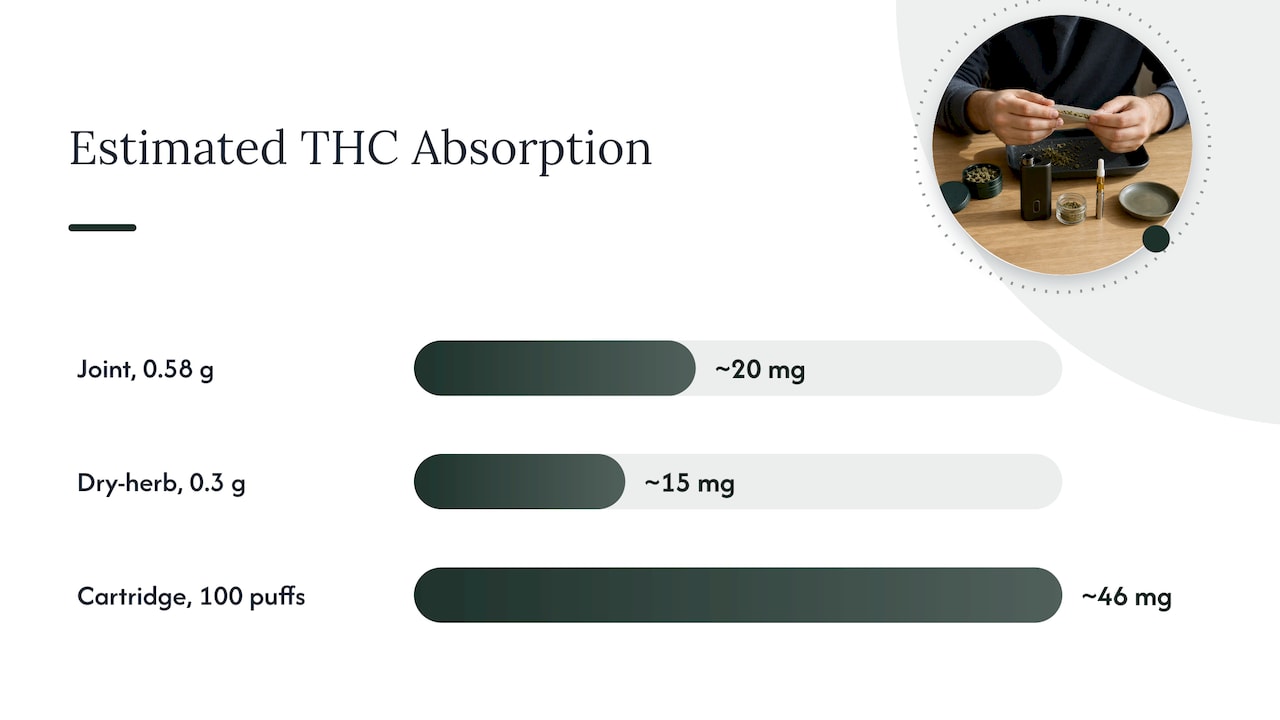
The same Permanente Journal review gives worked estimates for each format:
| Format | Example serving | Estimated THC absorbed |
|---|---|---|
| Joint | 0.58 g of 14% THC flower | About 20 mg (at 25% maximum bioavailability) |
| Dry-herb vape | 0.3 g serving | About 15 mg (at 35% bioavailability) |
| THC cartridge | 100 puffs of a 26% e-liquid | About 46 mg total, 0.46 mg per puff (at 35% bioavailability) |
These are estimates from the review’s clinical dosing examples, and your own numbers will move with how you inhale. But they show how the formats differ in practice.
A joint is a big serving you work through over several minutes. A dry-herb vape is a smaller serving that is used efficiently. A cartridge is a long series of very small puffs, each one dense. If you are used to joints, where you might pass it around for ten minutes, a cart can surprise you because each pull concentrates more THC than the same pull from a joint.
This is also where the “are joints less strong than carts?” question lands. Per puff, usually yes. Per session, it depends entirely on how many puffs you take and what is in the product.
How fast it hits and how long it lasts
Speed is similar, with the vape often a touch quicker. Inhaled THC is detectable in blood seconds after a puff and peaks around 6 to 10 minutes after smoking, and THC and its active metabolite are almost fully metabolized 2 to 3 hours after inhaling. The Permanente Journal review describes both smoking and vaping as having rapid onset within 0 to 10 minutes and a duration of about 2 to 4 hours.
So the practical difference is not how long the high lasts. It is how high the peak climbs. For a closer look at timing, our guide to how long a vape high lasts walks through what to expect.
One popular belief deserves a correction. People often say smoking feels heavy and vaping feels clear and functional. A Vice piece on the topic points out that this is mostly anecdote, with no strong evidence that the delivery method itself decides whether you feel energized, sleepy or focused. The cannabinoids and terpenes in the product matter more. Our piece on how temperature changes terpenes explains why flavor and feel can shift between a vape and a joint.
Tolerance changes the answer
The studies above mostly used infrequent users, and that matters. Your tolerance sets how strong any format feels.
A 2013 Pharmacotherapy review states that tolerance to THC has a high probability of developing with as few as four days of daily use, and a low probability under intermittent use. Heavy daily users can also get unpredictable, blunted highs, according to the Permanente Journal review.
At the other end, that same review notes that inhaled THC doses of 2 to 3 mg can already affect attention, concentration and short-term memory. Low does not mean no effect.
In practice:
- Newcomers and occasional users feel a vape more strongly than the label suggests. Start small and expect a faster, bigger peak than a joint.
- Daily users may find a joint feels mild and a cart or concentrate feels right, but should still pace the first session with a new product.
- Anyone switching formats should treat it like starting over, because the dose per puff changed even if your tolerance did not.
A simple way to dose a vape or a joint
Inhalation dosing is harder to estimate than edibles, and a 2018 dosing review says why: chamber size, inhalation depth, breath-holding and THC strength all vary. Its advice for people starting out is steady and simple: take one inhalation, wait 15 minutes, then add one inhalation every 15 to 30 minutes if you want more. The same review explains that slow upward titration helps build tolerance to the unwanted psychoactive effects, which matters most for newcomers.
Here is how that looks:
- Check the lab results. Look at the THC percentage and the batch test before you decide how many puffs make sense.
- Take one puff or one pull. One, not a few.
- Wait 15 minutes. The peak arrives within minutes, so give it time.
- Add one more only if you need it. Stop at the first level that feels right.
- Keep the session simple. Do not drive, and be careful mixing with alcohol or other substances.
If you are using a cartridge or pen, our walkthrough on how to use a dab pen follows the same one-puff-and-wait approach. If you want something gentler than either, microdosing THC is a practical way to stay at low milligram doses.
Picking your format
You are choosing between smooth, efficient delivery and a ritual you can pace.
- Pick a joint or pre-roll if you want to share, enjoy the flower itself, and keep each pull relatively modest. Our guide to pre-roll sizes shows how grams and cone lengths translate into a session. Infused pre-rolls are a different animal: one can carry 100 to 200 mg, so read the label first.
- Pick a dry-herb vape if you want flower flavor with less waste. The 2023 review concluded that dried-product vaporizers carry a lower risk profile among vaporization types because of lower THC potency, a sensible starting point for many newcomers.
- Pick a cartridge or pen if you want speed, convenience and a small, easily carried device. Plan your puffs, because the oil is concentrated.
- Pick concentrates if you already have high tolerance and want the strongest hit. Our comparisons of badder and diamonds and shatter and wax help you choose.
If you want a similar result without inhaling, edibles are a separate path with their own dosing ladder. Start with our edible dosage guide.
Why lab-tested products make potency readable
Everything above depends on a number you can trust. If the THC percentage on the package is wrong, your one puff is not the dose you planned. That is the case for buying from a licensed shop with traceable, lab-tested products rather than from an informal source.
Our flower grades guide shows what to check on flower, and our note on diamond-infused pre-rolls explains why reading the lab test matters before a fast hit.
Our perspective
Most potency arguments miss the point. People ask whether a vape or a joint is stronger, and the honest answer is that the stronger one is the one you dose badly. Vapes deliver THC efficiently, so they reward a light touch. Joints give you a slower, more social pace.
What we care about at Say Less is that you know what is in your hand. Every product we carry is legal and lab-tested, and our staff are here to guide you rather than upsell you. If you are new, tell us what you want to feel and we will help you choose a format and a starting point that fits. If you are experienced, we will help you find the flower, vape or concentrate that suits your tolerance.
Start low, wait, and let the lab number do its job.
Jake
Get the right format delivered
Say Less is a licensed dispensary in the Bronx with lab-tested flower, pre-rolls, vaporizers, concentrates, edibles and tinctures, available for in-store pickup and fast NYC delivery. Whether you are comparing a pre-roll to a pen or want help reading a lab result, you can browse the full menu at Say Less NY.

If you would rather skip the smoke altogether, our fast-acting edibles guide shows how quickly those can work.
FAQ
Does vaping get you higher than smoking a joint?
Often yes, at the same dose. In the Johns Hopkins trial, vaporized cannabis produced higher peak blood THC and higher effect ratings than smoked cannabis in infrequent users. Experienced users with high tolerance may notice less of a gap.
Are joints less strong than carts?
Per puff, usually. Cartridge oil is commonly 40 to 95% THC, while flower is usually under 30%, and a joint also loses much of its THC to combustion. Total strength still depends on how many puffs you take and your tolerance.
Is a dry-herb vape stronger than a joint?
It can be. Heating flower at lower temperatures wastes less THC than burning it, so the same flower can deliver more. The 2024 clinical review estimates 35% bioavailability for vaporization against a 25% maximum for smoking.
How long should I wait between puffs?
Wait 15 minutes after your first puff before deciding on another. Clinical dosing guidance for inhaled cannabis suggests adding one inhalation every 15 to 30 minutes if needed. Both vaping and smoking act within minutes, so patience prevents overshooting.
Sources
- Acute Effects of Smoked and Vaporized Cannabis in Healthy Adults (JAMA Network Open, PMC)
- Vaping Cannabis Produces Stronger Effects Than Smoking (Johns Hopkins Medicine)
- Mode matters: how modes of cannabis consumption affect THC exposure (PMC, 2025)
- Peering Through the Haze of Smoked vs Vaporized Cannabis (JAMA Network Open)
- Vaping vs. Smoking Cannabis: What’s the Difference? (Vice)
- Clinical Evaluation of the Cannabis-Using Patient (The Permanente Journal, PMC)
- Cannabis vaporisation: Understanding products, devices and risks (Drug and Alcohol Review, 2023)
- Edible cannabis: an effect of longer duration and less predictable than with inhalation
- The Pharmacologic and Clinical Effects of Medical Cannabis (Pharmacotherapy, 2013)
- Practical considerations in medical cannabis administration and dosing (European Journal of Internal Medicine, 2018)