
A 510 thread is the screw-and-center-pin connection joining most vape cartridges to most vape batteries. It handles two jobs at once: a mechanical grip that holds the cart in place, and an electrical path that fires the coil. Fit is nearly universal across the category, but a matching thread doesn’t guarantee the voltage, pin depth, or draw resistance line up correctly.
TL;DR:
- Compatibility issues often arise from differences in connector depth, pin position, and manufacturing tolerances, despite both parts claiming 510 threading.
- The spring-loaded center pin is the most common point of failure, often blocked by residue, pushed flat, or corroded, causing firing issues.
- Proper troubleshooting steps include checking the battery charge, cleaning the threads and pin, and testing with a spare compatible battery before discarding a cart.
- 510 threading originated from early JoyeTech devices around 2007 to 2009 and became the standard due to its industry-wide interoperability.
- Propietary, non-510 systems typically lock cartridges to specific batteries, sacrificing flexibility for controlled performance, unlike standard 510-threaded hardware.
Table of Contents
- What Does “510” Actually Mean on a Cartridge or Battery?
- How Does a 510 Connection Actually Work?
- Where Did the 510 Thread Standard Come From?
- Is a 510 Cartridge Really Universal? Here’s Where It Isn’t
- How Do You Pick and Use a 510 Battery the Right Way?
- What Should You Do When a 510 Cart or Battery Stops Working?
- Not Every Vape Uses a 510 Thread. Here’s When It Doesn’t Apply
- Our Take: Compatibility Isn’t the Same as Performance
- Sources
What Does “510” Actually Mean on a Cartridge or Battery?
The number isn’t a model name or a marketing label picked out of thin air. It describes the connector’s physical geometry, and once you know the code, you can eyeball a thread and know instantly if it’s 510 or something else.
The most widely repeated explanation ties “5” to a roughly 5-millimeter diameter and “10” to a thread count, usually described as about 10 threads per inch with a 0.5-millimeter pitch between each ridge. The shorthand spread as an industry-wide term even though different sources describe the exact spec slightly differently, which is common when a casual engineering nickname outlives its original precision.
That inconsistency causes real confusion. Some sellers describe threading in millimeters, others in threads-per-inch, and a few just say “standard” without specifying either. If you’re staring at a cartridge trying to figure out what you’re dealing with, skip the math and check these instead:
- Thread appearance: fine, tightly spaced ridges running around a short cylindrical base, not the wider, coarser threads found on some proprietary pod systems.
- Turn count: a 510 cart typically seats after two to four full turns, not a quarter turn or a snap-lock click.
- Center pin: a small raised or flush metal post sitting inside the ring of threads. No pin means it’s not 510.
- Base diameter: roughly the width of a standard pencil eraser, consistent across brands.
If a cartridge fails all four checks, you’re probably holding a proprietary pod, not a 510-thread part.
How Does a 510 Connection Actually Work?
Two separate jobs happen at that tiny threaded joint, and understanding both explains most of the failures you’ll ever run into. The 510 thread combines a threaded mechanical connection with a center pin for electrical contact, and each part does something different.
The outer threads handle the mechanical hold and also serve as the ground, or negative, side of the circuit. The center pin, usually spring-loaded so it can flex slightly under pressure, carries the positive charge up into the cartridge’s heating coil. When you press the fire button (or draw, on auto-draw devices), the battery completes a circuit: current runs through the pin, into the coil, heats the oil, and returns through the threaded ground connection back to the battery.
That spring-loaded pin is also the single most common point of failure in the whole system.
- Oil residue building up around the pin blocks contact.
- A pin pushed too flat from a badly seated cart won’t reach the battery’s connector.
- Corrosion from repeated exposure to concentrate residue eventually stops conducting altogether.
Most “my cart won’t fire” complaints trace back to that one small spring-loaded contact rather than a dead battery or bad oil.
Where Did the 510 Thread Standard Come From?
The 510 thread’s name is widely tied back to early cigalike-style devices sold under the Joye brand, part of the JoyeTech product lineage that helped popularize vaping hardware in the mid-to-late 2000s. Historical accounts link JoyeTech’s early products, around 2007 to 2009, to the spread of compatible threading, though origin stories online don’t all agree on exact dates or which specific model came first.
What’s clearer is why the format won. Once multiple manufacturers started building parts that screwed onto the same connector, an aftermarket ecosystem formed almost overnight.
- Batteries from one brand worked with cartridges from another, which lowered the cost of entry for new hardware makers.
- Adapters bridged the rare mismatches, keeping the format flexible instead of forcing a hard standard.
- Retailers could stock fewer battery SKUs while supporting a wider catalog of cartridge brands.
That interchangeability is the entire reason 510 outlived competing thread designs from the same era. Standards rarely win because they’re technically superior. They win because switching away from them costs everyone money.
Is a 510 Cartridge Really Universal? Here’s Where It Isn’t
Thread compatibility and functional compatibility are two different things, and mixing them up is where most frustration starts. A cart can screw on perfectly and still refuse to fire, or fire and taste burnt within three puffs.
Mechanical mismatches show up first. Connector depth, cartridge width, and manufacturing tolerance stack-up commonly cause fit issues even between parts that both claim 510 threading. A cart with a slightly recessed pin might not reach a battery whose own pin sits too far below the threads. Over-tightening makes this worse, not better. It’s a common instinct to crank a loose-feeling cart down harder, but that usually just flattens the spring pin further and kills the connection you were trying to fix.
Electrical mismatches are the second category. A battery pushing more voltage than a coil’s resistance was designed for scorches oil fast; one running too low leaves you sucking on a cart that barely warms up. Voltage control and tolerance stack-up are the two variables that decide whether a mechanically compatible pair actually performs well together.
Run through this order before assuming a cart is dead:
- Confirm the battery is actually charged; a blinking light often just means low charge, not a broken connection.
- Try the cart on a second, known-good battery. Battery-side contact issues cause far more “defective cart” complaints than the carts themselves.
- Wipe the threads and pin with a dry cotton swab or a lightly alcohol-dampened one, then let it fully dry.
- Check whether the battery has adjustable voltage, and if so, nudge it up in small increments rather than jumping straight to max.
- Reseat the cart with a firm quarter-turn, never a hard crank.
Pro Tip: Keep one spare 510 battery around specifically for testing. It takes ten seconds to rule out a bad connection versus a dead cart, and it saves you from tossing perfectly good cartridges.*
How Do You Pick and Use a 510 Battery the Right Way?
The right battery depends less on brand and more on how you actually consume. A few structural types cover almost every situation you’ll run into.
Basic pen batteries are single-button, fixed or near-fixed voltage, and built for people who want to screw a cart on and go. Twist or variable-voltage pens add a dial so you can dial in more heat for thicker oils. Box mods trade pocket-friendliness for bigger batteries, screen displays, and finer voltage or wattage control, which matters more for people running higher-viscosity concentrates. Auto-draw batteries skip the button entirely and fire on inhale, which some users find more natural but which offers zero fine control over heat.
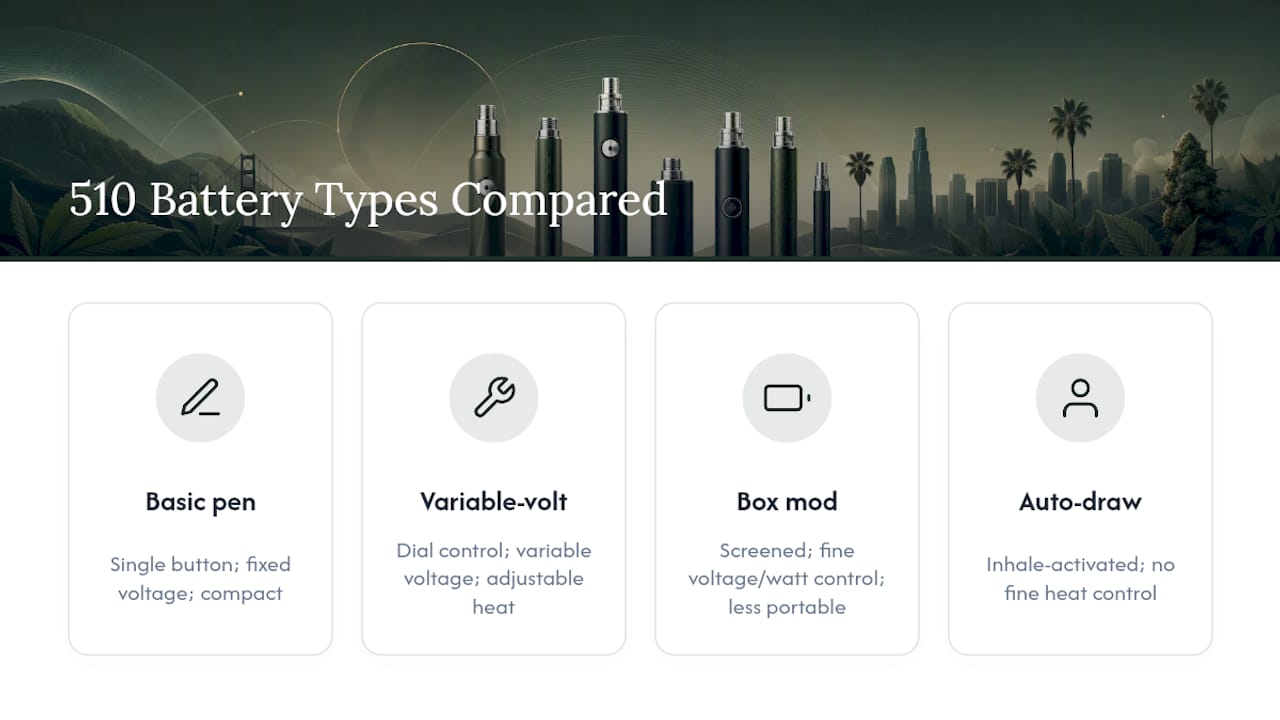
Voltage guidance is where a lot of people either underheat or scorch their oil. Most oil cartridges perform best somewhere between roughly 2.4 and 3.2 volts, with thinner distillate oils sitting comfortably on the lower end and thicker, more viscous extracts like live rosin often needing the higher end or a preheat cycle to loosen the oil before a full draw. Starting low and working up in small steps protects both the flavor and the coil.
Higher mAh capacity means fewer charging cycles per day but usually a bulkier device. Preheat functions, common on twist and box-mod styles, gently warm the coil for a few seconds before full power kicks in, which matters a lot for viscous oil that would otherwise clog or produce a thin, weak pull. If you’re weighing which formulation to run through a given setup, it’s worth reading up on how different extraction methods affect viscosity and heat needs before assuming your battery is underperforming. A compact, reliable option like the Yocan Kodo Pro covers the pen and twist-voltage categories in one small unit if you want a single battery that handles most cartridge types without a learning curve.
What Should You Do When a 510 Cart or Battery Stops Working?
Most failures follow a predictable pattern, and working through it in order saves you from replacing parts that weren’t actually broken.
- Check the charge first. A blinking light after ten presses is almost always a battery that needs juice, not a dead cart.
- Inspect the threads and pin. Look for a flattened pin, visible oil residue, or gunk sitting in the threads.
- Clean gently. A dry or barely-damp alcohol swab on the threads and pin, left to air dry for a minute, clears most contact issues.
- Swap batteries. If a spare is available, test the cart there before writing it off.
- Check resistance and voltage. If your battery displays ohms or lets you adjust voltage, confirm the reading looks normal for the cart’s rated resistance rather than reading zero or wildly high.
Storage matters more than people expect. Keep carts upright, or at minimum not fully inverted for long stretches, since gravity pulls oil toward the mouthpiece and can flood the coil chamber over time. A gentle nudge to a recessed center pin, using something nonconductive like a toothpick, can restore contact if it’s sitting too low, but never force metal tools into the connector.
Some symptoms mean stop, not troubleshoot. A burnt or plastic-like smell, a battery or cart that’s noticeably hot to the touch, or blinking that persists after a full clean-and-swap cycle are signs to retire the part rather than keep pushing power through it.
Pro Tip: If a cart tastes burnt immediately after cleaning and reseating, drop your voltage by at least 0.2V before trying again. Scorched flavor almost always means too much heat, not a dirty connection.
Not Every Vape Uses a 510 Thread. Here’s When It Doesn’t Apply
Closed pod systems and most disposables intentionally skip 510 threading. Manufacturers lock the cartridge to a matched battery, or fuse both into one sealed unit, to control performance and prevent third-party carts from being used. Proprietary systems remain a minority of the cartridge market, with 510-threaded hardware covering the majority of cartridge-based vaping products, but that minority is significant enough that not every cart you’ll encounter fits a standard battery.
If you want the flexibility to mix cartridge brands, swap batteries, and adjust voltage on the fly, 510 threading is the format built for that. Closed systems trade that flexibility for a simpler, more locked-down experience.
Our Take: Compatibility Isn’t the Same as Performance
Here’s what most explainers get wrong: they treat “universal” as a finish line instead of a starting point. Yes, a 510 thread screws onto almost any 510 battery. That fact gets repeated constantly, and it’s true. But it tells you nothing about whether that pairing will actually vaporize your oil the way it should.
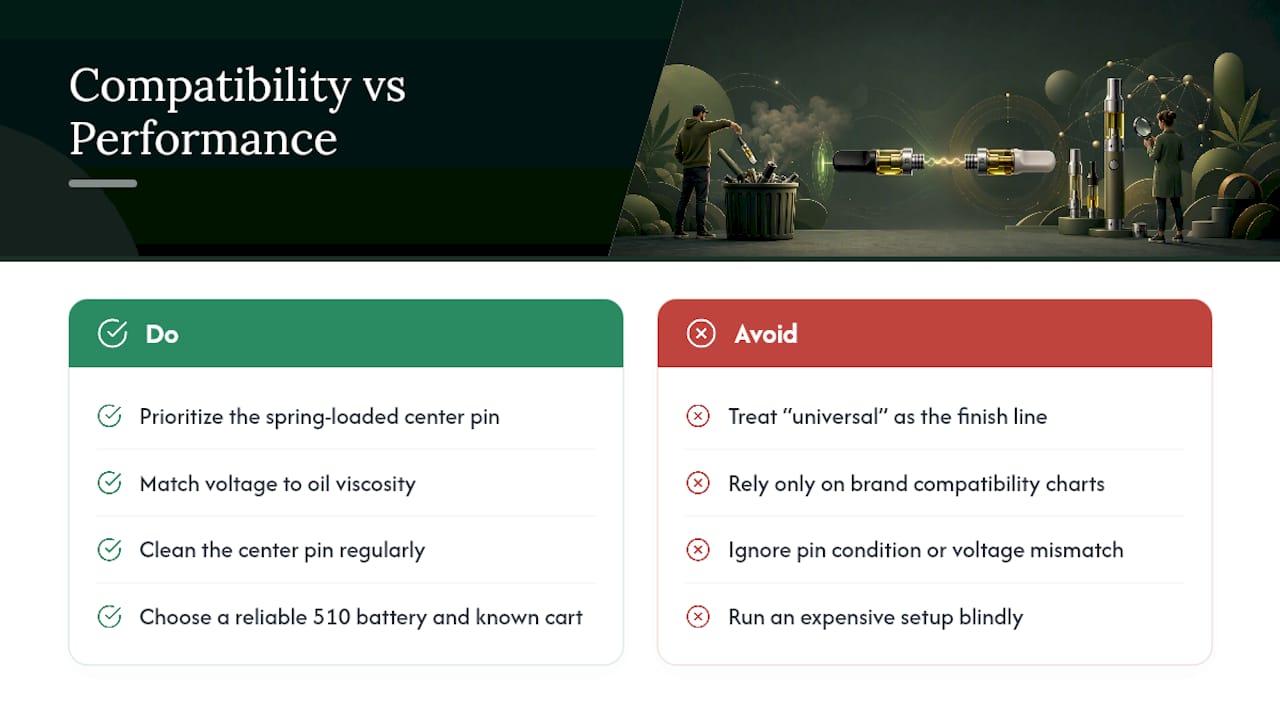
The conventional advice stops at fit. The better advice starts at voltage and pin condition, because those two variables cause more real-world complaints than thread mismatch ever does. If you take one thing from this explainer, prioritize the spring-loaded center pin over everything else. It’s small, it’s cheap to clean, and it’s responsible for a disproportionate share of “broken” carts that were never actually broken.
If you’re shopping for cartridges, spend less time worrying about brand compatibility charts and more time matching voltage to oil viscosity. A reliable 510 battery paired with a cart you actually understand will outperform an expensive setup you’re running blind.
— Jake
Ready to put this into practice? Say Less carries curated cartridges from trusted names like Cannabals and Florist Farms, lab-tested and paired with reliable 510-thread hardware, available for pickup or same-day delivery across NYC. If you’re still narrowing down what fits your routine, our guide on choosing cannabis products that actually fit you walks through formulation, potency, and device pairing in plain language.
Sources
- What Is the 510 Thread, and How Does It Work?
- The Complete Guide to 510-Thread Batteries | The Vaper’s Guide
- 510 Battery & Cartridge Compatibility Explained: What You Need to Know
- 510 Thread: Explanation, History and Use in the Vaporiser World