
A cannabis tincture is a concentrated cannabis extract suspended in a liquid base, usually alcohol, oil, or glycerin, and measured by the dropper for precise dosing. If you’re new to tinctures, start conservative: 1 to 2.5 mg THC if you’re sensitive to cannabis, or 2.5 to 5 mg if you have some tolerance, and always check the mg/mL printed on the label before you draw your first dropper. Wait at least 45 minutes, ideally 90, before taking more. Buy only lab-tested products so you actually know what’s in the bottle.
Key Takeaways
Precise mg/mL math, a 60 to 90 second sublingual hold, and patience between doses are what separate a good tincture experience from a guessing game.
| Point | Details |
|---|---|
| Start low | Begin with 1 to 2.5 mg THC if sensitive, or 2.5 to 5 mg with some tolerance, and check the label’s mg/mL. |
| Do the math, not the drops | Divide total mg by total mL to get mg/mL; dropper size varies too much to count drops reliably. |
| Hold before you swallow | A 60 to 90 second sublingual hold speeds absorption; swallowing behaves more like an edible. |
| Wait before redosing | Give any dose 45 to 90 minutes to fully show its effects before taking more. |
| Choose Say Less for certainty | Lab-tested tinctures from curated Say Less brands give you an exact starting dose without home-brew guesswork. |
Where to Read More
- Leafly’s tincture explainer covers dose tables and basic mg/mL math.
- The NCBI Bookshelf review explains mucosal absorption mechanisms in plain clinical terms.
- The oral THC systematic review breaks down why swallowed doses vary so much.
Table of Contents
- What Is a Cannabis Tincture, Exactly?
- Why Choose a Tincture Over Smoking or Edibles?
- How Do You Take a Tincture Correctly?
- How Do You Calculate Tincture Dosage Correctly?
- How Long Do Tinctures Take to Kick In?
- How Do You Make Cannabis Tinctures at Home?
- Alcohol vs. Glycerin vs. Oil: Which Base Should You Use?
- How Should You Store a Tincture, and How Long Does It Last?
- What Safety Precautions Should You Know Before Using Tinctures?
- Can You Cook With Cannabis Tinctures?
- What Does the Research Say About Sublingual vs. Oral Dosing?
- Why We Built This Guide the Way We Did
- Ready to Try a Lab-Tested Tincture?
- Frequently Asked Questions
- Sources
What Is a Cannabis Tincture, Exactly?
A tincture is cannabis extract dissolved into a liquid carrier, sold in a small dropper bottle with the potency printed as milligrams per milliliter (mg/mL). That number is the single most important piece of information on the label. It tells you exactly how much THC or CBD you’re getting per drop, per half-dropper, or per full dose, instead of leaving you to guess the way you might with a joint or a bowl.
The word “tincture” technically means an alcohol-based extract, a distinction that goes back centuries in herbal medicine and shows up in early pharmacopeia records long before cannabis dispensaries existed. In practice, the cannabis industry stretched the term to cover almost any liquid dropper product. You’ll see it applied to:
- Alcohol-based tinctures — the original format, fast-acting and shelf-stable
- Oil-based infusions — technically not a tincture, but sold under the same name; think MCT or olive oil carriers
- Glycerin-based tinctures — alcohol-free, sweeter, gentler on the mouth
- Commercial dropper bottles and sublingual sprays — pre-dosed, often flavored, built for convenience
So when someone hands you a “CBD tincture” that’s actually MCT oil, they’re not wrong by industry standards, just loose with the original definition.
Why Choose a Tincture Over Smoking or Edibles?
Tinctures solve a problem that smoking cannabis doesn’t: they let you dose with real precision. You know exactly how many milligrams you’re taking every single time, which matters if you’re managing pain, sleep, or anxiety and don’t want to guess.
Here’s what makes tinctures worth considering:
- Precise, repeatable dosing down to the milligram
- No smoke, no vapor, no lingering odor
- Discreet enough to use almost anywhere
- Flexible onset. Hold it under your tongue for faster effects, or swallow it for something slower and longer
People use tinctures differently depending on the goal. A small daytime dose (2.5 to 5 mg) works for focus-friendly microdosing. A slightly higher evening dose supports winding down before bed. Larger, symptom-specific doses get used for pain or nausea, usually under a clinician’s guidance. One thing that comes up again and again with new users: knowing your exact dose in advance takes a lot of the anxiety out of trying cannabis for the first time. You’re not rolling the dice on how strong a gummy or a hit off a joint will actually be.
How Do You Take a Tincture Correctly?
Place your dose under your tongue, hold it there for 60 to 90 seconds, then swallow. That hold time is what determines whether you get faster sublingual absorption or a slower, edible-like effect, and skipping it is the most common mistake beginners make.
Here’s the full routine:
- Draw your dose using the dropper markings, based on the mg/mL math you’ve already worked out (more on that below).
- Place the liquid under your tongue, aiming for the soft tissue where blood vessels sit close to the surface.
- Hold it there for 60 to 90 seconds. Don’t swish it around. Just let it sit.
- Swallow normally. Anything left over gets absorbed through your stomach anyway.
- Wait 45 to 90 minutes before considering another dose, and jot down how you feel at the 30, 60, and 90 minute marks.
If the taste is harsh (common with alcohol-based tinctures) a small sip of water afterward helps without diluting the dose you already took. Some people get mild tongue or gum irritation from high-proof alcohol bases; if that happens consistently, switch to a glycerin or oil-based product instead.
You can also just add a tincture to food or a drink and swallow it directly, skipping the sublingual hold entirely. That’s a legitimate option, but it changes the timeline substantially, which matters for planning your day.
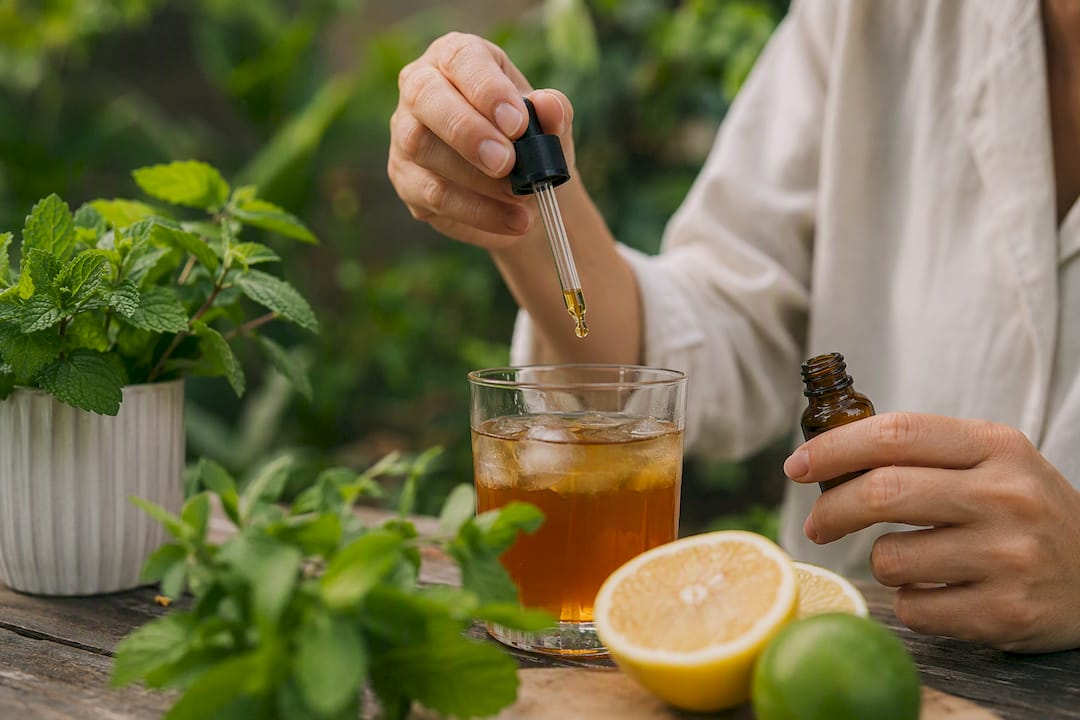
Pro Tip: Tilt your head slightly forward, not back, while holding the dose under your tongue. Tilting back encourages you to swallow early, which cuts your hold time short and reduces how much gets absorbed through the mucosa instead of your gut.
How Do You Calculate Tincture Dosage Correctly?
Always calculate your dose from the bottle’s total mg divided by total mL, never from counting drops. Dropper sizes vary between brands, and even between batches of the same product, so “two drops” means nothing without doing the math first.
The formula is simple: total mg of THC or CBD ÷ total mL in the bottle = mg per mL. From there, you multiply that number by however many milliliters you’re taking.
A beginner-friendly titration plan looks like this:
- Start at 1 to 2.5 mg and hold that exact dose for two to three sessions before touching anything else.
- Increase in small steps, roughly 1 to 2.5 mg at a time, only after you know how the current dose feels.
- Give each new dose at least 90 minutes to fully show its effects before judging whether to adjust again.
- Keep notes. What you took, when, and how you felt at 30 and 90 minutes.
Skip counting individual drops as your unit of measurement. Oil-based tinctures are thicker than alcohol ones, which changes drop size on the same dropper, and dropper variability is one of the most common reasons people accidentally take double the dose they intended.
How Long Do Tinctures Take to Kick In?
Held under the tongue, most tinctures start working in 15 to 45 minutes. Swallowed straight down, or mixed into food, they behave much more like an edible: 30 to 90 minutes or longer before you feel anything, but with effects that tend to last several hours.
That gap comes down to absorption route. Sublingual administration lets cannabinoids reach the bloodstream through the mucosa in your mouth, partly skipping the liver’s first-pass processing. Swallow it instead and it travels through your digestive system first, where THC converts into 11-hydroxy-THC, a metabolite that a Phase I crossover study found forms in greater amounts after oral dosing and tends to produce stronger, longer effects.
A few things shift these windows around:
- Body chemistry. Metabolism, body weight, and tolerance all move onset time in either direction.
- Empty vs. full stomach. Food, especially fat, slows and sometimes intensifies swallowed doses.
- Alcohol. Combining it with a tincture can amplify sedation unpredictably.
How Do You Make Cannabis Tinctures at Home?
Three home methods cover almost every use case: alcohol extraction (sometimes called Green Dragon), oil infusion, and glycerin tincture. Alcohol gives you the fastest, strongest extraction and the longest shelf life. Oil is the friendliest for cooking. Glycerin is the mildest tasting and works well if you want to avoid alcohol entirely.
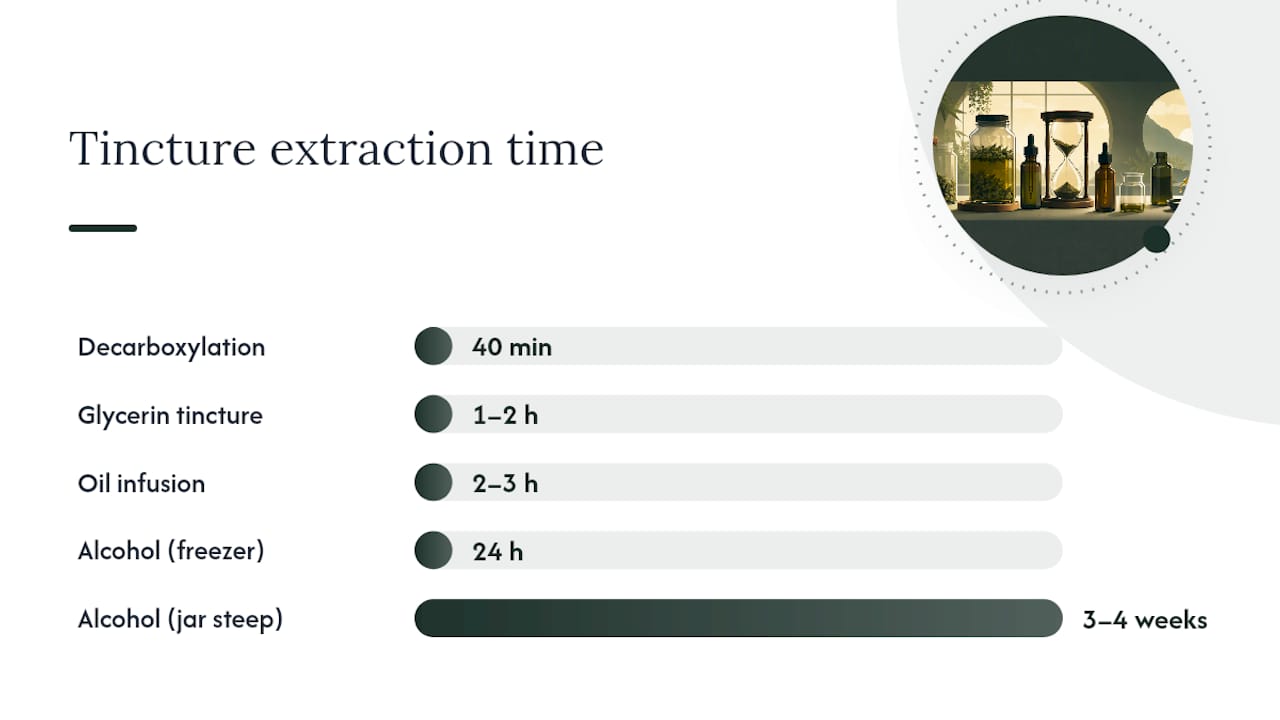
Before any of these, you need to decarboxylate your cannabis. Raw flower contains THCA, not THC, and THCA doesn’t get you high until it’s converted by heat. Spread ground flower on a parchment-lined tray and bake at 240°F for 40 minutes, stirring once halfway through. Skip this step and your tincture will be far weaker than expected, regardless of which base you use.
Alcohol tincture (Green Dragon):
- Decarb your flower as described above.
- Place it in a mason jar and cover with high-proof food-grade alcohol.
- Seal and store somewhere dark for 3 to 4 weeks, shaking daily. (A faster freezer method exists: freeze the jar for 24 hours, shake vigorously, then strain immediately, though it extracts less efficiently.)
- Strain through cheesecloth into a dark dropper bottle.
Oil infusion:
- Decarb your flower.
- Combine with MCT or olive oil in a double boiler.
- Simmer at low heat (under 200°F) for 2 to 3 hours, stirring occasionally.
- Strain and bottle.
Glycerin tincture:
- Decarb your flower.
- Mix with food-grade vegetable glycerin in a double boiler.
- Heat gently for 1 to 2 hours, well below boiling, since glycerin can scorch.
- Strain and bottle.
To estimate potency, use the same math from the dosage section: if you infused 3.5 grams of flower testing at roughly 20% THC (roughly 700 mg total, accounting for decarb loss) into 2 ounces (about 60 mL) of alcohol, you’d land near 11 to 12 mg/mL, though home extraction efficiency varies enough that this should be treated as a conservative estimate, not a guarantee.
Pro Tip: High-proof alcohol is flammable. Never heat it directly on a stovetop, and always work in a ventilated space away from open flame.
Alcohol vs. Glycerin vs. Oil: Which Base Should You Use?
Alcohol wins on speed and shelf life. Glycerin wins on taste. Oil wins if you plan to cook with your tincture or want something that pairs naturally with fats.
- Alcohol: Fast onset, strong potency, shelf-stable for years, but it stings and carries a sharp taste that some people find hard to tolerate straight.
- Glycerin: Alcohol-free, sweet, gentle on the mouth, but generally lower potency and a shorter shelf life than alcohol.
- Oil (MCT or olive oil): Neutral taste, blends easily into food, but slower onset and shorter shelf life than alcohol.
If discretion and dosing speed matter most, reach for alcohol. If you’re cooking or reinfusing into recipes, oil is the practical choice. If you just want something that doesn’t taste harsh under your tongue, glycerin is your best bet.
How Should You Store a Tincture, and How Long Does It Last?
Store any tincture in a dark glass bottle, in a cool spot away from direct light, tightly capped. Alcohol-based tinctures last the longest, often two years or more. Oil infusions hold up for roughly six months to a year. Glycerin tinctures are stable but can absorb moisture over time since glycerin is hygroscopic, so keep the cap sealed tight.
- Keep bottles below room temperature, ideally in a cabinet, not a sunny windowsill
- Shake before each use since cannabinoids can settle
- Watch for cloudiness, a sour smell, or separation as signs it’s time to toss it
What Safety Precautions Should You Know Before Using Tinctures?
The most common side effects are drowsiness, dry mouth, and impaired coordination, all of which fade as the dose wears off. If you take too much, the best response is to stay calm, hydrate, and rest somewhere comfortable until it passes; it’s uncomfortable, not dangerous, in the vast majority of cases.
- Dry mouth and mild dizziness are common and temporary
- Impaired coordination means don’t drive or operate machinery after dosing
- Overdoing it typically resolves within a few hours with rest and water
If you take medications processed by the liver, particularly ones metabolized through CYP450 enzymes, talk to a clinician before combining them with cannabis tinctures. This matters more than people expect, since cannabinoids can slow how quickly the liver clears certain drugs, including some blood thinners and sedatives, which can intensify their effects unpredictably.
Cannabis legality and purchase rules vary significantly by jurisdiction, even within the same country. Buy and consume tinctures only where it’s legal to do so, and check your local regulations before you order anything, since possession limits and purchase age requirements differ by state and country.
Can You Cook With Cannabis Tinctures?
Yes, tinctures work well in food and drinks, but heat can reduce potency depending on temperature and cook time. Add your tincture after cooking whenever possible, especially with anything that goes above 300°F in an oven, and use your mg/mL math to convert your intended dose into the right volume for the recipe. Just remember: once swallowed in food, a tincture behaves like an edible, meaning slower onset and a longer-lasting effect than the sublingual route.
What Does the Research Say About Sublingual vs. Oral Dosing?
Controlled pharmacokinetic studies consistently show earlier Tmax (the time to reach peak blood concentration) for sublingual routes compared to swallowed doses, though individual variability is substantial across every study on the topic.
A four-way crossover study comparing sublingual, buccal, oro-pharyngeal, and oral capsule administration of a cannabis-based extract found earlier peak concentration with sublingual dosing, along with markedly higher levels of 11-hydroxy-THC after oral capsules, a metabolite tied to stronger, more sedating effects.
Formulation matters too. Research on sublingual delivery systems, including cyclodextrin-complexed THC, shows that how a tincture is engineered can meaningfully change how much cannabinoid actually reaches your bloodstream. What this means practically: two people taking the same labeled dose of the same tincture can feel noticeably different effects, which is exactly why tracking your own response session to session matters more than following someone else’s dosing chart.
Why We Built This Guide the Way We Did
We wrote this guide the way we’d want a friend to explain tinctures to us: straightforward math, honest about the variability, no shortcuts on safety. Cannabis tincture guidance only means something if the products behind it are trustworthy, which is the entire reason Say Less insists on lab-tested tinctures with clear mg/mL labeling on every bottle we carry.
Ready to Try a Lab-Tested Tincture?
Making your own tincture at home teaches you the math, but it also means living with estimated potency and a few weeks of steeping before you get to test anything. If you’d rather skip the guesswork entirely, Say Less carries lab-tested tinctures and infused products with mg/mL printed clearly on the label, so your first dose is exact instead of estimated.

Browse curated brands like CRU Cannabis and Florist Farms, or ask a staff member in-store for help matching a product to your experience level and desired dose. Whatever you choose, buy and use only where it’s legal, and always check the lab report before your first dropper. Start with a low dose, see how it feels, and go from there.
Frequently Asked Questions
How many mg of THC should a beginner start with in a tincture?
Most guidance points to 1 to 2.5 mg for sensitive users, or 2.5 to 5 mg for those with some cannabis tolerance, always checked against the bottle’s mg/mL label.
Is a tincture stronger than an edible?
Held sublingually, a tincture often kicks in faster than an edible. Swallowed, it behaves almost identically to one, with a similar delayed onset and longer duration.
Can I use a cannabis tincture in coffee or tea?
Yes. Add it after brewing rather than during heating to preserve potency, and expect edible-like timing since you’re swallowing it.
How long do homemade tinctures last?
Alcohol-based tinctures typically last two years or longer if stored in a cool, dark place; oil infusions last roughly six months to a year.
Do tinctures show up differently on a drug test than smoking?
The active compound, THC and its metabolites, is what’s detected either way; the delivery method doesn’t change what a standard test looks for.
This article is general information, not a substitute for advice from a qualified doctor. Consult a qualified healthcare professional about your own circumstances before acting on anything here.
Sources
- Cannabis tinctures 101: How to make, consume, and dose them
- A Phase I, Open Label, Four-Way Crossover Study to Compare the Pharmacokinetic Profiles of a Single Dose of 20 mg of a Cannabis Based Medicine Extract (CBME)