
For most adults, a cannabis vape high lasts roughly 1–3 hours total, with onset in under 5 minutes and peak effects arriving within 10–30 minutes. That window shifts considerably based on what you’re vaping, how much, and your personal tolerance.
Quick reference by product type:
- Cartridges and distillate pens: onset in 2–5 minutes, peak at 10–20 minutes, total duration 1–2.5 hours
- Dry herb vaporizers: onset in 3–8 minutes, peak at 15–30 minutes, total duration 1.5–3 hours
- Live resin, rosin, and dabs: onset nearly immediate, peak at 5–15 minutes, total duration 2–4+ hours
The four variables that move those numbers most are dose and potency, the cannabinoid and terpene mix in the product, your personal tolerance, and how you structure the session (number of puffs, spacing, inhalation depth). Everything else in this article unpacks those four levers.
Key Takeaways
Vaping cannabis typically produces onset within 2–8 minutes, a peak within 10–30 minutes, and total effects lasting 1–3 hours for most adults, though concentrates and repeated dosing can push that to 4 hours or beyond.
| Point | Details |
|---|---|
| Typical vape high duration | Most adults experience 1–3 hours total; concentrates and heavy sessions can extend to 4+ hours. |
| Onset and peak timing | Onset arrives in 2–8 minutes; peak effects typically land within 10–30 minutes of the first puff. |
| Blood THC vs. impairment | Blood THC can return to near-baseline while cognitive impairment persists; don’t drive for at least 3–4 hours. |
| Dose before re-dosing | Wait 10–15 minutes after each puff before deciding to take another; stacking hits during the peak window extends duration unpredictably. |
| Saylessny product selection | Lab-tested cartridges and concentrates with batch COAs are available for pickup or same-day delivery across NYC. |
Table of Contents
- What determines how long a vape high lasts
- Onset, peak, and total duration compared across methods
- How your device and material change the experience
- How many puffs does it take, and how should you dose?
- Safety, impairment, and why blood THC doesn’t tell the whole story
- Practical steps to manage or shorten a strong high
- Lab testing, product safety, and how to choose a vape you can trust
- A note on vaping responsibly, from Say Less
- Where to find lab-tested vapes in NYC
- Sources
What determines how long a vape high lasts
Dose and THC potency
The total milligrams of THC you actually absorb matters far more than the percentage on the label. What drives duration is absorbed dose, not label concentration. Higher absorbed doses generally produce both a stronger peak and a longer tail.
Cannabinoid and terpene profile
THC is the main driver, but it doesn’t work alone. CBD can blunt THC’s psychoactive intensity, which may shorten the felt duration of a high. CBN tends to add sedation. THCV, at low doses, may actually reduce THC’s effects, while at higher doses it can amplify them. Terpenes like myrcene and linalool are associated with more body-heavy, relaxing effects that can make a session feel longer even at the same THC dose. For a deeper look at how minor cannabinoids interact with THC, the differences are meaningful.
User biology
Body fat percentage matters because THC is fat-soluble. People with higher body fat may store and slowly re-release THC, which can extend the tail of a session. Metabolism speed, liver enzyme activity, sex, and age all influence how quickly THC is processed. A first-time user and a daily user vaping the same product will have dramatically different experiences, both in intensity and duration.
Session pattern
How you inhale shapes the outcome as much as what you’re inhaling. Long, slow draws held briefly in the lungs increase absorption. Short, quick puffs reduce it. Stacking multiple hits in the first 10 minutes before the first puff has fully peaked is one of the most common reasons people end up higher than intended, for longer than expected.
Pro Tip: Wait at least 10–15 minutes after your first puff before deciding whether to take another. The peak hasn’t arrived yet, and stacking hits during that window is how a 90-minute session becomes a four-hour one.
The flower session might peak at a comfortable level and fade in 90 minutes. The distillate session can push into territory that lasts well past two hours, especially for someone with moderate tolerance.
Onset, peak, and total duration compared across methods
A crossover clinical trial of adults who infrequently use cannabis found that vaporized cannabis produced stronger subjective effects and higher peak blood THC than the same doses smoked. Blood THC and heart rate peaked within 30 minutes and returned toward baseline within 3–4 hours, but subjective effects and cognitive impairment sometimes persisted up to about 6 hours.
| Method | Onset | Typical peak | Total duration |
|---|---|---|---|
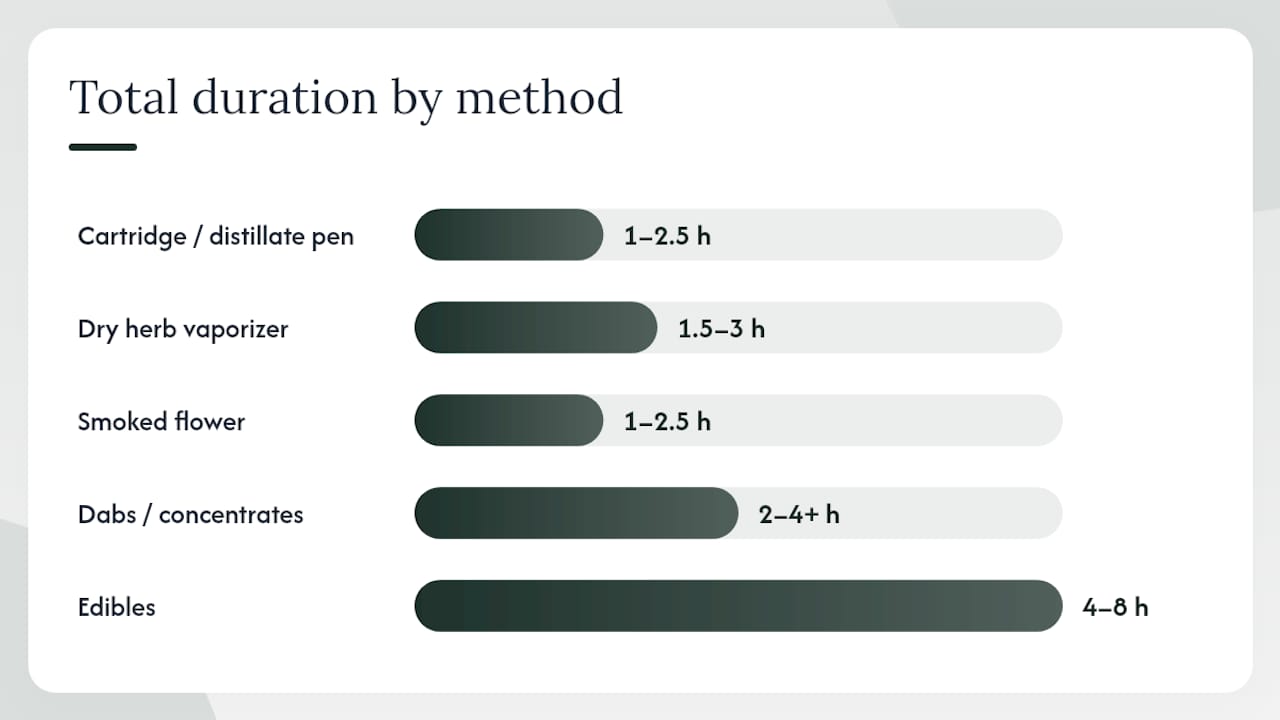
| Cartridge / distillate pen | 2–5 min | 10–20 min | 1–2.5 hrs |
| Dry herb vaporizer | 3–8 min | 15–30 min | 1.5–3 hrs |
| Smoked flower | 5–10 min | 20–30 min | 1–2.5 hrs |
| Dabs / concentrates | Under 2 min | 5–15 min | 2–4+ hrs |
| Edibles | 30–90 min | 1.5–3 hrs | 4–8 hrs |
A population pharmacokinetic analysis pooling data across multiple studies found vaping produces faster peak blood THC levels (reported at approximately 7.2 minutes) and higher estimated bioavailability (roughly 25%) compared with smoking (roughly 15%). The lung delivers THC directly into the bloodstream, bypassing the digestive system entirely.
Edibles work through a completely different mechanism. Research comparing oral and inhaled cannabis shows pharmacodynamic effects after oral ingestion can be delayed 30–60 minutes and often peak 1.5–3 hours post-dose. The liver converts THC into 11-OH-THC, a metabolite that crosses the blood-brain barrier more readily and produces a longer, often more intense experience. That’s why edibles catch people off guard, and why vaping is generally easier to titrate.
A few important caveats on the table above:
- Low-tolerance users often experience longer, more intense effects at any given dose
- Chronic daily users may find their subjective high compresses to 45–90 minutes even from concentrates
- Outlier sessions, particularly with dabs or repeated hits, can extend well past four hours
How your device and material change the experience
Device type
A basic 510-thread pen cart running at low voltage delivers a consistent, moderate dose per puff. A high-wattage mod or a desktop vaporizer like a Volcano pulls significantly more vapor per draw, which means more THC per inhalation and a faster, harder onset. Convection dry-herb vaporizers heat air rather than the herb directly, which tends to produce a cleaner, more gradual onset compared with conduction models that heat the herb itself. Temperature’s effect on terpene profiles is another layer worth understanding if you’re dialing in a specific experience.
Material type
- Distillate cartridges: high THC, often stripped of terpenes, predictable but sometimes flat in effect profile
- Live resin and rosin carts: full-spectrum, retain terpenes and minor cannabinoids, more nuanced and often longer-lasting effects
- Dry herb: lower THC per puff than concentrates, more gradual onset, easier to pace
- Dabs (wax, shatter, budder): highest THC per inhalation, fastest onset, longest potential duration, least forgiving for beginners
Temperature
Higher temperatures extract more cannabinoids per draw, which accelerates onset and can intensify the peak. But running a device too hot also degrades terpenes and can produce a harsher, less controlled experience. Some users find that lower-temperature sessions produce a more functional, shorter high, while high-temp sessions hit harder and linger longer.
Pro Tip: If you’re using a variable-voltage battery, start at the lowest setting (usually around 2.4–2.8V for most 510 carts). You’ll get a cleaner flavor, better terpene preservation, and more control over how quickly effects build. Dial up only if the draw feels insufficient.
How many puffs does it take, and how should you dose?
There’s no universal answer, but there’s a useful framework. That’s enough for a noticeable effect in most people with low to moderate tolerance.
For beginners:
- Take one small, slow puff (2–3 seconds).
- Exhale normally. Do not hold the vapor in; research on vaporized THC dosing shows holding vapor longer does not meaningfully increase absorption but does increase irritation.
- Wait 10–15 minutes. Assess how you feel.
- If effects are mild and comfortable, take a second puff.
- Stop there for the session. Effects will continue building for another 10–20 minutes.
For regular users:
Tolerance compresses both the felt intensity and the duration of a high. Regular users often need more material to reach the same subjective state, but that doesn’t mean stacking hits rapidly is the right approach. Spacing puffs 10–15 minutes apart gives you better control over where you land. Vaping multiple sessions across a day? Allow at least 2–3 hours between sessions to let effects fully resolve before re-dosing.
A note on concentrates: dabs and live resin hits can deliver 10–30 mg of THC in a single draw. That’s a very different proposition from a standard cart puff. Beginners should avoid concentrates entirely until they have a clear sense of their tolerance with lower-potency products.
Safety, impairment, and why blood THC doesn’t tell the whole story
The blood THC problem
A PubMed-indexed review confirms what many researchers have noted for years: blood THC concentration is often a poor standalone indicator of impairment. Levels can return to near-baseline while cognitive and psychomotor effects are still measurably present. This matters enormously for anyone making decisions about driving or operating equipment.
Research distinguishing subjective intoxication from blood THC adds another layer: vaping commonly produces rapid subjective effects that can dissipate faster than some other methods, which may encourage re-dosing behavior. Users feel like the high is fading when measurable impairment may still be present.
University of Sydney researchers studying cannabis intoxication timing found that assessing impairment for driving purposes requires careful timing of assessments, precisely because subjective and objective impairment don’t always align.
Driving and legal implications
Don’t drive or operate heavy machinery for at least 3–4 hours after vaping. For beginners or after a heavy session, that window should extend to 6 hours or longer. U.S. laws on cannabis-impaired driving vary by state, but most states have zero-tolerance or per se THC limits for drivers. Criminal and administrative consequences can apply even when you feel fine. When in doubt, wait longer.
Safety checklist
- Stop vaping immediately if you feel anxious, dizzy, or overwhelmed
- Seek medical attention for chest pain, severe vomiting, or altered consciousness
- Don’t mix cannabis with alcohol, which significantly amplifies impairment
- Keep cannabis products secured away from children and pets
- Never drive based on how you feel; base it on time elapsed since last dose
Practical steps to manage or shorten a strong high
If a session goes further than intended, a few things genuinely help and several popular remedies don’t.
What to do:
- Stop vaping immediately. Adding more THC to manage too much THC makes no sense.
- Drink water. Hydration doesn’t metabolize THC faster, but it helps with dry mouth and keeps you grounded.
- Eat something. Food won’t cut the high short, but it can reduce nausea and help you feel more stable.
- Move to a calm, familiar environment. Anxiety from cannabis is heavily context-dependent; a quiet room with low stimulation helps.
- Breathe slowly and deliberately. A slow 4-count inhale, brief hold, and 6-count exhale activates the parasympathetic nervous system and reduces acute anxiety.
- Use a distraction. A familiar show, music you like, or a simple task can redirect attention away from the discomfort.
What doesn’t work as advertised:
- Cold showers: they may temporarily sharpen alertness but don’t accelerate THC metabolism
- Coffee: caffeine can increase heart rate and anxiety, making a bad high worse
- “Sweating it out” through exercise: THC stored in fat can actually release during intense exercise, potentially extending effects
What may actually help:
CBD has some evidence behind it as a modulator of THC’s psychoactive effects. Taking a CBD product during an uncomfortable high may reduce intensity for some people, though responses vary considerably and the evidence is limited. Time remains the most reliable solution.
Pro Tip: Keep a CBD tincture or capsule on hand if you vape regularly. A dose of 25–50 mg CBD taken at the start of an unexpectedly strong session may take the edge off without fully ending the experience. Results vary, and this isn’t a guaranteed fix.
If you experience severe chest pain, uncontrollable vomiting, extreme confusion, or loss of consciousness, seek emergency medical care immediately.
Lab testing, product safety, and how to choose a vape you can trust
The single biggest variable in predicting vape high duration is product consistency.
What a certificate of analysis (COA) tells you
A COA is a third-party lab report that should accompany every legal cannabis product. Here’s what to look for:
- Potency panel: THC, THCA, CBD, and total cannabinoids. This tells you what you’re actually getting, not just what the label claims.
- Residual solvents: Distillate carts use solvents in extraction. A clean COA shows levels below state-mandated limits.
- Heavy metals: Lead, arsenic, cadmium, and mercury can concentrate in cannabis plants. A passing COA confirms they’re within safe limits.
- Pesticides: Particularly relevant for flower and live resin products where the full plant is used.
- Terpene profile: Tells you which terpenes are present and at what concentration, which helps predict the character of the effect.
Batch-level vs. product-level COAs
A product-level COA tests one sample from a production run. A batch-level COA tests the specific batch you’re buying. Batch-level is meaningfully more informative because potency can vary across a production run. Licensed dispensaries in New York are required to carry products that meet state testing standards, which provides a baseline level of protection that unlicensed sources cannot offer.
Pro Tip: Before buying a new cart or concentrate, ask to see the COA or look it up on the brand’s website using the batch number on the packaging. If a brand doesn’t publish batch-level COAs, that’s worth noting.
For a practical example of what a well-documented vape product looks like, the Ayrloom Cereal Milk vape review walks through what to expect from a lab-tested, licensed product in terms of potency and effect profile.
A note on vaping responsibly, from Say Less
Vaping cannabis is one of the more controllable ways to consume, but controllable doesn’t mean automatic. The clinical research is clear: subjective effects can outlast blood THC, re-dosing too early is the most common way to overshoot, and the gap between a pleasant session and an overwhelming one is often just one extra puff taken too soon.
At Saylessny, the approach is straightforward: carry products with accessible COAs, curate from brands that take testing seriously, and make it easy for customers to ask questions before they buy. Whether you’re picking up in-store at The Bronx location or using same-day delivery across NYC, the staff can walk you through potency, terpene profiles, and what to expect from any product on the menu. Responsible use starts with knowing what you’re actually consuming.
Where to find lab-tested vapes in NYC

If you want predictable vape high duration, the product you start with matters as much as how you dose it. Saylessny carries a curated selection of lab-tested cartridges, disposables, and concentrate options from brands that publish their COAs.
For cartridges and disposable vapes, the Cannabals brand page is a strong starting point, with options across potency levels and effect profiles. If you’re drawn to live resin and concentrate-based products that tend to produce longer, fuller-spectrum effects, Koa Cannabis Co. offers live resin infused options worth exploring.
Both in-store pickup at The Bronx and same-day delivery across NYC are available. Before you buy, ask for the batch COA on any product you’re considering. The Saylessny team can pull that information for you in-store, or you can browse the full menu at Saylessny and order online.
Sources
The following sources informed this article. Individual responses to cannabis vary, and these references are for educational purposes only.
- Acute Effects of Smoked and Vaporized Cannabis in Healthy Adults Who Infrequently Use Cannabis: A Crossover Trial | Cannabis | JAMA Network Open | JAMA Network
- PubMed indexed review about THC blood concentration and impairment
This article is for general informational purposes only and is not a substitute for medical, legal, or professional advice. Cannabis laws and regulations vary by state; confirm current rules with your state’s relevant authority or a qualified professional.