
No — carrying cannabis edibles on a commercial flight is not legally permitted under U.S. federal law. TSA officers who discover suspected cannabis are required to refer it to local law enforcement, regardless of your departure state’s legalization status. That referral is not discretionary.
Three things to know before you pack:
- Hemp-derived products at ≤0.3% Δ9‑THC are federally legal under the 2018 Farm Bill, but TSA officers cannot verify THC concentration on sight — if it looks or smells like cannabis, expect a referral.
- FDA-approved cannabinoid medications (such as Epidiolex or dronabinol) travel under different rules than dispensary products; carry the original prescription packaging and a physician’s letter.
- Buy at your destination. It is the single most effective way to eliminate airport risk entirely.
Pro Tip: Many major airports, including LAX and Denver International, have amnesty boxes near security checkpoints where you can surrender cannabis products before screening with no legal penalty. Use them.
Table of Contents
- What the TSA actually says about flying with edibles
- Federal law vs. state law: why state legalization usually doesn’t protect you when flying
- Practical risk differences: checked bag vs. carry-on vs. international flights
- What can happen if TSA or police find edibles at the airport?
- Special guidance for medical marijuana patients: documentation, risks, and safer alternatives
- Recent TSA wording changes and the myths they created
- Key Takeaways
- The real reason we tell customers to leave it at home
- Saylessny: legal cannabis in NYC, ready when you land
- Authoritative sources for deeper reading
What the TSA actually says about flying with edibles
The TSA’s official screening policy is built around one priority: aviation security. Drug detection is not part of the mission. TSA officers are not looking for your gummies — but if they find them, the policy is unambiguous.
That referral is where your fate shifts from TSA policy to local law enforcement discretion. The TSA itself has no authority to arrest you; the responding officer does.
The 2018 Farm Bill created a narrow federal carve-out: hemp defined as cannabis containing no more than 0.3% Δ9‑THC on a dry weight basis is federally legal. CBD oils, hemp gummies, and similar products that meet this threshold are technically permissible. In practice, the checkpoint still creates risk, because TSA officers are not chemists.
| TSA stance | Typical checkpoint outcome | Traveler action |
|---|---|---|
| Does not search for drugs | No proactive cannabis screening | Pack compliantly; remove risk items before checkpoint |
| Must refer discovered cannabis to law enforcement | Local officer assesses; outcomes vary by jurisdiction | Use amnesty box if you have cannabis products |
| Hemp/CBD products technically permitted | Officer may still flag if appearance/odor triggers suspicion | Carry certificate of analysis (COA) for hemp products |
| Medical marijuana: “Yes (Special Instructions)” on TSA tool | Still referred to law enforcement if found | No federal exemption; plan alternatives instead |
Pro Tip: If you travel with hemp-derived CBD products, carry a certificate of analysis from the manufacturer showing Δ9‑THC at or below 0.3%. It won’t guarantee smooth passage, but it gives you documentation if questions arise.
Federal law vs. state law: why state legalization usually doesn’t protect you when flying
State cannabis laws stop at the airport door. Airports and the aircraft above them operate under federal jurisdiction, which means the Controlled Substances Act governs, not New York’s MRTA or California’s Prop 64. Cannabis remains a Schedule I controlled substance under federal law, full stop.
The legal hierarchy works like this:
- Federal law controls airports and aircraft — The FAA regulates airspace; the TSA operates under the Department of Homeland Security. Both are federal agencies operating under federal statutes.
The practical consequence: a traveler flying from a state where cannabis is fully legal to another legal state is still committing a federal offense the moment they pass through a TSA checkpoint with cannabis. State legalization is a defense against state prosecution, not federal prosecution.
| Legal framework | What it covers | What it doesn’t cover |
|---|---|---|
| State cannabis laws | Possession, purchase, and use within state borders | Federal property, airports, aircraft, interstate transport |
| 2018 Farm Bill | Hemp products ≤0.3% Δ9‑THC | Cannabis above that threshold; dispensary edibles |
| Controlled Substances Act | Federal scheduling of cannabis as Schedule I | No exemption for state-legal products or medical cards |
| FAA/TSA jurisdiction | All commercial airports and aircraft | No carve-out for legal-state travelers |
Practical risk differences: checked bag vs. carry-on vs. international flights
The location of your edibles changes how they’re discovered, not whether discovery triggers a referral.
Carry-on bags go through X-ray at the security checkpoint. If a TSA officer spots something suspicious, they open the bag on the spot. You are present. The interaction is immediate.
Checked bags are screened separately, often by automated systems. If flagged, TSA may open the bag without you present and leave a notice. The referral to law enforcement still happens; you just may not know until you land.
International travel is a different category of risk entirely. Destination-country customs laws apply the moment you land, and some countries impose severe penalties for any cannabis-derived product, including hemp CBD. Thailand, Japan, and the UAE have imposed criminal sentences for amounts that would be legal in most U.S. states. Deportation, fines, and imprisonment are documented outcomes.
The “I flew with it once and nothing happened” logic is genuinely dangerous here. Checkpoint outcomes are effectively random: different airports, different local law enforcement units, different officers. An uneventful past trip is not a reliable predictor.
Risk-mitigation steps before you travel:
- Check all bags and remove any cannabis or cannabis-adjacent products before leaving for the airport.
- Research whether your departure airport has amnesty boxes and use them if needed.
- For international travel, check the U.S. State Department’s country-specific travel advisories and the destination country’s customs rules directly.
- Plan to purchase at your destination rather than transport from home.
Pro Tip: If you’re traveling to a legal state, look up licensed dispensaries at your destination before you leave. Most states with legal cannabis have online menus and same-day pickup options, so you’re never more than a short drive from what you need.
What can happen if TSA or police find edibles at the airport?
The sequence after discovery is fairly consistent, even if the outcome isn’t.
- TSA officer discovers suspected cannabis — during screening (carry-on X-ray, bag check, or physical inspection).
Typical outcomes range widely:
- Arrest and criminal charges — more likely with larger quantities, in states without legalization, or when the officer determines federal trafficking statutes apply.
Pro Tip: If you are stopped and questioned, cooperate with the screening process. You are not required to answer questions beyond what’s needed for security screening. If you are detained by law enforcement, ask for an attorney before making any statements.
Special guidance for medical marijuana patients: documentation, risks, and safer alternatives
A state-issued medical marijuana card carries no legal weight on federal property. Airports are federal property. That card will not prevent a TSA referral, and it will not protect you from federal prosecution.
What documentation actually helps — and what it doesn’t:
- Doctor’s letter: Useful for explaining a medical need, but not a legal shield against federal law.
- Original prescription packaging: Required for any prescription medication, including FDA-approved cannabinoids. Epidiolex (cannabidiol) and dronabinol are FDA-approved and travel under standard prescription rules.
- State medical card: Establishes state-level authorization only; no federal protection.
- Certificate of analysis: Helpful for hemp-derived CBD to document THC content; does not apply to dispensary cannabis products.
Safer alternatives for patients who need cannabis-based relief while traveling:
- Consult your prescribing physician before travel about FDA-approved alternatives (Epidiolex, dronabinol, nabilone) that travel under standard prescription rules.
- Research licensed dispensaries at your destination. Most legal states have online dispensary menus with same-day pickup, so you can plan your supply before you land.
- Ask your physician about telemedicine options in your destination state if you need a local recommendation.
- For nausea, sleep, or anxiety, ask about non-cannabis alternatives your physician can prescribe for the travel period.
Pro Tip: If you rely on cannabis for a specific medical condition, contact a dispensary at your destination in advance. Many will hold an order for pickup, and some offer delivery. You can also explore edibles for nausea or other condition-specific products available locally.
Recent TSA wording changes and the myths they created
In 2026, TSA updated its “What Can I Bring?” tool to display “Yes (Special Instructions)” for medical marijuana, replacing a flat “No.” The internet interpreted this as TSA loosening its stance. It did not.
NORML confirmed that the wording change was a clarity edit, not a policy change. The “Special Instructions” text links directly to the same referral-to-law-enforcement language that has always governed TSA’s response to discovered cannabis.
Common myths the wording change amplified:
- Myth: TSA now allows medical marijuana — False. The referral policy is unchanged.
The bottom line: the TSA website is a reference for screening procedures, not a source of legal permissions. What changed was a display label. What didn’t change is the federal law governing cannabis transport.
Key Takeaways
Flying with cannabis edibles is a federal violation under the Controlled Substances Act, and TSA’s referral-to-law-enforcement policy applies regardless of state legalization, medical status, or the 2026 wording update.
| Point | Details |
|---|---|
| Federal law governs airports | Cannabis remains Schedule I; state legalization provides no protection at TSA checkpoints or on aircraft. |
| TSA refers, not arrests | TSA officers refer discovered cannabis to local law enforcement; outcomes vary by jurisdiction and officer discretion. |
| Hemp exception is narrow | Only products with ≤0.3% Δ9‑THC qualify under the 2018 Farm Bill; dispensary edibles do not meet this threshold. |
| International risk is severe | Some countries impose criminal penalties for any cannabis product; never transport edibles across international borders. |
| Saylessny offers a safer path | Travelers heading to NYC can order lab-tested edibles from Saylessny for pickup or same-day delivery, eliminating airport risk entirely. |
The real reason we tell customers to leave it at home
The legal risk of flying with edibles is real and unevenly enforced, which is actually the most dangerous part. Predictable consequences are manageable; random ones aren’t. When a traveler’s outcome depends entirely on which officer responds and what jurisdiction they’re in, the risk-reward calculation doesn’t hold up.
What I find most overlooked in the coverage of this topic is the interstate trafficking angle. Most people think about the checkpoint moment — will TSA find it? — and not about what they’re actually doing legally, which is transporting a federally controlled substance across state lines. That’s a different charge than simple possession, and it applies even when both states have legal cannabis markets.
The 2026 TSA wording update made this worse by giving travelers a false sense of progress. “Yes (Special Instructions)” sounds like permission. It isn’t. The instruction is still “we will call law enforcement.” The only thing that changed was the label on a website tool.
For medical patients, the calculus is harder, and I have genuine sympathy for anyone managing a condition who has to navigate this. But the answer isn’t to gamble on checkpoint discretion. It’s to plan ahead: find a dispensary at your destination, talk to your doctor about travel-safe alternatives, and use the legal infrastructure that exists rather than the one you wish existed.
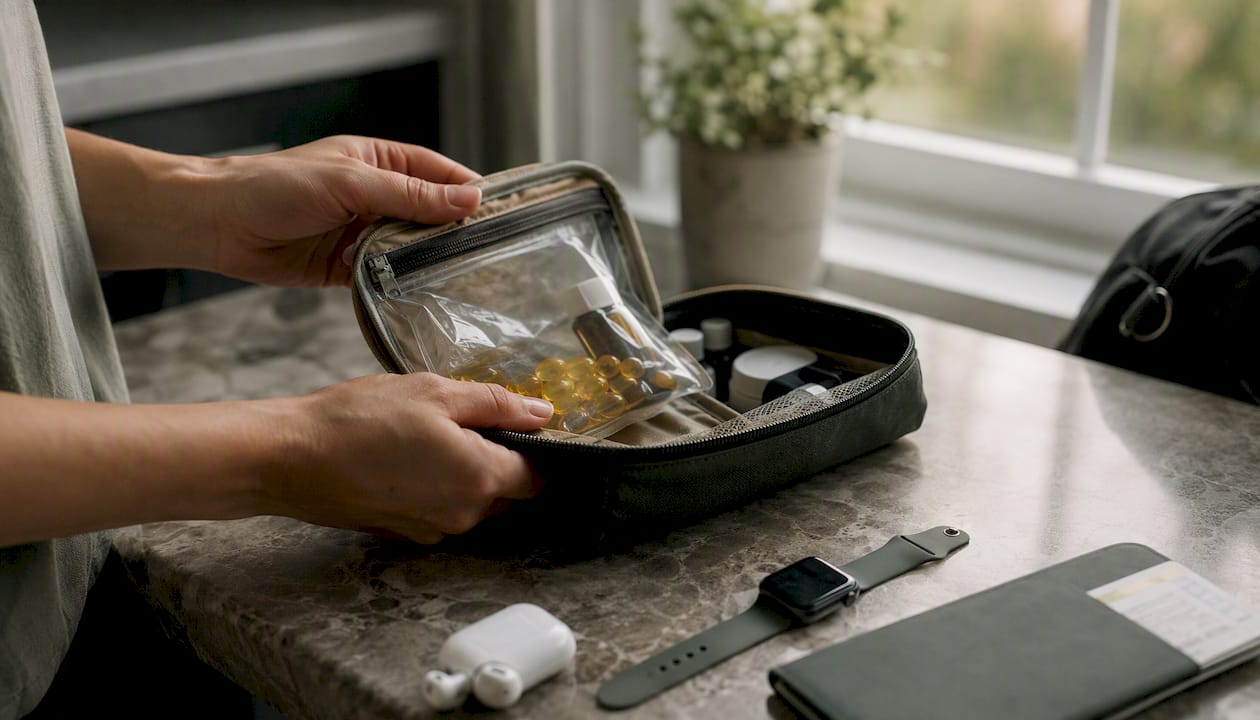
The safest trip is the one where your cannabis is waiting for you when you land, not packed in your carry-on.
Saylessny: legal cannabis in NYC, ready when you land
If you’re traveling to New York City, the airport risk disappears the moment you land and order from a licensed dispensary. Saylessny, The Bronx’s premier recreational dispensary, carries lab-tested edibles from premium brands with same-day delivery across NYC — no guesswork, no checkpoint anxiety, no legal exposure.

The menu includes flower, pre-rolls, vapes, concentrates, and a full edibles selection from brands like Jeeter and Florist Farms, all verified for potency and compliance with New York state law. Every product is lab-tested, accurately labeled, and available for pickup or delivery the same day you order. If you want to know what’s legal to buy in New York before your trip, that page covers current state rules in plain language. Order online at saylessny.com and have your order ready for pickup or delivery when you arrive.
Authoritative sources for deeper reading
These are the primary federal and expert sources that govern this topic. When in doubt, go to the source.
| Source | What it covers |
|---|---|
| TSA Medical Marijuana page | Official TSA policy on cannabis at checkpoints; referral language and screening procedures |
| TSA screening overview | Full security screening policy and the “What Can I Bring?” tool |
| DEA Drug Scheduling | Federal scheduling of cannabis under the Controlled Substances Act |
| USDA/AMS Hemp Legal Opinion | 2018 Farm Bill hemp definition and the ≤0.3% Δ9‑THC threshold |
| NORML on TSA wording change | Expert explanation of what the 2026 TSA wording update did and didn’t change |
| cannabistravel.org airport rules | Practical guide to federal jurisdiction at airports and checkpoint outcomes |
| USA Today travel explainer | Reporting on international penalties and domestic enforcement variability |
This article is general information, not legal advice. Cannabis laws change frequently and vary by jurisdiction. Confirm current rules with the relevant federal agencies or a qualified attorney before traveling.