
When exploring the world of cannabis concentrates, choosing between shatter vs. wax can feel overwhelming due to their vastly different textures, appearances, and handling styles. While both of these popular extracts deliver a highly concentrated dose of cannabinoids, they appeal to very different preferences and dabbing setups. Understanding these key differences is the secret to finding the perfect match for your personal cannabis ritual.
Cannabis Extracts: A Beginner’s Primer
At its core, a cannabis extract is a highly concentrated form of the plant’s active ingredients. To make these concentrates, processors typically use a solvent like butane or carbon dioxide to strip the cannabinoid-rich trichomes away from the raw plant material. This process is commonly known as Butane Hash Oil (BHO) extraction.
The resulting oil is packed with tetrahydrocannabinol (THC), CBD, and flavorful terpenes. Once the solvent is completely purged in a vacuum oven to ensure a clean and safe product, the remaining concentrate is refined into various textures. While raw flower usually tops out at around 15% to 30% THC, legal concentrates regularly reach potencies between 60% and 90%+.
For consumers in New York, sourcing these products from a licensed dispensary ensures that all solvents have been fully purged and the final concentrate is completely safe to consume.
What Is Shatter? (The Glass-Like Classic)
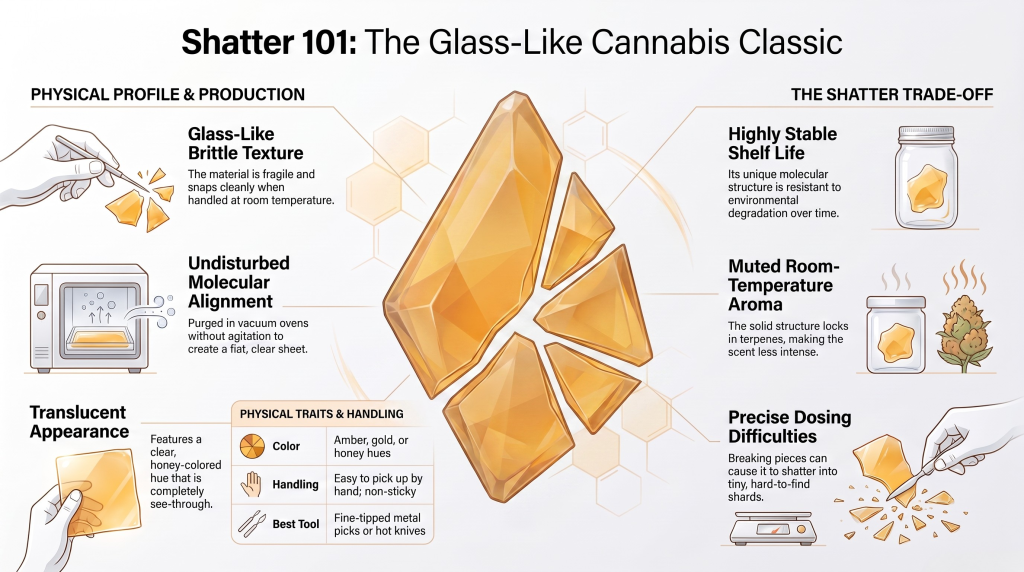
Shatter is famous for its clean, translucent look and its signature glass-like texture. It is one of the most visually distinct concentrates on the market.
+-------------------------------------------------------------+
|                       SHATTER AT A GLANCE                   |
+-------------------------------------------------------------+
|  Texture: Glass-like, brittle, snaps when bent              |
|  Appearance: Translucent, amber/gold, clear                 |
|  Best Tool: Fine-tipped metal picks or hot knives           |
+-------------------------------------------------------------+
Appearance, Texture, and Physical Features
Shatter typically features an amber, honey, or golden hue. It is completely translucent, meaning you can see right through it. True to its name, it has a brittle, fragile texture that snaps like thin glass when handled at room temperature.
How Shatter Is Made
Shatter is made by keeping the extracted cannabis oil completely still during the purging process. Once the cannabinoids and terpenes are extracted, the mixture is poured onto flat trays and placed in a vacuum oven. By avoiding any agitation, stirring, or rapid temperature swings, the molecules align perfectly. This undisturbed cooling process forms a flat, clear, glassy sheet.
Pros and Cons of Shatter
- Pro: Long Shelf Life. The molecular structure of shatter makes it highly stable and resistant to environmental degradation.
- Pro: Easy to Handle by Hand. You can often pick up a small piece of shattered glass with your fingers without leaving a sticky residue behind.
- Con: Hard to Portion. Because it is brittle, trying to break off a small dose can cause the piece to shatter into tiny, hard-to-find shards.
- Con: Muted Aromas. The stillness required to make shatter sometimes locks in the terpenes, making it smell less intense than other concentrates at room temperature.
What Is THC Wax? (The Versatile Crowd-Pleaser)
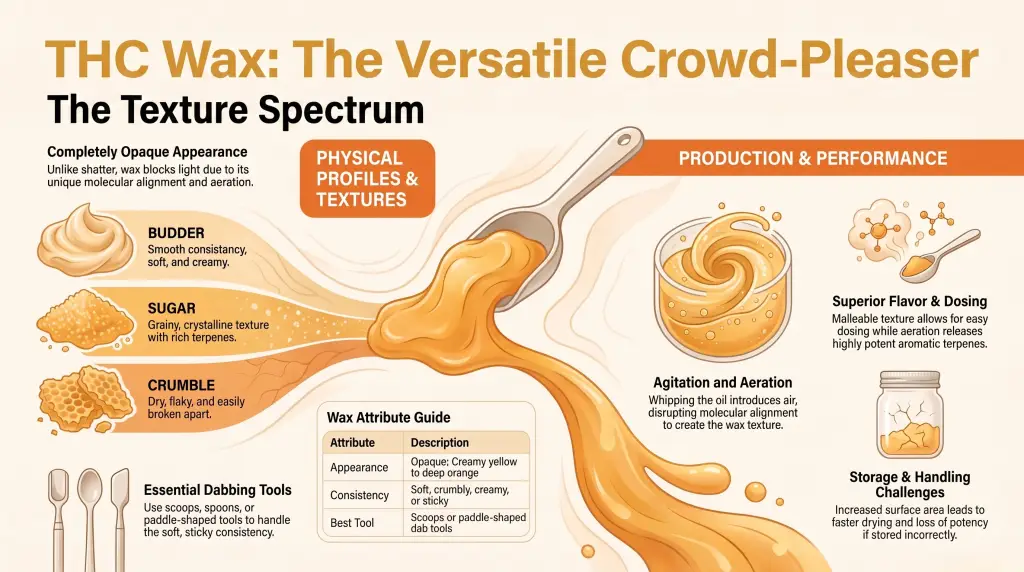
THC wax represents the softer, highly aromatic side of BHO concentrates. It is beloved by extract enthusiasts for its rich flavor profiles and malleable consistency.
+-------------------------------------------------------------+
|                         WAX AT A GLANCE                     |
+-------------------------------------------------------------+
|  Texture: Soft, crumbly, creamy, or sticky                  |
|  Appearance: Opaque, creamy yellow to deep orange           |
|  Best Tool: Scoops, spoons, or paddle-shaped dab tools      |
+-------------------------------------------------------------+
Appearance, Texture, and Physical Features
Unlike shatter, wax is completely opaque. It does not let light pass through it. Depending on the moisture content and how it was finished, wax can take on several distinct sub-textures:
- Budder/Badder: Smooth, whipped, and creamy, resembling warm butter or cake frosting.
- Sugar: A wet, grainy texture that looks like raw sugar mixed with honey.
- Crumble: A dry, flaky form of wax that easily breaks apart.
How Wax Is Made
Wax starts with the exact same extraction process as shatter. However, during or after the vacuum purging stage, the extract is actively agitated. By whipping, stirring, or shaking the oil while applying gentle heat, processors introduce air into the mixture. This agitation disrupts the molecular alignment, causing the cannabinoids to crystallize and trap tiny pockets of air and liquid terpenes.
Pros and Cons of Wax
- Pro: Easy to Dose. The soft, clay-like consistency makes it incredibly easy to scoop up the exact size dose you want with a dab tool.
- Pro: Rich Aroma and Flavor. Whipping the concentrate releases the aromatic terpenes, making wax smell and taste highly potent right out of the jar.
- Con: Shorter Shelf Life. The whipped texture exposes more surface area to air, meaning it can dry out or lose potency faster if stored incorrectly.
- Con: Sticky Cleanup. Wax melts quickly on your fingers, making it nearly impossible to handle without a proper tool.
What is Crumble? (The Dry, Terpy Alternative)
If shatter and wax represent opposite ends of the moisture spectrum, crumble sits comfortably in the middle as a dry, easy-to-use alternative.
Appearance, Texture, and Key Features of Crumble
Crumble has a matte, honeycomb-like appearance and a very dry, powdery texture. It easily falls apart when handled. Because it contains less moisture and surface lipids than creamy budder, it is not sticky to the touch.
How Crumble Compares to Shatter and Wax
Crumble is purged at lower temperatures for a longer period of time, often under a deeper vacuum. This slow, dry purge removes almost all residual moisture while preserving a massive amount of terpenes. Compared to shatter, it is much easier to portion out. Compared to wax, it is far less sticky, making it a favorite for those who want a mess-free dabbing experience.
Shatter vs. Wax: Head-to-Head Comparison
To help you decide which concentrate deserves a spot in your setup, let’s look at how they perform head-to-head across several key categories.
| Feature | Shatter | THC Wax |
|---|---|---|
| Texture | Glass-like, brittle, solid | Creamy, crumbly, or sticky |
| Transparency | Translucent (Clear) | Opaque (Cloudy/Solid) |
| Average THC Potency | 70%−90% | 60%−85% |
| Terpene Profile | Moderate / Muted | High / Highly aromatic |
| Handling Method | Finger-friendly / Sharp tools | Scoop-shaped dab tools |
| Storage Stability | Very high (Long-lasting) | Moderate (Prone to drying) |
Physical Consistency and Molecular Stability
Shatter is the king of stability. Its molecules are locked in a tight, orderly grid that resists change. Wax is much more volatile; its whipped, airy structure makes it prone to changing textures if it gets too warm.
Potency and THC Concentration
While both are incredibly strong, shatter occasionally edges out wax in raw THC percentages. Because shatter is more refined and holds fewer terpenes and plant lipids, it can sometimes reach up to 90% THC. Wax usually settles between 60% and 85%. However, wax offers a more balanced “entourage effect” due to its higher retention of diverse cannabinoids and terpenes.
Terpene Profiles: Which Delivers the Best Flavor Profile?
Wax almost always wins the flavor battle. The whipping process and lower heat processing used for many premium waxes keep the fragile, aromatic terpenes alive. If tasting the distinct, skunky, or fruity notes of a specific cannabis strain is your priority, wax is your best bet.
Ease of Use: Loading Your Dab Rig vs. a Portable Vape Pen
Loading a portable vape pen or a pocket-sized wax pen is much easier with wax or crumble. Because wax sticks easily to a dab tool, you can gently place it directly onto a heating coil without it rolling away. Shatter, on the other hand, can snap and fly across the room if you try to load it into a small vape chamber without warming the tool first.
Why Shatter Turns Into Wax: The Science of Nucleation
Have you ever left a slab of clear, beautiful shatter in your drawer only to find a cloudy, sugared-up mess a few weeks later? This is a natural process called nucleation.
Nucleation occurs when the cannabinoids (mainly THC-A) begin to separate from the liquid terpenes and plant lipids. In a perfect slab of shatter, these elements are evenly distributed in an unstable, glass-like state. Over time, exposure to warmth, humidity, or even light prompts the THC-A molecules to pull away from the liquid mixture and bind together into crystals.
As these crystals form, the shatter loses its transparency and turns into a sugary, wax-like consistency. While “sugared” shatter might not look as pretty, it is still completely safe to consume and often smells even stronger because the trapped terpenes have been released to the surface.
Optimal Temperature Guide: Vaporizing Shatter vs. Wax
To get the most out of your extracts, you need to control your dabbing temperature. Vaporizing at the wrong temperature can burn away the flavorful terpenes or leave behind a puddle of wasted oil.
Low-Temp Dabbing:  315°F - 450°F  ==> Best for Flavor (Wax)
High-Temp Dabbing: 450°F - 550°F  ==> Best for Vapor Production (Shatter)
Best Temperatures for Low-Temp Terpene Preservation
- Ideal Range: 315∘F to 450∘F (157∘C to 232∘C)
- Best For: THC Wax, Budder, and Sugar.
- At these lower temperatures, you preserve the delicate terpene profiles. This delivers an incredibly smooth, flavorful hit that won’t irritate your throat, though it produces thinner clouds.
Best Temperatures for High-Temp Vapor Production
- Ideal Range: 450∘F to 550∘F (232∘C to 288∘C)
- Best For: Shatter.
- Because shatter is dense and chemically stable, it requires slightly more heat to vaporize cleanly. Dabbing shatter at this range produces thick, heavy, and highly satisfying vapor clouds.
- Note: Avoid going above 600∘F (315∘C), as this will instantly scorch your concentrate and ruin the flavor.
Choosing the Right Tools: Dab Rigs, Pens, and Accessories
Using the wrong tool for your concentrate is a recipe for sticky fingers and wasted product. Pairing your extract with the right hardware makes a world of difference.
Best Dab Tools for Brittle Shatter (Blades and Picks)
Because shatter is solid, a flat, blade-like tool or a sharp, pointed pick works best. You can use the blade to slice cleanly through a sheet of shatter.
Dabber Tip: Gently heat the tip of your metal dab tool with your torch for just one second before touching your shatter. The warm tool will melt smoothly into the shatter, allowing you to pick up a perfect piece without it snapping or flying away.
Best Dab Tools for Sticky Wax and Budder (Scoops and Spoons)
Sticky wax, creamy budders, and dry crumbles require tools that can scoop. Use a tool with a spoon-shaped tip, a small paddle, or a hollow cup. These designs let you scoop up a neat portion of wax and drop it directly onto your hot banger or heating coil without making a mess.
How to Store Your Concentrates in New York’s Changing Seasons
New York weather is notoriously unpredictable. Between humid, scorching summers and freezing, radiator-heated winter apartments, your concentrates face a constant battle against the elements.
Storing Shatter: Why Parchment Paper Beats Glass
Shatter should always be stored wrapped in food-grade silicone-coated parchment paper. Keeping it flat inside parchment paper preserves its shape and prevents it from sticking to itself. Avoid storing shatter loose in glass jars; if the room gets warm, the shatter will melt, stick to the bottom of the glass, and become incredibly difficult to scrape out.
Storing Wax: Why Glass Jars Beat Silicone
Wax and budder should always be stored in small, airtight glass or ceramic jars. Because wax contains volatile terpenes, it can actually act as a mild solvent over time. If kept in a silicone container for months, the terpenes can degrade the silicone, leaving you with dry, ruined wax. Airtight glass keeps those precious terpenes locked inside the jar.
Combating NY Humidity: Keeping Your Stash Cool and Dark
Moisture is the enemy of all concentrates. If steam from your shower or heavy summer humidity gets into your concentrate jar, it can cause the oil to crackle and spit when it touches your hot banger.
- Keep your jars in a cool, dark drawer or a dedicated lockbox.
- For long-term storage, you can use a refrigerator, but always let the cold jar sit at room temperature for 10 to 15 minutes before opening it. This prevents condensation from forming inside the container.
Buyer’s Guide: Which Concentrate is Right For You?
Are you still torn on which concentrate to choose for your next session? Use this quick checklist to find your perfect match.
- Choose Shatter if: You want a highly potent, stable extract that lasts a long time, you prefer handling your concentrates with your hands, and you enjoy thick, heavy vapor clouds.
- Choose Wax if: You prioritize mouth-watering flavor, you want an extract that is incredibly easy to scoop and dose, and you use a portable vape pen or e-rig.
- Choose Crumble if: You want the rich terpene profile of wax but prefer a dry, non-sticky texture that is easy to load without a mess.
Frequently Asked Questions
Which is stronger, shatter or wax?
Shatter can occasionally have a slightly higher THC concentration due to its refined manufacturing process. However, the difference is usually minimal. Both extracts are incredibly potent and will deliver a much stronger effect than traditional cannabis flower.
Can you put wax or shatter in a joint?
Yes! You can add both to a joint, a method often called “twaxing.” You can break shatter into tiny shards and mix them inside with your ground flower, or roll wax into a thin snake-like shape and wrap it around the outside of your rolled joint.
Can I touch shatter with my hands?
Yes, shatter is generally stable enough to touch with dry, clean hands without melting instantly. However, try to handle it quickly, as the natural warmth from your fingertips will eventually cause it to soften and stick to your skin.
Why is my shatter sticky and bendy instead of glass-like?
This usually means the shatter has a slightly higher terpene content, or it has been exposed to warm temperatures and humidity. It is still perfectly safe to use; it has simply moved closer to a pull-and-snap or wax-like consistency.
Does wax degrade faster than shatter?
Yes. Because wax has an airy, whipped texture, it has more surface area exposed to oxygen. This causes the terpenes to evaporate faster and the cannabinoids to degrade quicker than they would in a dense sheet of shatter. Always keep your wax jars tightly sealed.
Experience the Best NY Concentrates with Say Less
No matter where you fall in the shatter vs. wax debate, the most important factor in your dabbing experience is starting with clean, legally tested, premium extracts.
At Say Less, we bridge the gap between authentic New York cannabis culture and safe, state-licensed products. Located right in the heart of the Bronx on East Tremont Ave, our dispensary is fully stocked with the finest concentrates, vaporizers, flower, and accessories the legal market has to offer.
Don’t feel like making the trip? We’ve got you covered. We offer fast, discreet, same-day delivery right to your door across NYC. Save yourself the hassle, get the good stuff, and let the quality speak for itself.
Visit the Say Less online menu today to browse our fresh selection of premium shatter, wax, and dabbing accessories, or swing by our Bronx dispensary to chat with our expert budtenders!