
Choosing between Badder vs. Diamonds can feel overwhelming given the massive variety of cannabis concentrates available today. While both options deliver an incredibly elevated experience compared to traditional flower, they cater to completely different preferences. This comprehensive guide will break down the structural, chemical, and experiential differences between these two premium extracts so you can decide which one is right for your next session.
Understanding Cannabis Concentrates: Why Texture Matters
Cannabis concentrates are highly refined extracts that isolate the most desirable compounds of the plant, namely cannabinoids and terpenes, while filtering out raw plant matter. When browsing the shelves at a licensed dispensary, you will notice these extracts come in a vast array of textures, from crumbly waxes to sticky oils.
The texture of a concentrate is not just for looks. It dictates how the extract handles on your tool, how it melts, and how it vaporizes on a hot surface. A wet, sticky texture requires a scoop-style tool, while a hard crystalline structure requires a pointed pick. Understanding these physical properties is the first step toward a seamless dabbing experience.
The Chemical Difference: THCA vs. THC
To truly understand premium concentrates, you need to understand the science of the plant. Both badder and diamonds are typically rich in Tetrahydrocannabinolic Acid (THCA). THCA is the raw, non-psychoactive precursor to THC that exists naturally in live cannabis plants.
When you apply heat to THCA during the dabbing process, a chemical reaction called decarboxylation occurs. This heat instantly removes a carboxyl group from the chemical structure, converting the raw, non-intoxicating THCA into active, intoxicating Delta-9-THC. While both concentrates rely on this heat conversion, the way these molecules are structured inside the extract changes everything about your session.
What Is Badder?
Badder (sometimes spelled batter) is a cannabis concentrate known for its creamy, uniform, and cake-batter-like consistency. It is highly sought after by those who want a balanced, aromatic, and easy-to-manage extract.
The Science: The Whipping and Purging Process
The smooth texture of badder is achieved through meticulous post-extraction processing. After the initial extraction using a solvent like butane or propane, extraction technicians apply low heat while continuously whipping the material.
This mechanical whipping processes forces residual solvents out while evenly trapping a uniform mixture of cannabinoids and volatile terpenes. Instead of allowing the compounds to separate, the whipping action creates a stable, homogenized emulsion that looks and feels like thick frosting.
Why People Love It
- Easy Handling: It has a highly malleable, scoopable texture that stays securely on your dab tool without making a mess.
- Intense Aroma: Because the terpenes are whipped directly into the mixture, opening a jar of badder immediately releases a loud, fragrant aroma.
- Consistency: Every single scoop contains the exact same ratio of cannabinoids and terpenes, ensuring a predictable experience every time.
The Vapor Experience
A hit of badder delivers a highly smooth, well-rounded experience. Because the terpenes are perfectly integrated throughout the cream, the flavor is front-and-center from the moment the extract hits the heated surface. The vapor expands smoothly in the lungs, producing a balanced head-and-body high that highlights the unique characteristics of the specific cannabis strain.
Best For
Badder is an excellent option for everyday dabbers, flavor chasers, and beginners. Its forgiving consistency makes it incredibly easy to dose and handle, removing the frustration often associated with stickier or harder concentrates.
What Are THC Diamonds?
THC diamonds are semi-transparent, gem-like crystalline structures that represent the peak of raw cannabinoid isolation. They look exactly like small diamonds or coarse sugar crystals and are renowned for their unmatched psychoactive strength.
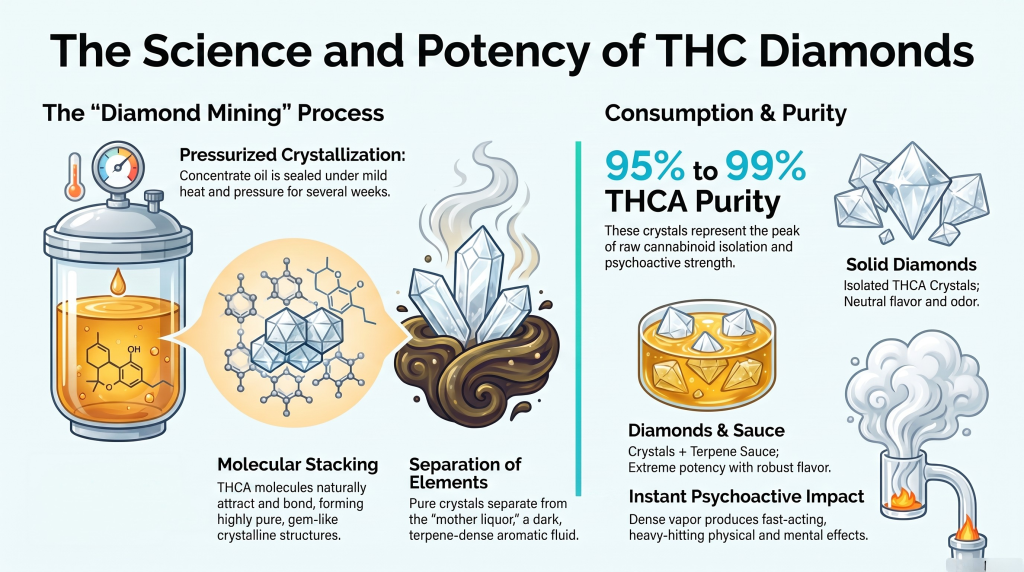
The Science: The “Diamond Mining” Crystallization Process
Creating diamonds requires a slow, precise technique often referred to as “diamond mining.” After extraction, the uncured concentrate oil is placed under mild heat and sealed inside a pressurized container for several weeks.
Over time, under constant pressure, the THCA molecules begin to separate from the rest of the mixture. The raw THCA molecules naturally attract one another, stacking and bonding together to form highly pure crystalline structures. The remaining liquid portion is a dark, terpene-dense fluid known as “mother liquor” or terpene sauce.
Why People Love Them
- Extreme Potency: Diamonds frequently reach purity levels of 95% to 99% THCA, making them the strongest concentrates on the market.
- Clean Effects: Because they are nearly pure cannabinoids, they provide an exceptionally clean, hard-hitting high without any plant interference.
- Customizable Sessions: Users can choose to dab the crystals completely raw or mix them with specific amounts of flavorful sauce.
Solid Diamonds vs. “Diamonds and Sauce”
When shopping for diamonds, you will typically find them in two forms. Solid diamonds consist of isolated, dry crystals that are completely neutral in flavor and odor. While incredibly strong, they lack the taste of the original plant.
To solve this, producers create Diamonds and Sauce, which reintroduces the pure crystals back into the intensely aromatic liquid terpene sauce. This combination provides the absolute best of both worlds: extreme potency paired with robust flavor.
The Vapor Experience
Dabbing a pure diamond produces a unique sensation. The vapor builds gradually in density, resulting in an incredibly intense, fast-acting psychoactive effect. Because the cannabinoid concentration is so high, the physical and mental effects take hold almost instantly, making it a very heavy-hitting option.
Best For
Diamonds are best reserved for high-tolerance users, experienced concentrate enthusiasts, and individuals looking for a premium, heavy-hitting session that delivers maximum psychoactive impact.
Head-to-Head Comparison: Badder vs. Diamonds
| Feature | Cannabis Badder | THC Diamonds |
| Consistency | Creamy, whipped, cake-batter texture | Hard, geometric crystalline shards |
| Average Potency | 60% – 80% THC | 95% – 99% THCA |
| Terpene Content | High (homogenized into the batter) | Low (unless paired with terpene sauce) |
| Handling Ease | Very easy (scoops and molds easily) | Moderate (can shatter or slide off tools) |
| Best Temperature | $500^\circ\text{F} – 550^\circ\text{F}$ ($260^\circ\text{C} – 287^\circ\text{C}$) | $550^\circ\text{F} – 600^\circ\text{F}$ ($287^\circ\text{C} – 315^\circ\text{C}$) |
Texture, Portioning, and Handling
Badder is expressive, soft, and highly sticky. You can easily cut through it with a paddle-style tool and pull away a perfectly measured dose. Diamonds, on the other hand, are rigid and solid. Portioning them requires breaking down the crystals into predictable shards, which can sometimes cause small pieces to snap off or slide off flat tools.
Flavor Profile, Terpene Content, and Entourage Effect
Because badder features a thoroughly blended mixture of cannabinoids and terpenes, it offers an immediate burst of flavor. This harmonious blend favors the Entourage Effect, a phenomenon where cannabinoids and terpenes work together synergetically to produce a deeper, more therapeutic high.
Pure diamonds offer almost no flavor on their own because terpenes do not form crystals. However, if you choose a “diamonds and sauce” option, you get an incredibly sharp flavor profile, though it functions more like two separate layers rather than a single unified blend.
Potency, Tolerance, and Psychoactive Effects
If potency is your primary goal, diamonds win by a landslide. With purity levels pushing 99%, a tiny crystal chunk delivers a concentrated dose that can quickly overwhelm a novice consumer. Badder sits comfortably in the 60% to 80% range, making it highly potent but noticeably more manageable for an average consumer’s daily routine.
Thermal Behavior: How Heat Affects Each Texture
- Badder: This extract liquefies and vaporizes almost instantly when it touches a heated surface. Because its delicate terpenes are exposed on the surface, overheating badder will instantly scorch it, creating a bitter, harsh taste.
- Diamonds: Because they are dense crystals, diamonds take slightly longer to melt completely down into a vaporizable liquid. They require a steady, sustained temperature to avoid wasting any unvaporized core material.
Shelf Life, Degradation, and Storage Requirements
Badder is highly sensitive to environmental factors. Because it is whipped and contains open pockets of air, it is highly prone to oxidation. If left uncovered or exposed to mild heat, it can quickly dry out, lose its aroma, or turn into a crumbly, crusty texture.
Diamonds are structurally far more stable. Because the THCA molecules are locked tightly inside a crystal lattice, they resist degradation from air and ambient heat far better, allowing them to retain their raw potency for extended periods.
Price Point, Market Availability, and Production Costs
The extensive labor, time, and specialized equipment required for the “diamond mining” process naturally positions diamonds as a luxury, top-shelf tier product. They are generally priced higher on dispensary menus. Badder is much faster and less expensive to manufacture at scale. This makes badder widely available and highly cost-effective for daily consumption.
Practical Guide: How to Dab Badder and Diamonds Properly
To get the most out of these premium concentrates, you need to tailor your approach to their unique physical traits.
The Right Tooling
A flat paddle or scoop-shaped dab tool is perfect for badder, allowing you to slice and gather the creamy paste cleanly. For diamonds, a pointed pick tool or specialized concentrate tweezers are ideal to firmly grip the hard crystals without causing them to shatter across your tray.
Optimal Dabbing Temperatures
To preserve the complex flavors of badder, keep your temperatures low, ideally between $500^\circ\text{F} – 550^\circ\text{F}$ ($260^\circ\text{C} – 287^\circ\text{C}$). This protects the fragile terpenes from burning.
For diamonds, raise the heat slightly to $550^\circ\text{F} – 600^\circ\text{F}$ ($287^\circ\text{C} – 315^\circ\text{C}$) or use an electronic rig. The slightly higher heat ensures the dense crystalline structures completely liquefy and vaporize efficiently.
Alternative Uses: “Twaxing” and Bowl Toppers
Diamonds offer great versatility because they can be crushed down into a fine powder. You can easily sprinkle this potent powder inside a joint or on top of a bowl of regular flower to supercharge its potency. Badder, due to its wet and sticky consistency, cannot be easily mixed into raw flower and is best reserved exclusively for a traditional glass rig or a portable concentrate pen.
The Verdict: Which Concentrate Should You Choose?
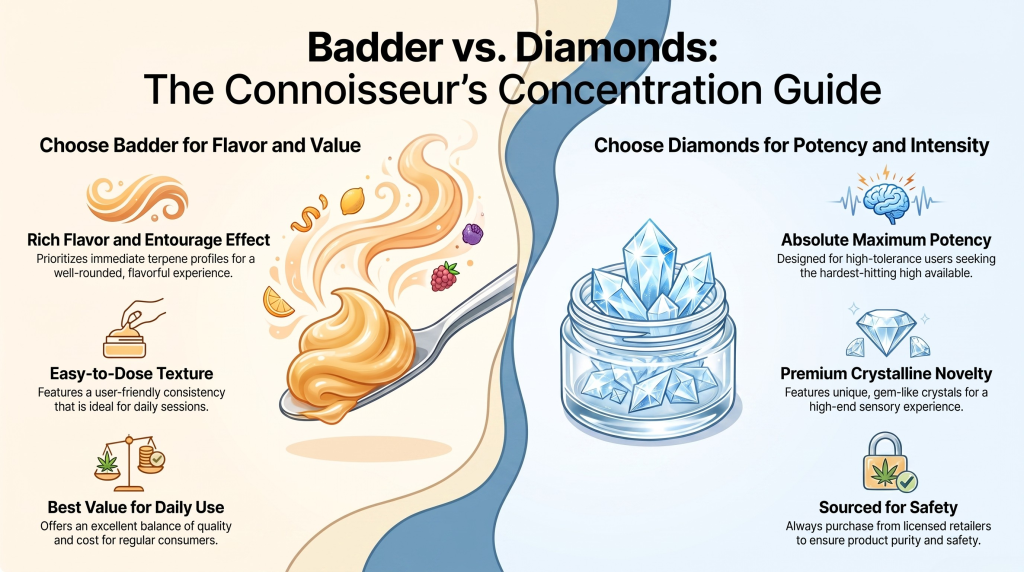
- Choose Badder If: You prioritize immediate flavor, prefer an easy-to-dose texture, enjoy a well-rounded entourage effect, and want an excellent value for your daily sessions.
- Choose Diamonds If: You have a high tolerance, want the absolute maximum potency per hit, enjoy the novelty of premium crystalline gems, and prefer a deeply intense, hard-hitting high.
No matter which texture aligns with your style, sourcing your extracts from an authentic, licensed retailer is vital to ensure safety and purity. For New York residents looking to explore top-shelf genetics and clean, lab-tested concentrates without the guesswork, Say Less NY provides a fully legal, premium selection rooted directly in the state’s authentic cannabis culture.
Frequently Asked Questions
Is badder stronger than sugar or crumble?
Not necessarily. Badder, sugar, and crumble generally fall into a similar potency bracket, typically ranging from 60% to 80% THC. The primary distinction between them lies in their post-extraction handling, which alters their physical texture and terpene retention rather than their raw psychoactive strength.
What is live resin badder vs. cured badder?
Live resin badder is crafted from fresh cannabis plants that are flash-frozen immediately after harvest, preserving the highest possible terpene content for maximum flavor. Cured badder is made from dried, cured cannabis buds, offering a deeper, more traditional profile with slightly fewer volatile terpenes.
Can you eat THCA diamonds directly for a high?
No. Raw THCA diamonds are non-psychoactive on their own. They must undergo decarboxylation through heat—such as being vaporized in a dab rig or smoked—to convert the inactive THCA into the active, intoxicating Delta-9-THC compound.
Are there solventless diamonds?
Yes. While most traditional diamonds are created using hydrocarbon solvents like butane, advanced extraction labs can now create solventless diamonds using mechanical heat and high pressure to isolate the THCA directly from premium live rosin.
Why does my badder look dried out or white?
If badder is exposed to air, light, or warm temperatures, the volatile terpenes will evaporate off the surface. This oxidation process dries out the smooth emulsion, leaving behind a chalky, pale, or crumbly appearance that lacks flavor.
Experience the Best New York Cannabis Culture Has to Offer
Finding the perfect balance of potency and flavor shouldn’t involve legal gray areas or questionable quality. Whether you prefer the creamy, terpene-rich experience of badder or the pure, heavy-hitting strength of premium crystals, Say Less NY delivers a fully licensed, lab-tested menu featuring New York’s absolute finest extracts. Skip the guesswork and elevate your next session with premium concentrates delivered straight to your door. Contact Say Less NY today to browse the curated menu or stop by the Bronx dispensary to speak with an expert budtender!