
If you have ever stared closely at a premium cannabis bud, you have likely marveled at the glittering, frost-like coating covering its surface. These sparkling crystals are called trichomes, and they are far more than just visual eye candy for cannabis connoisseurs. In this comprehensive guide, you will discover exactly what trichomes are, how they function, and how to preserve them to get the absolute best experience from your flower.
Trichomes in Plain English: What is the “Frost” on Cannabis?
Defining the Sticky Crystals on Your Buds
To the naked eye, trichomes look like a dusting of sugar or frost blanketing the leaves and flowers of the cannabis plant. Up close under a magnifying glass, however, they reveal themselves to be tiny, mushroom-shaped glandular structures. The word “trichome” originates from the Greek word trichōma, which translates to “growth of hair.”
These structures are the actual production houses of the cannabis plant. They are highly sticky to the touch because they are packed with dense, viscous resin.
A Quick, Real-World Analogy
Think of a cannabis plant like a citrus fruit tree. While an orange tree stores its fragrant, flavorful essential oils inside the rind of the fruit, the cannabis plant does the exact opposite. It projects its most valuable compounds outward, storing its aromatic oils and active ingredients inside these microscopic, external resin globes.
The Evolutionary Purpose: Why the Cannabis Plant Produces Trichomes
Cannabis did not evolve trichomes to satisfy human consumers; instead, these structures evolved as a brilliant survival mechanism. Because female cannabis plants must survive long enough to be pollinated and produce seeds, they require heavy protection from nature.
- Pest and Herbivore Defense: The thick, sticky resin acts as a natural deterrent. Creeping insects get trapped in the glue-like substance, while larger herbivores are put off by the bitter taste and pungent aromas.
- Natural Sunscreen: Just as humans need protection from solar rays, cannabis plants are sensitive to intense ultraviolet (UV) radiation. Trichomes act as a physical barrier, absorbing harmful UV-A and UV-B light to prevent the plant’s DNA from burning.
- Environmental Shielding: High winds and low humidity can quickly dry out a flowering plant. The dense layer of trichomes seals in moisture, insulating the delicate plant tissues against harsh winds and extreme temperatures.
Glandular vs. Non-Glandular: The Ultimate Breakdown of Trichome Types
Not all trichomes on a cannabis plant are created equal. Botanists categorize them into two primary umbrellas: non-glandular and glandular.
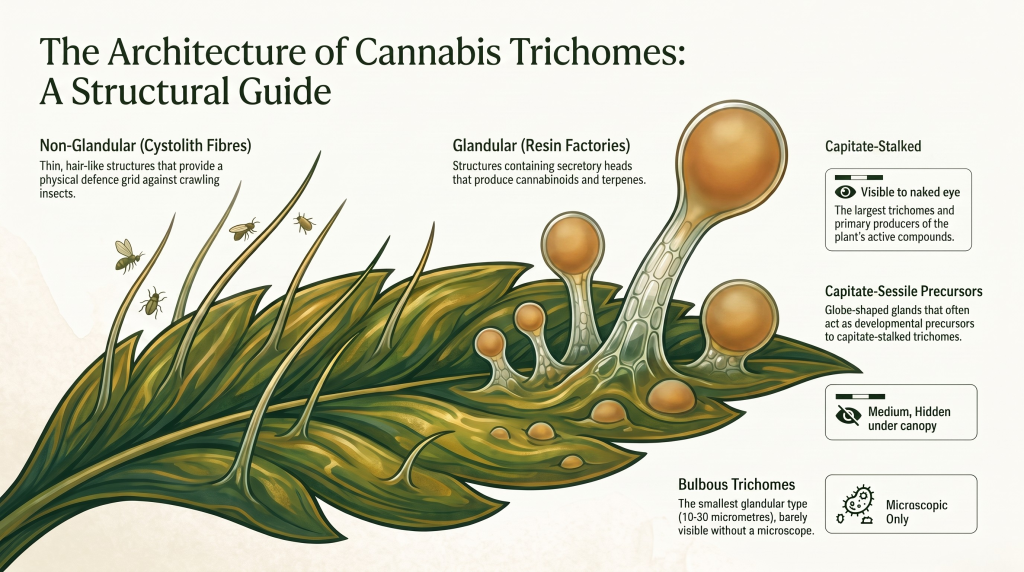
Non-Glandular Trichomes: The Mechanical Protectors
Known as cystolith fibers, these trichomes are thin, tapered, and resemble sharp little hairs. They do not contain a “head” and do not produce cannabinoids or terpenes. Instead, they provide a physical defense grid across the leaves, making it physically difficult for tiny insects to crawl across the plant’s surface.
Glandular Trichomes: The Resin Factories
Glandular trichomes possess a secretory head at the top of their structure, which acts as the chemical laboratory. There are three main types found on the cannabis plant:
- Bulbous Trichomes: These are the smallest of the group, measuring a tiny 10 to 30 micrometers. They are scattered evenly across the entire surface of the plant but are so small they can barely be seen without a powerful microscope.
- Capitate-Sessile Trichomes: Much larger than bulbous types, these possess a distinct globe-shaped head but lack a pronounced stalk. They sit flat against the plant tissue, hidden beneath the larger canopy of stalked glands.
- Capitate-Stalked Trichomes: These are the undisputed stars of the show. Ranging from 50 to 100 micrometers, they feature a distinct, elongated multicellular stalk topped by a massive secretory head. These are the “frost” particles you can easily see with the naked eye, and they produce the vast majority of the plant’s active compounds.
What the Latest Science Reveals About Glandular Precursors
Recent botanical research reveals a fascinating developmental lifecycle: capitate-sessile trichomes often act as precursors to capitate-stalked trichomes. As the female flower matures, hormonal shifts cause these stalkless glands to grow an elongated stem, lifting the secretory head into the air to maximize exposure to light and wind.
Inside the Trichome Head: The Chemical Factory
The round bulb at the tip of a capitate-stalked trichome is where the magic happens. The base of this head contains a disc of specialized secretory cells.
Biosynthesis in the Resinous Cavity
Using nutrients pulled up from the root system, these secretory cells synthesize lipids and plastids, transforming them into complex chemical compounds. These compounds are pushed upward into a resinous cavity, inflating the outer cuticle layer like a microscopic water balloon.
The Trichome’s Role in the “Entourage Effect”
Within this tiny resin bubble, the plant manufactures hundreds of different cannabinoids (like THC and CBD) right alongside aromatic compounds called terpenes (such as myrcene, limonene, and pinay-lin). When consumed together, these compounds interact synergistically. This phenomenon, known as the entourage effect, means that the combined profile of the trichome delivers a far richer, more balanced experience than any isolated chemical compound could achieve on its own.
Beyond THC and CBD: Flavonoids and Minor Cannabinoids
While major cannabinoids steal the spotlight, the secretory disc also produces vital minor cannabinoids (like CBG, CBC, and THCV) and flavonoids. Flavonoids provide the deep pigmentation and unique flavor notes of the smoke, working behind the scenes to fine-tune the consumer’s physiological response.
Reading the Trichome Rainbow: Colors as Maturity and Effect Indicators
For cultivators and discerning consumers alike, tracking the color shift of these microscopic heads provides an exact roadmap to the bud’s maturity and ultimate effects.
| Trichome Color | Stage of Maturity | Anticipated Chemical Effect Profile |
| Clear | Immature | Very low potency; clear heads indicate the cannabinoids have not yet fully formed. |
| Milky / Cloudy | Peak Maturity | Maximum THC concentration; delivers a highly potent, energetic, and cerebral effect. |
| Amber / Brown | Over-Mature | THC is actively breaking down into CBN; delivers a heavy, deeply relaxing, and sedative effect. |
Reading the Rainbow Accurately
It is important to remember that color is a helpful guide rather than a rigid rule. A single bud will never turn completely amber or perfectly milky all at once. Instead, a mature plant will exhibit a gradient across its surface.
Macro-Photography Mapping: Where You Look Matters
When analyzing maturity, looking at the “sugar leaves” (the small leaves growing out of the bud) can be deeply misleading. Sugar leaves mature much faster than the actual flower calyxes. True potency and maturity must be judged by inspecting the trichomes nestled deep within the interior clusters of the bud itself.
Consumer Guide: How to Spot Trichome-Rich Flower at the Dispensary
When walking into a dispensary, you can easily evaluate the quality of the shelf options by keeping a few sensory indicators in mind.
- Visual Cues: High-quality flower should appear distinctly crystalline, shimmering under ambient light. If the buds look dull, overly manicured, or completely bald, the delicate trichome heads have likely been stripped away by aggressive mechanical automated trimmers.
- Aroma Cues: Gently squeeze a bud or open its jar. A rich burst of complex aroma indicates that the trichomes are completely intact and actively venting their volatile terpenes. A faint smell of hay or grass indicates degraded, empty resin glands.
- Texture Cues: Premium flower should feel slightly spongy and noticeably sticky. If a bud crumbles into dry powder with zero tactile stickiness, the trichomes have completely dried out and lost their essential oils.
Landrace vs. Modern Cultivars
Ancient “landrace” strains native to rugged mountain ranges grew short, tightly bound trichomes to survive harsh environments. Thanks to decades of modern selective breeding, today’s advanced cultivars feature massively enlarged, crowded capitate-stalked trichomes designed to produce historic levels of resin output.
From Plant to Product: Trichomes, Kief, Hash, and Concentrates
Because trichomes contain almost all of the plant’s valuable properties, the entire cannabis extraction industry is dedicated to separating these tiny resin heads from the surrounding green plant material.
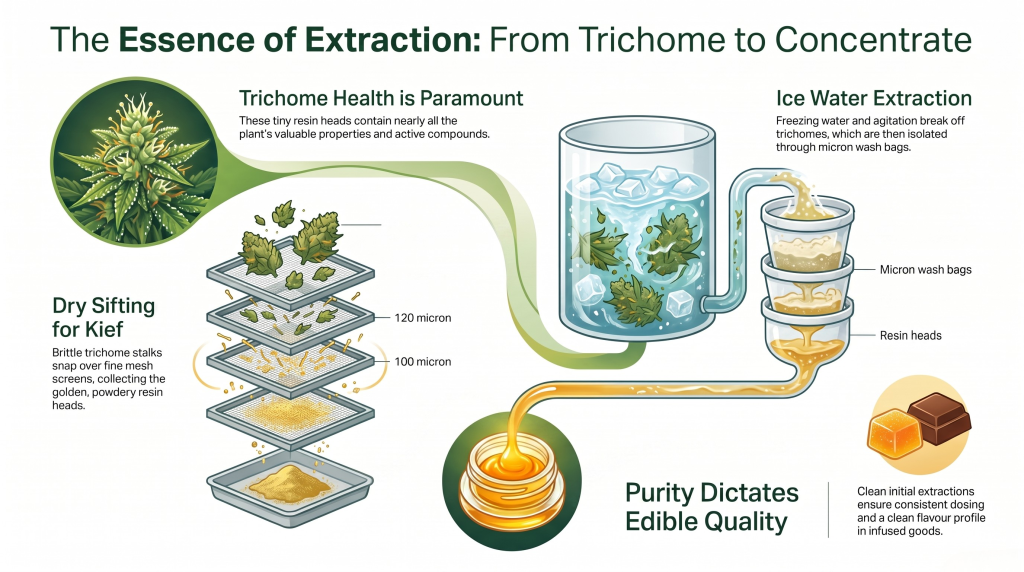
- Making Kief: By gently rubbing dry cannabis over a fine mesh screen, the brittle stalks snap, allowing the golden, powdery trichome heads to fall through. This collected powder is known as kief.
- Ice Water Extraction: By agitating buds in a bath of freezing ice water, the trichome stalks freeze and break off. The mixture is poured through multi-layered micron wash bags, isolating pure, unadulterated trichome heads to create premium bubble hash.
- Why Edible Consumers Should Care: Even if you prefer consuming infused baked goods, gummies, or sublingual tinctures over smoking, trichome health remains paramount. The purity and clean profile of the initial extraction dictate the clean flavor and consistent dosing of the final edible product.
The Science of Trichome Preservation: Consumption & Storage
Once trichomes are damaged or degraded, they cannot be recovered. Proper handling is the single most important factor in maintaining your flower’s shelf life and performance.
Vaporization vs. Combustion
When you light a joint or a bowl with a standard flame, the extreme heat (frequently exceeding 1000°F) instantly vaporizes and destroys a massive percentage of the trichomes before you can even inhale them. Utilizing a dry herb vaporizer allows you to gently heat the flower to precise boiling points, cleanly boiling off the resin inside the trichome head while preserving the delicate terpene profile.
Environmental Killers
Three environmental factors actively destroy your frost:
UV Light: Directly breaks down THC into CBN, causing your daytime strain to turn sleepy and weak.
Heat: Causes the volatile terpenes to evaporate out of the resin head, leaving behind a harsh, flavorless smoke.
Oxygen: Accelerates oxidation, drying out the outer protective cuticle of the trichome until it cracks open and spills its oils.
Mechanical Degradation
Rough handling is a silent killer. Storing your buds in loose plastic baggies creates static electricity, which physically pulls the fragile trichome heads right off the flower, leaving them stuck to the sides of the bag.
Optimal Storage Solutions
To keep your flower in pristine condition, always store your buds in airtight glass jars. Keep them in a cool, dark cupboard, and utilize specialized two-way humidity control packs to lock in a perfect 58% to 62% relative humidity level.
Common Trichome Myths Cleared Up
“Those long, orange hairs are the trichomes.”
- The Reality: Those bright orange or red hairs are actually pistils, the reproductive organs of the female plant meant to catch pollen. They contain virtually no cannabinoids or terpenes.
“More visible crystals automatically mean higher THC percentages.”
- The Reality: While high visual frost indicates a healthy plant, it does not tell you what is inside the resin. A strain completely white with frost could be a specialized hemp variety packed with 20% CBD and less than 1% THC.
“Amber trichomes exclusively indicate a heavy Indica couch lock.”
- The Reality: Amber heads simply signal that the THC has converted into CBN. While this introduces a heavy physical sensation, the base genetics of the strain (its unique terpene layout) still largely dictates the overall direction of the experience.
Conclusion: Prioritizing Trichome Health
Understanding the complex biology of trichomes transforms the way you view, shop for, and enjoy your cannabis. By learning to identify, respect, and preserve these microscopic powerhouses, you guarantee a cleaner, more flavorful, and predictable experience every single time.
If you want to experience pristine, expertly preserved cannabis flower that treats trichomes with the absolute highest level of care, turn to the experts at Say Less NY. Their dedicated team prioritizes premium sourcing and immaculate handling, ensuring that the valuable “frost” remains completely intact from the farm to your hands. Contact Say Less NY today to browse their elite selection or reach out directly to speak with a knowledgeable specialist.
Frequently Asked Questions (People Also Ask)
Can you smoke trichomes by themselves?
Yes. When trichomes are mechanically separated from the plant material, they form a powder known as kief. Kief can be smoked by itself, pressed into traditional hash, or sprinkled on top of regular flower to significantly boost potency.
Do autoflowering strains have fewer trichomes?
No. Modern autoflowering genetics have advanced significantly. Exceptional breeding ensures that contemporary autoflower strains are capable of producing just as dense a coating of resin and trichomes as traditional photoperiod strains.
What causes trichomes to fall off the plant?
Physical agitation, rough machine trimming, dropping your buds on hard surfaces, and static electricity from plastic packaging all cause the brittle stalks of the trichomes to snap, separating the valuable heads from your flower.
Why do some leaves have crystals while others do not?
The small leaves growing directly out of the flowering buds (sugar leaves) are highly concentrated with glandular trichomes. The larger, broad fan leaves located further down the plant are utilized primarily for photosynthesis and feature very few glandular trichomes.
Does freezing cannabis ruin the trichomes?
Freezing does not damage the chemical compounds themselves, but it does make the trichome stalks incredibly brittle. If you move or shake frozen cannabis, the trichomes will instantly snap off. This is actually the exact technique used to harvest resin for making bubble hash.