
When lighting a premium pre-roll, a thick, dark, glossy band of oil often forms just below the burning cherry. This phenomenon, known as the resin ring, has quickly become the ultimate visual test for top-shelf cannabis quality among true connoisseurs. Understanding the science behind this oil ring can elevate your entire smoking experience, helping you separate poorly cured street weed from truly exceptional flower.
What is a Resin Ring? (The Ultimate Flex of Good Weed)
Many smokers confuse the sticky golden ring on a paper with the dirty black tar left inside a glass pipe. However, these two substances are completely different in chemistry, purity, and taste.
Joint Resin vs. Sticky Pipe Residue
The material building inside a dirty pipe is called reclaim. Reclaim is mostly carbon by-product, ash, and heavily burnt plant waste. It smells bad and tastes worse.
In contrast, the resin ring on a joint is made of fresh, pure, liquefied active compounds. It is a highly concentrated mix of cannabinoids and aromatic oils that have melted together instead of burning away.
Trichomes: The Natural Oil Factories in Premium Flower
To understand where this oil comes from, look closely at raw cannabis buds. They are covered in tiny, frosty crystals called trichomes.
These microscopic, mushroom-shaped glands act as the plant’s natural chemical factories. Trichomes produce and store all the major active ingredients, including:
- THC and CBD: The primary cannabinoids responsible for the potency and medical effects.
- Terpenes: The volatile aromatic oils that give each strain its unique smell, flavor, and specific vibe.
When flower is packed with dense, healthy trichomes, it contains a massive amount of internal moisture and oil. When heat is applied, these microscopic pockets burst open, liquefying the oil and flooding the surrounding joint paper.
The “Oil Ring Test”: Why New York’s Connoisseurs Judge Flower by Its Bleed
In New York’s evolving cannabis culture, the presence of a bleeding resin ring is viewed as a badge of honor. It serves as visual proof that the flower inside the paper was grown cleanly, handled gently, and cured correctly. If a joint burns down to white ash while leaving a thick, syrup-like trail behind the cherry, you know you are smoking premium, untampered bud.
The Thermodynamics: How Heat Forces the Ring to Form
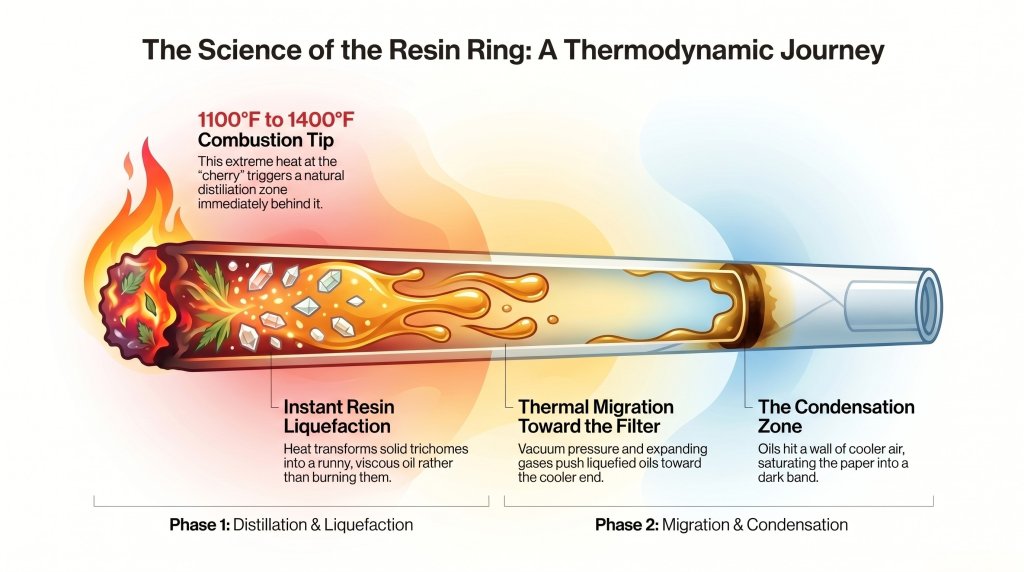
The creation of a resin ring is actually a beautiful lesson in thermodynamics and basic physics. It relies directly on structural shifts that happen when matter changes from a solid to a liquid, and then to a gas.
The Distillation Effect: How the Fire Element Liquefies Cannabinoids and Terpenes
When lighting a joint, the temperature at the glowing tip (the cherry) can reach upwards of 1100∘F to 1400∘F. This extreme heat easily destroys plant material, turning it to ash.
However, right behind that wall of fire is a highly sensitive zone of lower temperature. In this area, the heat acts as a natural distillation mechanism. Instead of burning the trichomes, it gently heats them past their melting points, instantly transforming solid resins into a runny, viscous oil.
Vapor Pressure & Thermal Migration: Why Melting Oils Flee Backward Into the Joint
As the smoker draws air through the filter, a vacuum pressure is created inside the joint. At the same time, gases expand rapidly near the hot cherry.
This environment creates a natural push-and-pull system. The newly liquefied cannabinoids and terpenes flee from the extreme heat of the tip, migrating backward along the inside of the rolling paper toward the cooler end of the joint.
Condensation Zone: Why the Resin Collects Right Behind the Burn Zone
As these hot, vaporized oils travel down the joint, they quickly hit a wall of cooler air and unburnt, room-temperature flower. This sudden temperature drop forces the gaseous oils to condense, cooling them back into a thick liquid state.
The liquid oils saturate the paper, creating a clear, dark band right at the boundary where the hot air meets the cool bud. As the joint continues to burn down, the cherry constantly melts this accumulated pool, pushing the ring forward in a continuous cycle.
Natural Factors: Choosing Flower That Bleeds
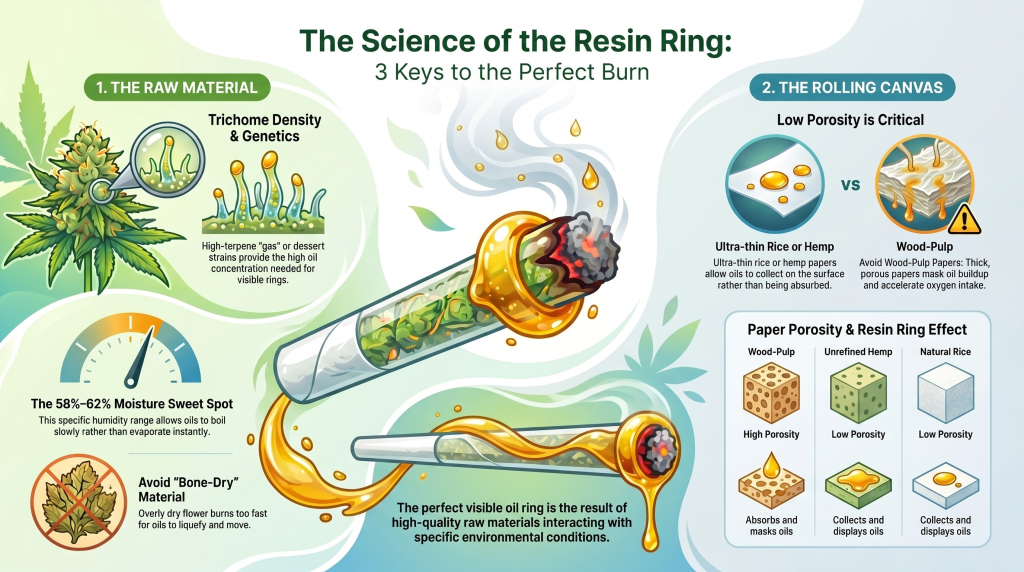
You cannot get a perfect resin ring out of old, low-grade brick weed. The physical ability to produce a clean oil ring depends heavily on the natural quality of the raw material inside the paper.
Trichome Density & Cultivar Genetics
Some cannabis strains are genetically programmed to produce massive amounts of sticky resin, while others produce far less. High-terpene, modern “gas” profiles or heavy dessert strains usually display the highest concentration of trichomes. The more trichomes present per square millimeter of plant material, the more oil is available to break free and coat the paper during combustion.
The Moisture Sweet Spot: Why Expertly Cured Flower Beats Dry Bud Every Time
If cannabis flower is too wet, it will not burn evenly. However, if it is bone-dry, the trichomes become brittle, turning to dust while the essential oils evaporate into thin air. Dry bud burns up instantly like dry tinder, leaving no time for oils to liquefy and move.
The ideal cure maintains an internal relative humidity of 58% to 62%. This precise moisture balance protects the natural oils, allowing them to boil slowly rather than flash-fry.
Paper Porosity: Rice vs. Unrefined Hemp
The type of paper used to roll acts as the canvas for the resin ring. Standard wood-pulp papers are often thick and highly porous, meaning they absorb oxygen quickly and mask the natural oil buildup.
On the flip side, ultra-thin papers made from unrefined hemp or natural rice have incredibly low porosity. They allow the joint to burn much slower, giving the escaping oils a smooth, non-absorbent surface to collect on and shine through.
Rolling Engineering: Hand-Rolled vs. Machine Pre-Rolls
Beyond genetics and paper choice, the mechanical design of how a joint is constructed plays a huge role in oil formation. The way a joint resists or encourages airflow determines how heat moves through it.
- Grind Consistency: If the flower is ground into a fine dust, the air channels get blocked, stopping the oil from migrating. If the chunk sizes are too large, the heat escapes too quickly. A consistent, medium-coarse grind creates the perfect structural matrix for airflow.
- Airflow and Packing Density: A joint packed too tightly will choke out the cherry, preventing it from reaching the high temperatures needed to melt the resin. A joint packed too loosely burns down like a chimney fire. Finding a balanced, uniform pack ensures a steady, slow crawl that coaxes the resin ring outward.
- Inhalation Styles: Taking short, frantic puffs pulls cool air in too rapidly, lowering the distillation temperature. Taking slow, deep, controlled draws pulls the heat smoothly through the center of the bud, gently baking the trichomes right ahead of the flame line.
- Filter Backpressure: A well-structured filter (or crutch) acts as a microscopic wall. It creates a slight pocket of backpressure inside the paper barrel, forcing the vaporized oils to stall out and condense onto the paper rather than shooting straight out into your mouth.
Cheating the System: Infused Pre-Rolls vs. The “Donut” Joint
While growing or rolling a perfect natural resin ring takes immense skill, modern cannabis culture has figured out how to supercharge this process artificially through infusions.
+-------------------------------------------------------------+
|                     THE HASH HOLE ANATOMY                   |
|                                                             |
|   [ Cherry ] ===> ( Resin Ring ) ===> [ Unburnt Flower ]    |
|                         ||                                  |
|            ============// \\============                    |
|           # # # # # # # | | | # # # # # # #  <- Flower Bed  |
|           ==============| | |==============                 |
|                         \\ //                               |
|                          ||                                 |
|               [ Inner Rosin/Resin Core ]                    |
+-------------------------------------------------------------+
The Donut Joint (Hash Hole)
A donut joint, often called a hash hole, is rolled by spreading out a flat bed of ground flower and placing a long, thin cylinder of pure cannabis concentrate (like live rosin or badder) directly down the exact center. When rolled up, the concentrate forms an inner core.
As the joint burns, the inner concentrate melts significantly slower than the surrounding plant matter. This creates a literal hole in the middle of the ash that looks like a donut, forcing a massive, syrupy resin ring to bleed heavily through the outer paper.
Liquid Diamonds and Kief Coatings
Another popular method used by mass manufacturers involves painting the outside of a rolled joint with liquid THC diamonds or distillate oil, then rolling the sticky joint in a heavy coating of dry kief crystals. This creates an immediate, heavy oil ring right from the very first puff, regardless of the flower quality underneath.
Skip the Rolling Table: Heavy-Hitter Infused Pre-Rolls
If you do not want to buy expensive concentrates, parchment paper, and tools to roll your own complex hash holes, you can purchase expertly engineered options off the shelf. Top-tier brands have completely automated this science:
- Jeeter: Famous for their iconic “Baby Jeeters,” these pre-rolls are deeply infused with liquid THC diamonds and dusted with premium kief to ensure a thick, heavy resin ring that stays lit from start to finish.
- Sluggers: Known for their triple-infused “Juiced” pre-rolls, these packs blend high-potency flower with live resin and diamonds to create a massive, slow-burning oil bleed designed specifically for heavy consumers.
Troubleshooting: When the Resin Ring Goes Wrong
While an oil ring is a beautiful sight, an over-abundance of sticky resin can sometimes cause annoying physical issues during your smoking session.
The Sticky Clog: Why Oil Blocks Your Filter Airflow
When a joint produces an exceptionally thick resin ring, the liquid oil can sometimes migrate too far down the paper barrel. Once it cools near the mouth tip, it can condense directly inside the folds of your paper filter. This creates a sticky, black seal that completely blocks your airflow, making the joint impossible to pull.
Lip Protection: How to Stop Hot Resin Splatter
If you draw too hard on a heavily resinous joint, the liquid oil pooled near the base can splatter directly onto your lips and teeth. This residue leaves a bitter, numbing taste and stains your skin. To prevent this, always take gentle, shallow pulls and consider using a glass or ceramic tip to catch the hot splatter before it hits your mouth.
The Uneven Burn: Fixing “Canoeing”
Canoeing occurs when one side of your joint burns down rapidly while the other side stays unburnt. This often happens in DIY donut joints if the concentrate snake is not placed perfectly down the mathematical center of the flower.
If the oil shifts to one side, it slows down the burn rate on that specific half of the paper. To fix this, apply a small amount of saliva right under the running side to slow it down, or use a lighter to gently touch up the unburnt side until the cherry is perfectly square again.
Say Less: How to Secure the Perfect Smoke in NYC
Achieving the perfect, trouble-free smoke session comes down to sourcing your products from professionals who understand the real culture and science of the plant.
Shop Top-Shelf Flower and Infused Pre-Rolls in the Bronx
Located right on East Tremont Avenue, Say Less stands as the premier legal cannabis dispensary in the Bronx. The shop proudly strips away all the confusing industry jargon and gatekeeping, offering a highly curated menu of lab-tested products. Whether you want to browse exotic, high-terpene flower from local legends like Florist Farms or secure heavy-hitting infused multi-packs from Jeeter and Sluggers, the team has you covered.
Tap In: Reliable Same-Day Cannabis Delivery Across New York City
If you cannot make it down to the Bronx storefront, you can easily skip the trip entirely. Say Less offers fast, discreet, same-day legal cannabis delivery directly to your door across Manhattan, Brooklyn, Queens, and the Bronx. You can check the live online menu, build your cart, verify your age, and get premium, resin-bleeding products delivered safely without any stress.
Frequently Asked Questions (FAQ)
Do resin rings mean the joint is stronger?
Generally, yes. A prominent resin ring proves that the flower inside has a high concentration of intact trichomes, which contain the THC and terpenes. However, it also depends on the type of joint; an infused joint will create a massive ring due to added concentrates, making it significantly more potent than a traditional, non-infused joint.
Why does my joint have a dark ring but keeps turning off?
This usually indicates that the cannabis flower has a high oil content but was not cured properly, leaving too much raw moisture locked inside the plant cells. The extreme moisture puts out the cherry, even though the surrounding heat is high enough to melt the surface resins into a dark ring.
Why is my resin ring pitch-black instead of clear gold?
A clean, golden-brown ring means you are melting pure trichome oils and clean terpenes. If the ring turns pitch-black, thick, and smells like charcoal, it means the joint is burning too hot and melting excess plant lipids, fats, waxes, or leftover nutrients that were not properly flushed out of the plant before harvest.
Can you scrape a joint’s oil ring to smoke it later?
While you technically can scrape the condensed oil off the paper, it is not recommended. Once the resin has condensed on the paper, it has already been exposed to extreme heat and partial oxidation, meaning most of the flavorful terpenes have burned away, leaving behind a harsh, bad-tasting residue.
Where can I buy pre-rolls that are guaranteed to bleed an oil ring?
You can find top-shelf, guaranteed-to-bleed options like Jeeter liquid diamond packs and Sluggers live resin pre-rolls directly at Say Less. Visit their Bronx location or order online for fast home delivery across New York City.
Ready to experience a flawless, slow-burning session with a guaranteed resin ring? Skip the low-grade guesswork and tap into New York’s finest selection of clean, legal, lab-tested cannabis.
Browse the live Say Less menu now to order premium top-shelf flower or infused pre-rolls for fast, same-day delivery straight to your door across NYC!