
When exploring the cannabis plant, most people only look for the main compounds like THC and CBD. However, New York’s cannabis community is shifting its focus toward rare, target-specific plant compounds known as minor cannabinoids. Understanding the roles of CBG, CBN, and THCV can help you customize your wellness routine, and Say Less is here to guide you through the process.
The Science of Minor Cannabinoids
What Are Minor Cannabinoids?
The cannabis plant is complex. It contains over 100 active chemical compounds called cannabinoids. You are likely familiar with the “major” cannabinoids: THC (which causes a high) and CBD (which aids relaxation).
“Minor” cannabinoids are simply compounds that appear in much smaller amounts inside the plant. Even though they are found in low concentrations, science shows they have massive potential. Thanks to advanced extraction methods, we can now isolate these minor compounds to enjoy their unique benefits.
The Biological Engine: How Cannabinoids Interact with Your Body
Every human has a built-in cell-signaling system called the Endocannabinoid System (ECS). The ECS regulates vital daily functions like sleep, mood, appetite, and your body’s immune response.
Cannabinoids work by sending messages to two main types of receptors in the ECS:
- CB1 Receptors: Located mostly in your brain and central nervous system. They control things like pain, mood, and mental clarity.
- CB2 Receptors: Spread throughout your immune system and peripheral tissues. They help manage inflammation and physical recovery.
Deep Dive: Profiles of CBG, CBN, and THCV
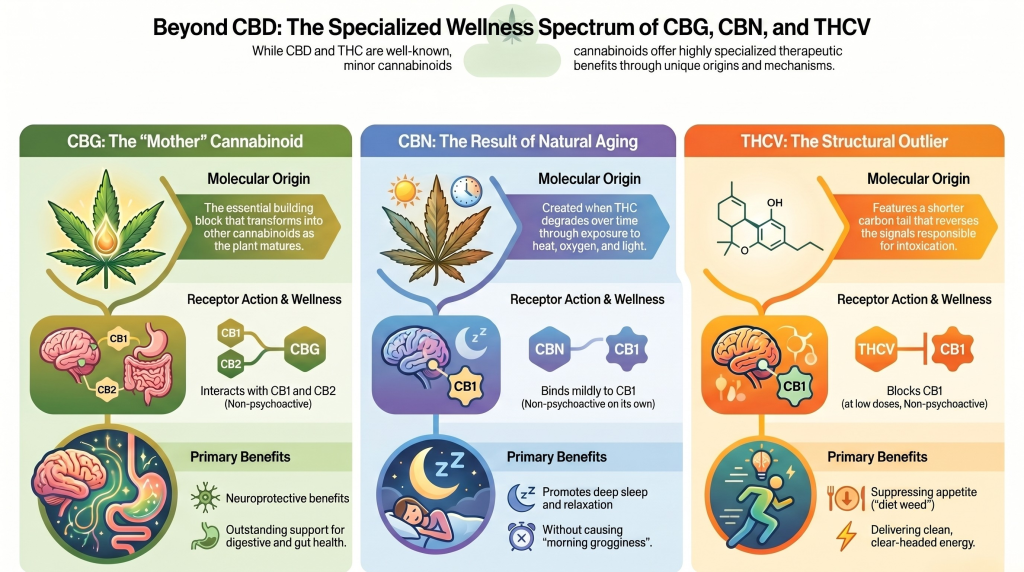
CBG (Cannabigerol): The “Mother” Cannabinoid
CBG is known as the “mother of all cannabinoids” because of its role as a biological building block.
[Young Hemp Plant] ---> CBGA (Acid Form)
                           │
         ┌─────────────────┼─────────────────┐
         ▼                 ▼                 ▼
     THCA line         CBDA line         CBGA leftover ---> CBG
In a young hemp plant, the chemical lifecycle starts with CBGA (the acid form of CBG). As the plant matures under heat and light, almost all the CBGA transforms into the precursor molecules for THC and CBD. Only a tiny fraction remains as raw CBG, making it rare and highly valuable.
- Mechanism of Action: CBG interacts with both CB1 and CB2 receptors. It does not cause any intoxicating effects, meaning it will not make you feel high.
- Primary Benefits: Research suggests CBG is an excellent tool for full-body wellness. It offers potential anti-inflammatory and neuroprotective benefits, and many users find it provides outstanding support for digestive and gut health.
CBN (Cannabinol): The Aging Component
CBN does not grow directly on a fresh cannabis plant. Instead, it is created over time through natural degradation. When THC is exposed to heat, oxygen, and ultraviolet light, its chemical structure alters and decays into CBN. If you have ever consumed older cannabis flower and felt incredibly sleepy, you have already experienced the power of CBN.
- Mechanism of Action: CBN binds mildly to CB1 receptors. It is technically non-psychoactive on its own, though it can slightly alter the felt effects of other cannabinoids.
- Primary Benefits: CBN is widely used to support deep relaxation and sleep quality. It is often formulated into nighttime products to help you unwind without a morning grogginess side effect. It may also act as a mild appetite stimulant.
THCV (Tetrahydrocannabivarin): The Vitality Variant
Despite its similar name to traditional THC, THCV acts like an entirely different compound. It features a shorter carbon tail in its molecular structure, which completely reverses how it interacts with your brain.
- Mechanism of Action: At low to moderate doses, THCV acts as a CB1 receptor blocker. This means it actively shuts down the signals that cause intense intoxication or the classic “munchies.”
- Primary Benefits: THCV is frequently nicknamed “diet weed” because it helps suppress appetite. It is also highly celebrated for delivering clean, clear-headed energy and focus during the day, while showing promise in scientific studies for blood sugar management.
Comparative Analysis & Synergy
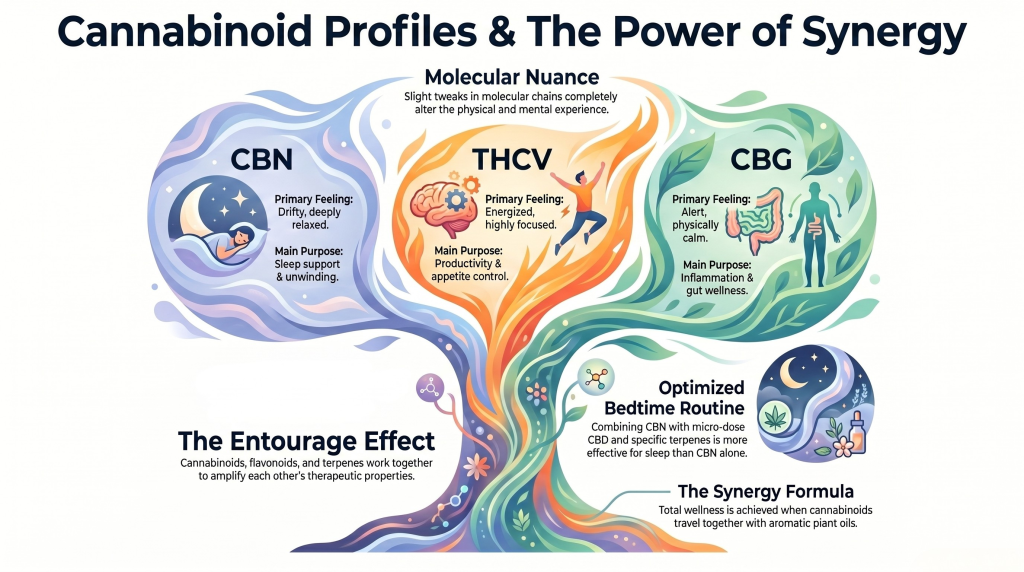
Molecular Structures and Functional Differences
While these chemical compounds share a similar biological baseline, slight tweaks in their molecular chains completely alter your experience.
| Cannabinoid | Psychoactive? | Primary Feeling | Main Purpose |
|---|---|---|---|
| CBG | No | Alert, physically calm | Inflammation, gut wellness |
| CBN | No (Very Mild) | Drifty, deeply relaxed | Sleep support, unwinding |
| THCV | No (At low doses) | Energized, highly focused | Productivity, curbing appetite |
The Entourage Effect: Maximizing Synergy
Cannabinoids work best when they travel together. The Entourage Effect is a biological phenomenon where cannabinoids, flavonoids, and aromatic plant oils (terpenes) work together to amplify each other’s therapeutic properties. For example, taking CBN by itself might make you a bit tired, but combining it with a micro-dose of CBD and sleep-inducing terpenes creates a far more effective bedtime routine.
Consumer Guide, Legalities, and Safety
Available Product Forms and Smart Dosing
When shopping for minor cannabinoids, you will generally find three styles of formulations:
- Full-Spectrum: Contains all natural plant elements, including trace amounts of legal THC.
- Broad-Spectrum: Contains all plant compounds, but the THC is completely filtered out.
- Isolates: Pure, extracted powders of just one specific cannabinoid (like pure CBG).
The golden rule for minor cannabinoids is to start low and go slow. Because your body’s endocannabinoid system is unique, start with a tiny dose (like 5mg to 10mg) and track how you feel for a few days before taking more.
Navigating Quality Control and Market Safety
Warning: The explosion of minor cannabinoid popularity means the market contains many unregulated, mislabeled products.
To protect your wellness, you must understand how to check for product transparency:
- Certificates of Analysis (COAs): Never buy a product unless the brand provides up-to-date, third-party lab results. A COA proves the product actually contains the exact amount of CBG, CBN, or THCV printed on the label. It also ensures the product is free of heavy metals, residual chemical solvents, and pesticides.
- Extraction Cleanliness: Make sure your products utilize clean extraction methods (like CO2 extraction) rather than cheap chemical treatments that can leave toxic residues behind.
- Drug Interactions: Always speak with a healthcare professional before trying minor cannabinoids if you take prescription medications, as cannabinoids can alter how your liver processes certain drugs.
The New York Legal Landscape: Compliance and Regulation
Federally, hemp-derived minor cannabinoids are legal under the US Farm Bill as long as they contain less than 0.3% Delta-9 THC. However, New York state has strict additional guidelines controlled by the Office of Cannabis Management (OCM).
Many unregulated gray-market smoke shops sell synthetic, untested variants. Buying your products from a legally licensed, adult-use dispensary is the only way to ensure your products are pure, accurately dosed, and fully compliant with New York law.
The Say Less Curated Guide: Finding Minor Cannabinoids in NY
Navigating these targeted formulations does not have to be overwhelming. At Say Less, our team does the heavy lifting for you by carefully curating a menu filled with clean, third-party tested, licensed New York products.
- For the Night Owl: If you struggle to count sheep, ask our team about our select range of CBN-infused gummies and evening tinctures. These options are specifically mixed with soothing terpenes to help put sleepless nights to bed.
- For the Focused Go-Getter: If you need help staying productive without the jittery crash of excessive caffeine, explore our daytime THCV vapes or CBG energy formulas. They are designed to support a clear, focused mental space.
- The Say Less Experience: You do not need to be a cannabis chemistry expert to find what works. Our highly trained budtenders are always ready to break down cannabinoid ratios in plain English, helping you choose options that align perfectly with your daily goals.
Frequently Asked Questions (FAQ)
Do CBG, CBN, or THCV show up on a drug test?
Pure CBG and THCV isolates generally will not trigger a positive result on standard workplace drug tests, which look specifically for THC metabolites. However, many full-spectrum products contain trace legal amounts of THC that can accumulate in your body over time. Additionally, because CBN is a direct byproduct of degraded THC, some sensitive drug screenings can mistake it for traditional THC. If you face mandatory drug testing, it is safest to stick strictly to broad-spectrum or isolate options.
Can I take CBG for energy in the morning and CBN for sleep at night?
Yes, this is a very common and effective wellness routine. Many people use CBG or THCV in the morning because they offer non-intoxicating support for clarity, focus, and inflammation management throughout the day. When the day winds down, they switch to a CBN formulation to encourage muscle relaxation and prepare the mind for deep, restorative sleep.
What is the difference between THCV and traditional THC?
While they sound almost identical, their molecular shapes cause completely opposite effects. Traditional THC binds strongly to your brain’s CB1 receptors, creating a psychoactive high and increasing your appetite. THCV does the opposite at normal doses; it blocks those same receptors, which promotes clean mental focus and actually curbs your appetite.
Is it safe to combine minor cannabinoids with my regular morning coffee?
Yes, mixing compounds like CBG or THCV with your morning coffee is a favorite ritual for many professionals. The uplifting properties of these cannabinoids often complement caffeine beautifully, offering sharp mental focus while smoothing out the classic caffeine jitters.
What side effects can occur when using minor cannabinoids?
Minor cannabinoids are generally very well tolerated by the human body. However, if you take a dose that is too high for your system, you may experience mild side effects like a dry mouth, slight dizziness, changes in appetite, or mild digestive upset. These symptoms will pass as the compound clears your body, and they can usually be avoided by reducing your next dosage.
Conclusion
The cannabis plant offers far more than just traditional THC and CBD. By learning to harness the anti-inflammatory power of CBG, the deep sleep support of CBN, and the vibrant, clean energy of THCV, you can build a highly customized wellness routine that works around your lifestyle.
Ready to cut through the confusion and elevate your cannabis experience? Stop by or contact Say Less today to speak with our expert team and find the perfect, third-party tested minor cannabinoid products for your goals.