
How many terpenes are there in the world, and more importantly, how many are in your favorite cannabis strain? While nature boasts over 20,000 unique terpene variations, the cannabis plant specifically produces around 150 to 200 of these aromatic compounds. Understanding this vast chemical landscape is the key to choosing the right products for your lifestyle and wellness goals.
Nature vs. Cannabis
When people ask, “How many terpenes are there?” they are often surprised by the scale of the answer. In the broader plant kingdom—including everything from citrus fruits to pine trees and lavender—scientists have identified between 20,000 and 50,000 different terpenes.
In the specific world of Cannabis sativa, the number is much more concentrated. While research is ongoing, we currently recognize:
- Total Identified in Cannabis: ~150–200 terpenes.
- The “Primary” Few: Only about 10–15 terpenes appear in high enough concentrations to significantly dictate the scent and effect of a strain.
- Market Presence: Most commercial lab tests only screen for the top 20–40 terpenes, meaning many “minor” players remain hidden.
Understanding the Terpene Hierarchy: From Hemiterpenes to Polyterpenes
To understand why there are so many terpenes, you have to look at their “building blocks.” Every terpene starts with a simple 5-carbon molecule called isoprene. Think of isoprene like a single LEGO brick; the more bricks you snap together, the heavier and more complex the terpene becomes.
The Isoprene Unit
Terpenes are classified by how many of these isoprene units they contain. This classification determines how easily the terpene evaporates and how it interacts with your body.
Chemical Classifications
- Hemiterpenes (C5): These use just one isoprene unit. They are highly volatile and often act as the initial “spark” of a plant’s scent.
- Monoterpenes (C10): Created from two isoprene units. These are the most common in cannabis. Examples include Myrcene and Limonene. They evaporate quickly, which is why you smell them the moment you open a jar.
- Sesquiterpenes (C15): Created from three units. These are “heavier” molecules like Caryophyllene. They linger longer on the palate and often provide the spicy or woody “heart notes” of a strain.
- Diterpenes (C20) and Beyond: These are much larger molecules. While rarer in the vapor of the plant, they are vital for the plant’s internal health and defense systems.
Why Does the Number of Terpenes Matter?
The sheer variety of terpenes is what creates the Entourage Effect. This is the scientific theory that cannabinoids (like THC and CBD) work better when they are “chaperoned” by a diverse profile of terpenes.
A strain with 20 different terpenes will offer a more nuanced, “full-bodied” experience than a distillate cartridge that only adds back two or three botanical terpenes. This diversity is the difference between a high-definition experience and a fuzzy, one-dimensional one.
The Most Common Terpenes Found in Nature & Cannabis
Even with hundreds of options, a few “celebrity” terpenes do most of the heavy lifting.
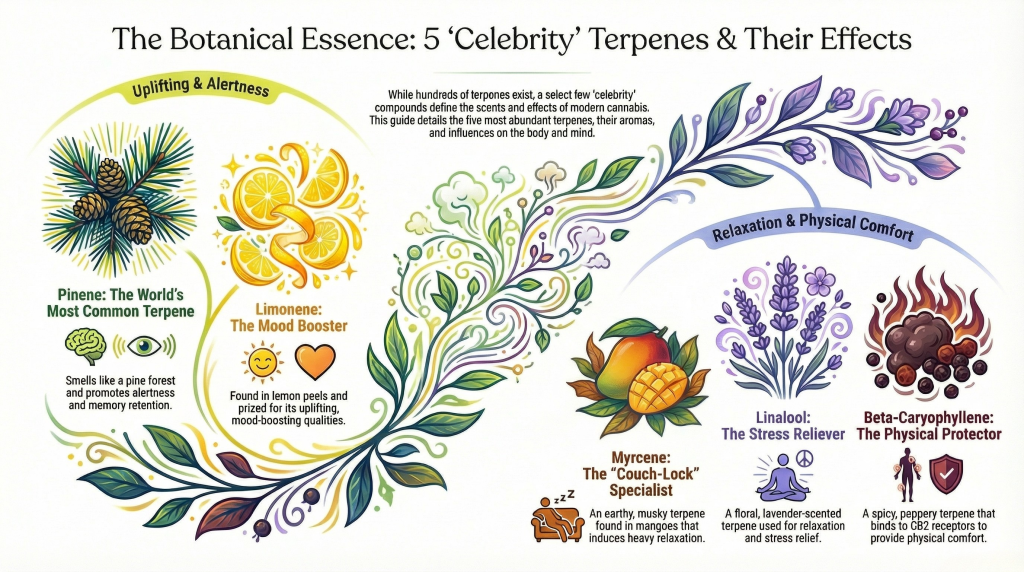
- H3: Myrcene: The most abundant terpene in modern cannabis. It’s earthy and musky, also found in mangoes. It is famous for the “couch-lock” effect.
- H3: Limonene: Think of fresh lemon peels. This terpene is prized for its uplifting, mood-boosting qualities.
- H3: Pinene: The most common terpene in the entire world. It smells like a pine forest and is often used to promote alertness and memory retention.
- H3: Linalool: This is the “floral” terpene found in lavender. It is the go-to for relaxation and stress relief.
- H3: Beta-Caryophyllene: Unique because it can actually bind to your CB2 receptors like a cannabinoid. It’s spicy, peppery, and great for physical comfort.
Rare and Emerging Terpenes: The “Minor” Players
As cultivation technology advances, “rare” terpenes are becoming the new benchmark for connoisseur-grade flower.
- H3: Ocimene: This terpene has a sweet, herbaceous scent. It is often found in mint and parsley and is believed to have strong antiviral and antifungal properties.
- H3: Terpinolene: A complex scent that smells like “freshness.” It’s a primary player in the famous Jack Herer strain and is currently being studied for its sedative potential.
- H3: Geraniol & Borneol: Geraniol smells like roses, while Borneol has a minty, camphor-like aroma. Both are being integrated into modern topicals for their ability to soothe the skin and reduce inflammation.
- H3: Guaiol & Bisabolol: These are “heavy” terpenes often found in chamomile. They are the new frontier for anti-inflammatory research because they stay in the system longer than lighter monoterpenes.
Terpenes vs. Terpenoids: Is There a Difference?
While people use these terms interchangeably, there is a technical difference.
- Terpenes are the live, “raw” hydrocarbons found in the growing plant.
- Terpenoids are terpenes that have been changed by oxidation.
When you dry and cure cannabis flower, the exposure to oxygen slightly shifts the chemical structure. This doesn’t make them less effective; in fact, many terpenoids are responsible for the complex “aged” flavors of high-end cured resin.
The VSC Factor: Why Terpene Counts Don’t Tell the Whole Story
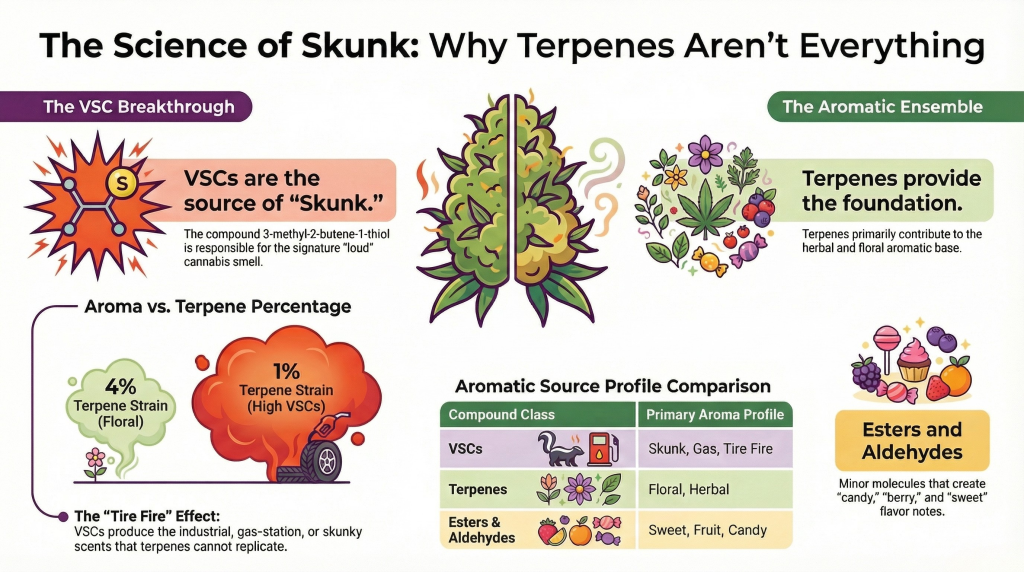
Have you ever bought a strain that had a low terpene percentage but still smelled like a “skunk” or “gas station”? For years, we thought terpenes caused that smell. We were wrong.
Volatile Sulfur Compounds (VSCs)
Recent 2024-2026 research has identified Volatile Sulfur Compounds (VSCs) as the true source of the “skunky” aroma. Specifically, a compound called 3-methyl-2-butene-1-thiol is responsible for that “loud” smell. You can have a strain with 4% terpenes that smells like flowers, and a strain with 1% terpenes and high VSCs that smells like a tire fire. Both are potent, but they serve different sensory preferences.
Esters and Aldehydes
These are minor non-terpene molecules that contribute “sweet” and “fruity” notes. They work in tandem with terpenes to create “candy” or “berry” flavors that terpenes alone can’t replicate.
How to Read a Terpene Analysis Report
When you look at a Certificate of Analysis (COA) or a label, don’t just look for the highest number. Here is how to read like a pro:
Total Terpene Percentage
- 1% or lower: Standard/Commercial grade. Mild flavor.
- 2% – 3%: High Quality. This is the “sweet spot” for most flower.
- 4% and above: Premium/Exotic. This flower will be extremely aromatic and “loud.”
Dominant vs. Trace Terpenes
Look at the top three terpenes. If Myrcene is #1, expect relaxation. If Limonene is #1, expect energy. The “trace” terpenes (the ones at 0.1% or lower) are what provide the unique “character” or aftertaste of the strain.
FAQs: Common Questions About Terpene Counts
Does a higher terpene count mean I’ll get higher?
Not necessarily “higher” in terms of intensity, but certainly “different.” High terpene counts modulate the high, making it feel more complex and lasting longer than pure THC.
Can you have too many terpenes?
Yes. In concentrates, if the terpene level exceeds 10–12%, it can become an irritant to the throat and lungs. For flower, nature rarely exceeds 5–6%.
Why does my weed lose its smell over time?
Terpenes are “volatile,” meaning they evaporate at room temperature. Heat, light, and open air are the enemies of terpenes. Always store your products in airtight glass containers.
Are “botantical” terpenes the same as “cannabis-derived” terpenes?
Chemically, yes. A Limonene molecule from an orange is the same as one from a lemon strain. However, cannabis-derived profiles include those “minor players” (VSCs and Esters) that botanical blends often lack.
Which terpene is best for sleep?
Myrcene and Linalool are the most commonly cited terpenes for sedation and relaxation.
Conclusion: The Future of Terpene Discovery
The world of terpenes is expanding every day. We’ve moved past the simple “Indica vs. Sativa” labels and into a world where we understand the chemical fingerprint of every plant. Whether you are looking for the 20,000 terpenes found in nature or the specific 150 found in your favorite jar, the goal is the same: finding the right balance for your body.
If you are looking to elevate your brand’s presence or tell a more compelling story about your products in this complex market, Say Less NY is the solution. We specialize in cutting through the noise and helping brands communicate quality with precision and style.
Ready to take your brand to the next level? Contact Say Less NY today and let’s build something unforgettable.